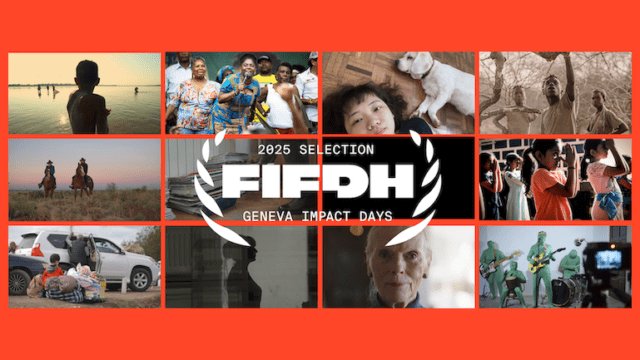
FIFDH Impact Days unveiled January 29 its 2025 programme which bring together NGOs, filmmakers, impact practitioners and funders to develop joint impact strategies around urgent, present-day issues.
Events kick off March 9 with a screening and discussion of Undercover: Exposing the Far Right by Havana Marking about Hope Not Hate, a British organisation at the forefront of the fight against the far right, which It investigates the working methods and funding of various movements by infiltrating them.
Highlights of March 10 include a keynote by Jenni Wolfson, CEO of Chicken & Egg Films (US), which will draw on her journey from UN human rights investigator to non-profit leader and storytelling advocate; and analyses of the Impact campaigns behind for Subina Shrestha’s Devi, about a rebel warrior, mother and sexual violence survivor, and Norwegian Tone Grottjord-Glenne’s, All That I Am which deals with child incest.
Also on March 10, a panel titled ‘Extremism on the rise: making challenging films in a polarised world’ explores why documentaries that expose extremist movements are more crucial than ever. Who is behind these films, and who finances them? What production and distribution obstacles do they face? And how should filmmakers and festivals navigate the security risks involved? A later panel will attempt to determine what are the key ingredients for communicating complex information through film, in a way that is both engaging and factually accurate.
The Swiss Focus is a new Impact Days event for connection and dialogue between Swiss impact stakeholders from all language regions, international Impact Days guests and Swiss filmmakers. The Impact strategies for four projects will be presented (see below).
On March 11, twelve Impact Lab film teams will pitch their impact strategies to an audience of international organisations and NGOs, film industry professionals and funders (see below).
Later, experts will gather during a morning panel to discuss alternative strategies and alliances for effective outreach, before Global Impact Producers Alliance coordinators demonstrate how audiences can play a key role in moving the story forward and amplify the message of a film by bringing their own expertise, experiences, knowledge and networks to the table.
Following a screening of Adelina Borets’ Flowers of Ukraine, a panel of experts will discuss what the future holds now that Trump has returned to power in the US. Is genuine peace really on the agenda? If so, under what conditions, and with what repercussions for European security? And then, how should Ukraine be rebuilt?
Rounding off events on March 11 is the Impact Days awards ceremony and party.
2025 International Impact Lab selection – March 10
- Above and Below the Ground by Emily Hong. Synopsis: In Myanmar’s first and only country-wide environmental movement, Indigenous women activists and punk rock pastors defend a sacred river from a Chinese-built mega-dam through protest, prayer, and Karaoke music videos.
- Children of Honey by Jigar Ganatra & Immanuel Musa Marc. Synopsis: Three young friends on a quest to find the meaning of life in nature. A story told by the Hadzabe hunter-gatherers immerses us in a pivotal moment of their 50,000-year history – at a crossroads between old and new, as loss of land and alcohol addiction seeps into their once-peaceful community.
- Cinderella Unbound by Ilinca Calugareanu. Synopsis: In Romania’s patriarchal society, a group of relentless women fight against a justice system that harms and silences child victims of sexual abuse. Will they be able to create lasting change or will the status quo silence them too?
- Dissidents by Manon Loizeau. Synopsis: This project is confidential and as such FIFDH cannot currently publicly disclose more information. The festival will contact pertinent organisations and foundations to organise direct meetings with the filmmakers.
- Igualada by Juan Mejia. Synopsis: In one of Latin America’s most unequal countries, Francia Márquez – a Black Colombian rural activist – challenges the status quo with a presidential campaign that reappropriates the derogatory term ‘Igualada’ and inspires a nation to dream.
- In Front of Us by Inna Sahakyan. Synopsis: A California judge finds herself on the other side of the courtroom in the most difficult case she’s ever seen – bringing a dictator accused of genocide to The Hague.
- Kalari by Maria Kaur Bedi & Satindar Singh Bedi. Synopsis: Kalari is enthralling young women in India. As the world’s oldest martial art, it is becoming increasingly significant in a society where violence against women is both historical and a daily reality. We follow four women on their journey towards self-empowerment.
- Queer As Punk by Yihwen Chen. Synopsis: This project is confidential and as such FIFDH cannot currently publicly disclose more information. The festival will contact pertinent organisations and foundations to organise direct meetings with the filmmakers.
- The Myth of Monsters by Beatrice Leong. Synopsis: How far will you fight to belong? After a lifetime of being misunderstood, filmmaker Beatrice faces her own camera, revealing her autism diagnosis after years of misdiagnoses, forced institutionalisation and coerced electroconvulsive treatment.
- The Other Side of Silence by Dheeraj Akolkar. Synopsis: Wars don’t end when peace treaties are signed. Gerd Fleischer travels to post-war countries collecting testimonies from generations of children born of enemy soldiers’ sexual violence. She urges authorities to create legal protections for children being born today.
- Traces by Alisa Kovalenko & Marysia Nikitiuk. Synopsis: The deep traces of trauma left within six women survivors of sexual violence and torture as a result of Russia’s aggression in Ukraine become a source of strength. As they come together, the women attempt to transform their ordeals into post-traumatic growth.
- Yurlu | Country by Yaara Bou Melhem. Synopsis: Aboriginal Elder Maitland Parker is fighting to heal his homelands scarred by Australia’s very own Chernobyl – the Southern Hemisphere’s largest asbestos-contaminated site. For Maitland and his people the landscape is a living, breathing entity; when the land is sick, we are sick.
2025 Swiss Focus selection – March 11
- A Satellite for Burulaï by Suium Sulaimanova and Antonin Lechat. Zhibek, 28 and founder of the Kyrgyz Space Program (KSP), fights for women’s rights in Kyrgyzstan. The KSP women want to change mentalities and open up a meaningful discussion about violence against women in Kyrgyzstan. They aim to launch the country’s first satellite, named after 20-year-old Burulai Turdaaly Kyzy who died a victim of Ala Kashuu, a forced marriage tradition involving abduction and rape. The whole of Kyrgyzstan will know that the Burulaï-1 satellite was made by women, and women only.
- Chess Behind Bars by Ivo Zen. If an individual in incarceration was given a second chance, what essential tool would society want them to possess before reintegration? Chess masters argue that chess serves as the ultimate bridge between a prisoner, their personal growth, and their readiness to re-enter the world. From the Philippines to Norway, the USA, Mongolia, and Armenia, Chess Behind Bars documents prison chess players—whether beginners or seasoned masters—as they study the game and prepare to compete in the prison chess world championships.
- Nathalie by Tamara Milosevic. Nathalie (56) reflects the fate of the many people who, despite their best efforts, live on minimum subsistence in Switzerland. Various circumstances have placed her in a difficult situation, making everyday life complicated for her and her children. This leads to health problems, particularly psychological ones, which create a vicious circle for her professional and family survival. Through her tireless struggle and dark humour, Nathalie shows that there is always a way forward. The film highlights her ongoing struggle as a single mother and domestic worker, and tackles the often-overlooked issue of poverty and debt in Switzerland.
- Priceless Forests by Orane Burri. Priceless Forests immerses us in the heart of local Swiss forests and their sustainable management spanning over 150 years, focusing on the people who bring them to life daily. Gradually, the film reveals the limitations of this ideal example by confronting it with the needs of its citizens, which impact other forests like the Amazon. It offers a critical perspective that connects the local to the global, challenging Western values and certainties in the face of the urgent need to preserve this treasure of our planet.