

March is a month very much dedicated to human rights, at least in film festival terms. One World (Czech Republic) kicks off next week, while Movies that Matter (Netherlands) and CPH:DOX (with its new human rights section) will play out during the final third of the month.
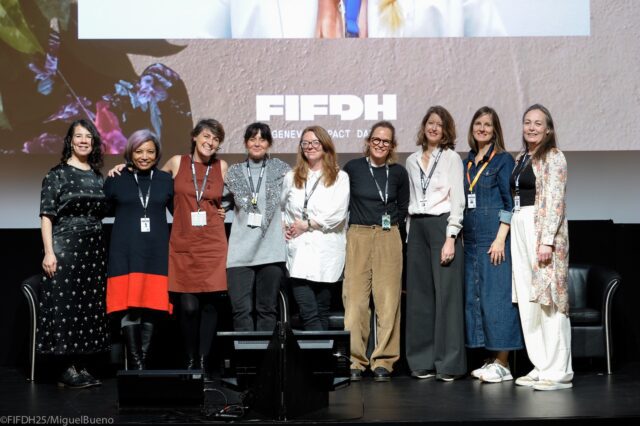
Happening right now, though, is FIFDH, the human rights festival based in heart of Geneva (home to “700 NGOs”), and its associated professional programme Impact Days which has a stated mission to channel the power of documentary film as a tool for concrete social and policy change.
The Impact Days programme officially kicked off March 9 with the screening of Havana Marking’s Undercover: Exposing the Far Right (with a subsequent discussion on neutering the Far Right’s appeal) but continues in earnest March 10 and 11 March with a packed programme of case-studies, key-notes and panel discussions focusing on the need for, and implementation of, best practice in the field of Impact.
After today’s (March 10) key-note by Chicken and Egg’s Jenni Wolfson on ‘Storytelling for social change: The bridge between art and advocacy,’ Impact Days will up the ante with case-study analyses of the outreach campaigns of two films: Subina Shrestha’s Devi and Norwegian Tone Grottjord-Glenne’s All That I Am.
“The campaign for All that I Am that has been going since 2020, and this is an amazing case study because of the connection between cinema and research,” says FIFDH Head of Impact Ana Castañosa. The film concerns the abuse suffered by protagonist Emilie as a child, and which she is now determined to face. “They have found the way to finance their Impact campaign in a very clever way. They have a very interesting business model and it’s one of the campaigns I’ve seen that is really sustainable.”
“With Devi, they also have a very important impact case-study,” Castañosa adds. “It’s much more political. They went international to try to change the law in Nepal.” The film tells of Devi Khadka, a rebel fighter and survivor of sexual violence in Nepal. She eventually became a member of parliament.
Impact Days will again turn to the subject of far-right extremism in a panel titled ‘Extremism on the rise: Making challenging films in a polarised world,’ moderated by Impact Producer Vivian Schröder, and which will again feature Havana Marking alongside Anrike Viser, Thematic Lead, Corruption Money Flows, at Transparency International, and Sandra Whipham, Co-Director of Doc Society. (Castañosa underlines how Doc Society and its revolutionary Good Pitch programme was a game-changer within the doc industry in terms of emphasising the need for Impact research and investment).
Panelists will later gather on March 10 to discuss the shift from factual reporting to engaged filmmaking. Castañosa explains the crux of the issue. It’s one thing an NGO making a 400-page report on the need for reform, change or investment, but that doesn’t engage folk, she says. “You cannot go with that to the general audience. It’s not the way to make them get emotional about the subject and to trigger a conversation. However, if you take the important information in those reports and you make a film about a specific story, about a specific community that shows you those problems, even if you don’t have all the numbers, then you are showing the actual problem.”
On the morning of March 11 twelve Impact teams will present their strategies for their dozen projects, some of which are completed, while others are in production or post-production. The common goal of Lab producers, who have been developing their campaigns over past months, and the Impact professionals they meet in Geneva is to address the root causes of the difficulties that protagonists within these films suffer, and to devise subsequent Impact strategies to effect real change.
“We believe these films have the power to help motivate structural and behavioural change,” Castañosa underlines, adding how “we have been working with them for two months now, and I think they are great stories…It’s very interesting to see the diversity of the topics and to see the passion with which the filmmakers to present their projects.”
The range of subjects is wide, addressing civil, environmental and children’s rights; health and Indigenous rights abuse; the rights denied to LGBTQI people and women & girls, and International Justice. The pitch event itself can be a highly charged and emotional affair, as witnessed directly last year when my neighbour within the auditorium wept throughout, such was the gravity of the topics and the effectiveness of the Impact pitches.
Ana Castañosa further describes the documentary landscape pre-Impact, one in which docmakers were telling “the stories that we want our audience to see, as we want to tell it, not as is it for real or as the community would tell their stories. For some years now, there are people who – fortunately – have started to rethink this, and to involve the communities and the participants of their films. It’s evolving.”
What’s more, the shift to acknowledge the need for Impact has been undertaken more or less by “countries in the north,” she adds, and somewhat latterly at that. For filmmakers from countries with lower production capacity, and with much meagre funding opportunities, Impact has always been a priority. “We have been talking to many professionals from, for instance, Kenya or Lebanon. And they were telling me, what you guys call Impact right now is what we have been doing forever in order to distribute our films,” Castañosa observes. “In the global south maybe they didn’t call it impact, but they know very well what it is.”
Castañosa sees her job as readying practitioners to overcome the hurdles that block the Impact road, such as lack of finance, keeping up energy levels, maintaining momentum even as public interest in the subject may wain. She also underlines the work of The Global Impact Producers Alliance who “work a lot on methodologies of ‘how to’ and show different case studies, different ways of working depending on the territory where you are, depending on the kind of stories you are telling and what impact producers should ask for. We are professionalizing the field, but we still have some things to improve.”
She also stresses the collegial ties that exist within the human rights festival community, especially in March with the likes of Movies that Matter which whom Impact Days shares guests, masterclasses and some of the Lab sessions.
Castañosa also underlines the value of her festival’s offer (and that of fellow human rights festivals) in a world where media is becoming less and less trustworthy.
“It is more my personal feeling that we believe less and less what we read and what we see, depending on the sources we are getting it from of course. So, people are eager to have places and resources where we get information that we think is real and is legitimate. And I think film festivals about human rights can offer exactly that.”





