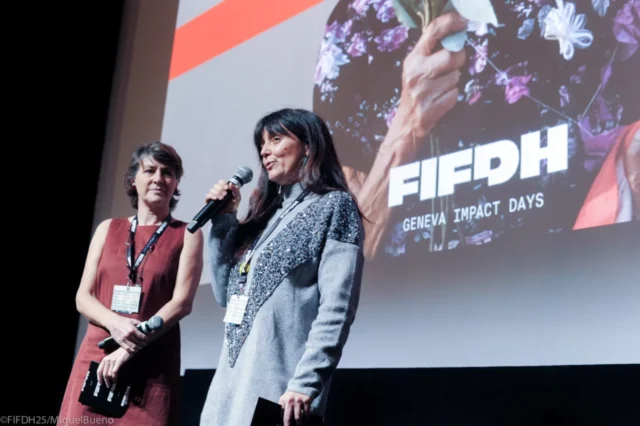
Since its launch in 2019, the influence of FIFDH Impact Days has grown and extended not by having a huge marketing budget, event Head Ana Castañosa Bielsa underlines to BDE, rather through a combination of excellent organisation, keen word of mouth and its good fortune to be located in Geneva, home to 700+ NGOs. It also helped that the event is intrinsically linked with FIFDH, one of the key international staging posts for the exhibition of cinema geared towards human rights.
But while, in the early years, each and every NGO and philanthropic organisation had to be pitched, persuaded and reminded to attend, these days the NGOs are calling the Impact Days team, keen to be part of the three-day event whose stated mission is to channel the power of documentary film as a tool for concrete social and policy change.
Yes, impact remains a “niche” sector within the film industry, but Impact Days’ effectiveness in underlining its importance is undeniable.
As Jon-Sesrie Goff of the Ford Foundation (US) testifies, “there are very few places where you have the opportunity to be seated next to someone from the UN, and a filmmaker, and a producer, and have these conversations about ways to advance and improve the conditions of human rights around the world.”
What’s more, the event’s influence is spreading beyond its Geneva dates, Castañosa Bielsa points out. “There are a number of festivals around Europe which are already looking also to impact labs and impact activities within their professional programmes, and we are very present there. Usually they call us and we call them to collaborate, and to do things together because it’s in the interest of the whole field to become stronger and more sustainable.” she says.
“Cinema can be political, in particular in our context of a human rights film festival,” she adds of the context within which she and her colleagues are operating.
What Castañosa Bielsa has also noticed over past years is that NGO involvement, in the main, mainly kickstarts on delivery of a finished film. This is something she wants to address, so this year Impacy pitchers are encouraged to articulate their need for earlier investment (whether of time, influence or cash) during the production and post-production phases. The International Pitch of impact campaigns will take place on the morning of March 10, while the Swiss Focus of four impact pitches is scheduled for the afternoon of March 9.
“They need to quickly speak about their goals, their timeline,” the Impact Days boss tells BDE of the shift in emphasis required. “What do they need to start implementing their campaign, or in some cases as they are still developing the campaign? What do they need immediately to go on? Because the NGOs sometimes felt a little bit like, ‘okay, call me when the film is finished.’ But there are many things they [film and impact producers] can already start with the partnership while in production.”
Castañosa Bielsa further notices a shift in appreciation among NGOs and philanthropic organisations on what the film can and should deliver. “They are understanding cinema as art, and not only as a piece with the right messages for communication purposes. Earlier we saw that they really needed films that were very journalistic where all the messages were clearly expressed,” she says of a tendency to have a film replicate the tone of a wider NGO campaign. “Now, they see more and more these emotional and aesthetic points that a film can develop. A film can offer a lot more nuance.”
IMPACT DAYS SCHEDULE 2026
Impact Days 2026 kicks off in earnest March 8 with a screening and discussion on Molly vs the Machines, attended by Ian Russell, whose 14-year-old daughter Molly took her own life after accessing thousands of harmful posts on Instagram and Pinterest.
The event continues March 9 with a keynote by renowned Palestinian filmmaker Rashid Masharawi, born and raised in Gaza’s Al-Shati refugee camp, who will explore two core dimensions of film and filmmaking in Gaza (From the Rubble to the Screen: Cinema for Survival).
“I think this keynote makes total sense in terms of understanding why we do what we do and why films are powerful tools, and in this sense Rashid is going to talk about how films help all those storytellers and filmmakers from Gaza and Palestine to keep their identities alive, and show much more of Palestinian culture than what we are seeing in media,” comments Castañosa Bielsa. “In the second part of the keynote, he’s going to talk about bringing films from outside to a festival for children in Gaza, which is the other side of the coin, because it’s giving hope to those kids that there’s something else besides what they are living right now.
Masharawi’s keynote is followed by two Impact case studies, the first focussing on how best to maximise Impact by applying the differing perspectives of multiple films on a given issue (The Indigenous Impact Alliance: Multiple Films for Collective Impact). The second case study is titled The Pickers Journey: How Strategy and Robust Funding Fueled a European Impact Campaign, about a successful Impact campaign which spanned 6 countries, engaging over 650,000 people across Europe.
Castañosa Bielsa flags up the Impact Days panel titled Beyond the Headlines: Media as Meaningful Partners for Change. Journalists and digital media outlets can be powerful allies in amplifying the reach and influence of an impact campaign. But beyond a traditional press strategy around a premiere, what does meaningful collaboration really look like? How can media professionals actively contribute to advancing shared impact goals and shifting public narratives?
The March 9 afternoon session kicks off with a ‘Meet the Organisations’ session titled Navigating NGOs: From First Contact to Meaningful Collaboration, moderated by Sophie Mulphin, NGO Programme Manager.
This is followed by the Swiss Focus Pitches and Roundtables, designed for connection and dialogue between Swiss impact stakeholders of all language regions, selected international Impact Days guests, and Swiss filmmakers. The event showcases four Swiss film projects https://fifdh.org/en/pro/news/impact-days-swiss-focus-2026/ open to impact collaborations both on a national and an international level.
The following day, Tuesday March 10, commences with the International Pitch by the 2026 Impact Lab film teams of their campaigns to an audience of international organisations and NGOs, film industry professionals and philanthropists. to read more each of the projects. Considered by many to be the core element of Impact Days, the 2026 Impact Lab film teams will pitch their campaigns to an audience of international organisations and NGOs, film industry professionals and philanthropists. Click here to read about this year’s selection.
Also on March 10, a panel titled Impact Financing Today: Insights, Challenges and Opportunities will seek to unite impact financing experts to reveal current trends and practical strategies for securing funding to drive social change through film.
“This panel, and the Beyond the Headlines panel, are for professionals from the cinema industry who really want to know about ways of collaborating with people who are working on financing and support, and who can give visibility to their impact campaigns,” Castañosa Bielsa advises.
The final Tuesday afternoon session (before the 2026 awards are handed out) is titled Anatomy of an Impact Campaign, during which impact practitioners from across the globe will share their strategies, insights, and lived experiences.
“There’s no single blueprint for an impact campaign, but countless creative ways to spark change,” Castañosa Bielsa signs off.