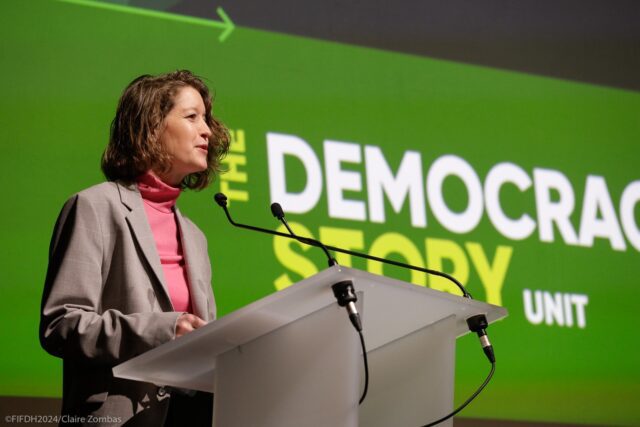
Doc Society’s Sandra Whipham addressed delegates March 11 at FIFDH and painted an ominous picture of the current streamer-led documentary landscape. Nevertheless, she offered a large measure of hope as she urged independent makers, who have hitherto been largely sidelined, to wrestle back financial, executive and creative control.
“Firstly, what is abundantly clear to us now is that we are not living in a golden age of documentary distribution,” said Whipham at the beginning of her keynote address, titled “Love and Rockets: Towards the Independent and Democratic Future We All Need and Deserve.
“The independent work that Doc Society has championed for the past 19 years, the patient observant long view made from the margins by artists who were editorially independent of political and commercial institutions was for a while in favour,” she reflected. Such doc output offered the streaming and film industry numerous awards and “good work brownie points and a counterweight to the overwhelming majority of their content,” she added, but it was all, alas, too good to be true.
“Right now, the film and TV industry at large finds itself in a state of paralysis across every single genre, and no one is talking about it. A lack of creative bravery, a fear of, and a capture by, the market. The system of commissioning by algorithm, and making work by committee is bringing the whole system, not just our corner of it, to a halt and is also unfortunately infecting the public service broadcasting system as well.”
Whipham spoke of the “increasingly polluted information ecosystem we find ourselves in,” in which “unchecked and unregulated platforms are promoting narratives from a mix of authoritarian regimes, major corporations and special interest groups actively spreading disinformation to further their own ends. The consequences are tangible with communities polarizing into mutually exclusive information and opinion spheres.”
And we are living in an era of peak streaming, Whipham reminded us, pointing out how more than 817,000 unique program titles across traditional TV and streaming services were broadcast in the US alone, up 26% from 2019. “Today, just six major companies capture 80% of our subscription streaming time and analysts expect further consolidation in the coming year. In 2023, these studio streamers narrowed their mandates to focus on mass appeal hits that will attract and retain the widest possible audience while avoiding risk or controversy.”
“Following the playbook set by the large social media companies, they [the streamers] prioritize the most sensational, comforting or addictive content, while mining audience data to push algorithmic recommendations that reinforce existing preferences. This is good business for the streamers, but it also contributes to the sensationalism, polarization and the narrowing of curiosity,” she added. “The streamers want true crime, celebrity-helmed projects and music biopics but, with rare exceptions, no politics, social justice or human rights, and to make sure that nothing awkward happens production is being taken in-house where [they can exert] financial and editorial control.”
The situation is compounded by the disappearance of titles from streamers’ catalogues which no longer fit the brand. “This is serious when we think of over a decade of work, which was sold to the streamers in all rights deals, which could have disappeared from public view because it no longer suits.”
“Governments have had no meaningful response to Big Tech’s advance. They both failed to regulate but also have done little to support media in the public interest in that time,” Whipham pointed out.
The picture has been no less bleak from a public service perspective, she maintained.
“Historically, the story-to-audience pipeline provided by free-to-air, publicly owned multi-platform media organizations has been one of the most reliable ways of informing and engaging mass audiences. However, what we used to think of as the broadly reliable and dominant sources of media in the public interest – film, television, radio, print, and journalism – have had their funding bubble up-ended, and public service broadcasters and journalists are defunded and attacked in every kind of political context from ‘democracies in name only’ like Hungary and India to western liberal democracies such as UK and the US and even the Nordic countries.”
“In many countries, there is no public media system at all, with media controlled by a small number of families. The market compression and political pressure has resulted in PSMs (Public Service Media) copying and competing with the streamers, commissioning by default and service for the algorithm.”
“If current trends continue, you do wonder whether we will even have a public service media system fit for purpose in a few years time,” Whipham observed.
She reminded delegates that this is the view ostensibly from the Global North, whereby makers from the Global Majority (“where work is made but is nowhere to be found,” she underlined) are generally sidelined.
That said, it is within the geographical realm of the Global Majority that meaningful answers can be found. Whipham acknowledged that we are all collectively ” at an existential inflection point” and she explained how Doc Society is looking to lead change and innovation across the independent doc industry.
Invoking the late Jess Search and her ‘Love and Rocket’ newsletter written in Summer 2023, Whipham underlined the organisation’s ongoing “funding of climate narratives and impact through the Climate Story Unit, all our thinking on distribution, and our work with the DISCO network on defining the meaning and value of independence. This is why we are thinking about not just our [own] corner, but obsessively communicating the [wider] 10,000-foot view, even as we double down on supporting the work and impact of our community of independent storytellers.”
Many of the answers to the afore-mentioned problems are being addressed, in great part through DISCO, a global network of cultural organizations of which Doc Society is a member, representing the Global Majority’s independent doc makers and audiences, she stressed. “What’s clear is that something is breaking and we need to build something new. If the system needs to be reimagined and rebooted, this time rebuilt for everyone, perhaps in the midst of this corporate/economic/political/climate poly-crisis comes an opportunity to collectively imagine a decentralized, decolonized system for the funding and distribution of independent media,” she stressed.
Whipham reminded how, currently, almost all funding for independent documentary film made anywhere in the world is controlled by a few global north cultural organizations and their foundation sponsors, plus the co-production investments from a handful of US and northern European broadcasters.
“We need to imagine a new global pool fund where resources are shared equitably to every region, where local experts can make decisions about what and where to spend, funding this work at scale,” she further stressed. “Funding the distribution and impact strategies we know are effective is the answer to the nightmare of AI-generated content creative conformity and political retreat we find ourselves in. There is an existing mycelium network for community distribution of film in many regions with trusted projects and vibrant networks that are ready to be activated. We believe this should be the first priority for immediate funding as both a potential antidote to polarization and as a means to keep the distribution pipelines open in this closing space for the most important narratives in a given region.”
She posited an idea, that we collectively imagine and design a new global public interest media tech platform, which is fit for the particular challenges of the 21st century. “One that upholds the principle of being free to all citizens anywhere with the ability to evade national censorship and self-censorship, with a new ownership model by citizens for citizens, which allows for new funding experiments that liberate the project from market pressures. Most profoundly underpinning the mechanics of such a platform with very different kinds of algorithms that do not repeat the same polarizing patterns of behaviour [applied within] a public service media algorithm.”
“We also need to think, all of us here seriously, about our role in supporting public interest media in key territories as it comes under attack, and build alliances around tech regulation, without which nothing will change,” she added.
At this point, Whipham performed a satisfying volte face. “As Doc society prepares for its 20th anniversary next year and looks back at the hundreds of documentary filmmakers we’ve supported, we can’t help coming to the conclusion that it has always been a golden age of documentary,” she said.
“All of the storytellers we have worked with have demonstrated vision, tenacity, and inventiveness in making their films and getting them to audiences, even as the public service media system and commercial broadcasters have equivocated over the value and importance of this work.”
She stressed again that the notion of independence “has been baked” into Doc Society’s mission since its foundation in 2005.
“Despite this, we realized that many in our sector, our allies in film and television as well as Civil Society, didn’t quite understand what it really meant and its true value. This is why DISCO is working on a technical definition of independence as well as a values-based framework that we can all share, which can be applied to independent work and recognized and valued as such, wherever it’s found. This work of independent storytelling and world-building takes commitment and partnership, and we’ll all need all our ‘love and rockets,’ our ideas, hope and joy for the road ahead.”
“We do have all of this in abundance and for that, as Jess would say, we are truly lucky fuckers,” Whipham signed off.