

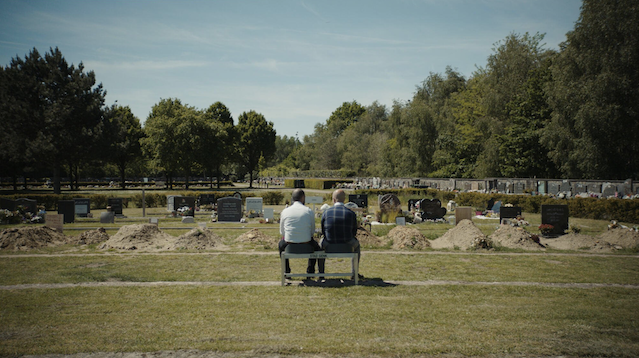
In Volkan Üce’s new feature doc Two Square Metres, presented at Flemish Film Days, Tayfun is the go-to undertaker for the Belgian Turkish community, many of whom want to send their deceased loved ones back to their former homeland to be buried. If you are expecting a grim and depressing film about death, then think again. Üce’s film is a loving and funny portrait of a good dad and sassy businessman whose natural tendency towards compassion is matched only by his considerable money-making acumen.
That said, Tayfun also has some oddball tics. “One of the first days we were shooting him, he was in his room where he works, a very small room, and he was hanging his undertaking diploma on the wall. And he was talking to himself while he was doing it, making promises to himself,” director Üce remembers. “Me and the DOP were looking at each other, and I said, ‘Tayfun, why are you talking to yourself? People will think you’re crazy.’ But he was like, ‘Oh, no, I always do it. I always talk to myself. when I have to drive around Belgium to pick up a dead body, I sometimes get angry at myself. Then I make up with myself. And then I become friends with myself again.’”
“He’s like a theatrical character,” the director continues. “That’s why I decided just to let him be himself.”
Later, to celebrate his company’s tenth anniversary (and to drum up more business), Tayfun puts on a show in which he presents his own funeral [complete with coffin], at the same time invoking the memory of folk he has buried in the past. Prizes handed out at the surprisingly moving ceremony include return tickets to Rome, as opposed to the one-way ticket he usually supplies, he jokes.
Tayfun works with a colleague (Kemal) in Kayseri, in Central Anatolia, who arranges for the bodies to be picked up from the airport and delivered to the local mortuary. Kemal is having a hard time. He smokes heavily and business is slow. He also sings a song, imploring three rich sons-in-law to come along to marry his three daughters, a scene that plays in telling counterpoint to the funny playful conversation we see Tayfun have with his own three sassy daughters back in Belgium.
Tayfun is also eyeing up the potentially lucrative German market, which houses an estimated 4 million people of Turkish origin, which is eight times larger than the estimated Belgian total of 500,000 people of Turkish descent. What’s more, he is canvassing poiticians for citizens to be granted their burial plots (the two square metres of the film’s title) in perpetuity. Right now, large payments must be made every twenty years or so in order to guarantee ongoing occupancy. If not, as we see towards the film’s conclusion, the bulldozers will come in to raze the tombstones to make space for new graves.
Director Üce first encountered Tayfun during the pandemic when he saw him on a television programme about the undertaking business. It was a fraught period for the planet, and Üce was concerned about his parents, or indeed what would happen if he were to die before them. But when he saw Tayfun, he was intrigued. “So I saw him on television and I was like, ‘whoa, so cool,’” he says. “He’s got sort of comic elements to him as well. But at the same time, he’s incredibly professional.”
Üce contacted Tayfun with a view to featuring him on celluloid, and organised a screening of his previous film All-In, which the undertaker liked even though he had to keep leaving the screening room to take business calls on his two phones. But the idea of being the subject of a documentary was thrilling. “Whoa, a documentary about me? That’s my dream,” Üce remembers Tayfun’s response. “He was saying, “OK, I have two passions in life: art and dead people. And with Two Square Metres, you will combine both of them!’”
One difficulty that Üce had to overcome was filming with mourning families on the premises. “It happens so fast. According to Islam, one should be buried within 24 hours,” the director stresses. “There are five flights a day from Brussels to Turkey. So it’s always, when someone dies, a big chaos. But Tayfun is like the rock during this chaos.”
“Still, the people are really emotional. The problem was sometimes when the son or the partner or the daughter says okay, you can film, but then the nephew becomes angry or aggressive,” Üce adds. “You don’t know how people react when they are in pain. And some people become aggressive as a way to show their grief or as a way to show that they care about the person who died…It was not so easy to film those moments.”
Another hurdle was Üce’s dreadful fear of dead bodies. He tells BDE how, even if he sees a dead pigeon on the street, he will cross to the other side. What helped him, at least during the duration of the film shoot, was the light-hearted approach of the undertakers. At the very beginning of the film we see, in a very discretely shot scene, Tayfun carefully clean and prepare a body for delivery to Turkey, but that doesn’t stop him discussing his football team Galatasaray at length.
On the flip side, in another quite beautiful scene shot in Turkey, we see a daughter and two female morticians prepare a mother’s body, remarking how beautiful her eyebrows are. “I thought that was really touching. I think it’s a very nice thing within Turkish culture, washing [the bodies] together,” says Üce.
There is a further, equally serious, undertow to the film. “It is more about the emotions of being a migrant,” says Üce. “The question is, where do I think I belong? It’s like making a choice between your future or your past. Do I want to be buried next to my parents? That’s a very comforting thought. Dying and knowing that you will sleep forever next to your mother and father, or between your mother and father in the village where they come from.”
“But the reality is, now most of these migrants [from Turkey] now have children and grandchildren in Belgium. They don’t know Turkey or the village where their parents or grandparents came from. They belong much more to Europe and they will stay in Europe. Do you want to lay next to your parents or do you want to be buried in Europe so your children and grandchildren can come and visit you? And, yes, [eventually] lay next to you.”
The (almost) finished film is being presented at Flanders Film Days, where producer Hans Everaert of Antwerp-based Menuetto will be looking for a 2026 festival premiere, together with sales agent CAT&Docs. “I’m proud of the film I made. I believe it’s a really good film. I’m looking so much forward to the world premiere,” says the director.
He also emphasises the light touch he applied when telling such an emotive story.
“I organised two test screenings. One in Belgium and one in Germany, and I was so surprised by the reactions,” he says. “Everybody was laughing harder than I thought. Me and the editor were looking at each other – ‘why are they even laughing at this scene?’ And after the screening, we got really nice feedback. There were these two women who said to me, ‘What did you do to us? We had to laugh, we had to cry, and then laugh again – and all within one minute.”





