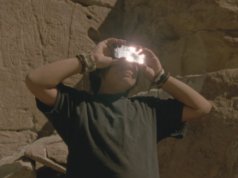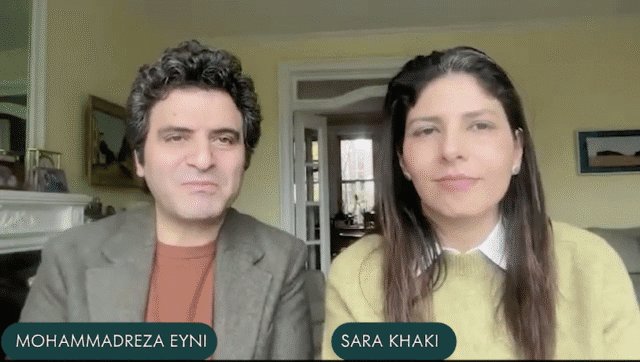
Emmy-winning docmaker Carla Gutierrez (Frida) sat down to talk with Sara Khaki and Mohammadreza Eyni about their acclaimed feature doc about Iranian Sara Shahverdi who, as the first elected councilwoman of her remote Iranian village, fearlessly breaks patriarchal traditions by training teenage girls to ride motorcycles, and by stopping child marriages.
Gutierrez kicked off the chat by asking the pair about their connection to the story and what determined them to tell it. It was obvious, from their responses, that this was a film that had to be co-directed.
“I was born and raised in Iran, Tehran. And I witnessed a lot of stories about women – just like Sara, who were fighting for their independence growing up – among my family and my extended family,” comments Khaki. “But then I left Iran at a young age, to the United States. And now, having lived equally between the two worlds, I feel that the ideas around what’s discussed in the film, around gender injustice in particular, is something that I can see here in the United States, too, especially in the way in which women’s bodies are being targeted, and [it] becomes a battleground no matter how you look at it, or where you are from.
Khaki continues: “I came across the story of a strong woman, Sara Shahverdi, who lives in the northwest of Iran, who rides a motorcycle, who’s been a midwife and delivered 400 kids…Speaking to her for six months or so, she told me that she’s thinking about running for a council seat. And I knew that there is a story here worth exploring. But I also knew that I wouldn’t be able to tell this story by myself, knowing that I’m going to enter this male-dominated space. I wouldn’t have been able to be the only director.”
So she turned to co-director Mohammadreza Eyni. “I’m coming from the community. Not the region, not the village, but the Azeri-speaking people,” underlines Eyni, who had his own concerns. “I know the culture and nuances and the dynamics, but it’s not possible for a male director to go and make an intimate film there. It was not possible at all because of the patriarchal nature of the society. I had the knowledge, but I didn’t have the ability as a male director to go and make the film. But Sara [Khaki] made it happen.”
He adds: “I remember when we had the first sessions of filming in the village, one of our colleagues told us, ‘Guys, I think you have a very good story – a woman who fights against patriarchy and wins the council seat. And this is it – you have the story.’ But we both decided to stay for more years in the village to see Sara using the power, and also how opponents respond to Sara being in power. So we wanted to see this conflict. And also we wanted to experience how the society is reflecting on Sara’s offer to bring the change in the society. So for us, it was very important [to see] different layers of power; power dynamic in the family, in the village, in the region and also…the whole system.”
The film, which won the Sundance Film Festival – Grand Jury Award for World Cinema Documentary, is also produced by Sara Khaki and Mohammadreza Eyni, in association with Meadow Fund, Chicken & Egg Films, Secret Sauce Media, InMaat and P-Squared Philanthropies. Furthermore, it is supported by, among others, the Sundance Film Institute, the IDFA Bertha Fund, the Bertha Foundation, the Hot Docs CrossCurrent Doc Fund the Doha Film Institute.
Click on the link above to watch the entire interview.