

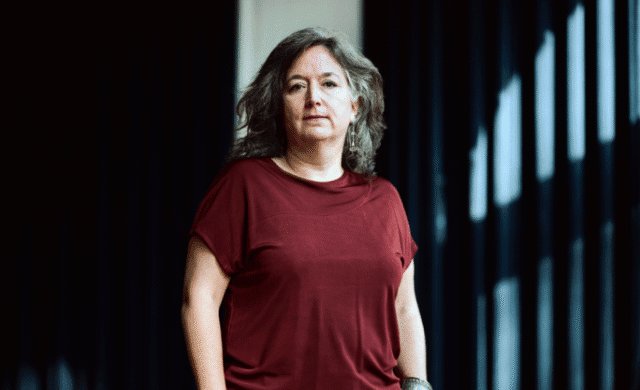
The 38th International Documentary Festival Amsterdam opens November 13 with a new Artistic Director at the helm. Isabel Arrate Fernandez, who for many years headed up the IDFA Bertha Fund, takes over from Orwa Nyrabia who was Artistic Director between 2018 and 2024.
The 2025 festival selection is, as ever, diverse and wide-ranging, both thematically and in terms of the films’ countries of origin. The Main Competition includes films from places as far afield as Iraq, Argentina, the US, the UK, Georgia and the UK. Envision, meanwhile, looks to all corners of the world (Lebanon, Iran, Mexico, China, the US) in its selection of new and visionary doc titles.
“As filmmakers and artists from all over the world share their work, they remind us that there is a space for reflection and connection,” Arrate Fernandez said of the selection when announcing her programme in October “They bring other perspectives. They open conversations about cinema—about what touches us, what feels urgent, what truly matters right now.”
Yes, Europe is represented across both International Competition and Envision, as well as within the festival’s other core sections, such as Luminous and Frontlight, but not in the same numbers as in past years. The powerhouse Nordic region, for example, seems to be represented mainly by Victor Kossakovsky’s Trillion in Envision, to the concern of some in the Nordic industries. Are these concerns justified, or is Arrate Fernandez satisfied with the geo-orientation of her programme?
“It’s understandable that people look at a programme from the point of view of representation of their country or region,” she responds to BDE. “However, this reasoning, the sidelining of films because of where they are made, is not in line with the principles of our selection process. Our team looks at all films received, and assessments are made on the artistic criteria. We are open to films from all countries in the world, and documentaries are made all over the world.”
“As an international festival, we take the responsibility to uphold our identity seriously and take pride in providing a platform for films and filmmakers from around the world,” she further counters. “Furthermore, there are more films in the program that have Scandinavian partners. Antipode (from Norway) is back as one of the main partners in Past, Future Continous. And then there is a whole bunch of films with Scandinavian co-production partners like A Fox under a Pink Moon, Lowland Kids, The Trial, From Redlight to Limelight and two short films.”
One European country that remains firmly in focus during IDFA is (maybe somewhat understandably) The Netherlands, which continues to produce top quality docs, headed up by Diego Gutiérrez’s The Shipwrecked, which plays in International Competition.
“It’s great to have filmmakers like Luuk Bouwman (The Desert of the Real, Frontlight), Maasja Ooms (My Word Against Mine, Luminous) and Diego Gutiérrez screening their work at IDFA alongside newcomers like Jeroen Kooijmans (Love-22-Love, Envision), Dawood Hilmandi (Paikar, Luminous) and Daya Cahen (Eyes of the Machine, Frontlight),” says Arrate Fernandez.
“We also see with films by Nordin Lasfar (Mohammed & Paul – Once Upon a Time in Tangier, Luminous) and Marjolein Busstra (House of Hope, Luminous), filmmakers that are going beyond the national borders. And then there is also Aboozar Amini (Kabul, Between Prayers), who brings his new film after premiering in Venice. Overall it’s an interesting, varied crop of films exploring mental health, personal stories, addressing human rights and social themes. Films that in their thematic and artistic approach can generate interest beyond the Dutch borders.”
In the run-up to IDFA 2025, Arrate Fernandez and her colleagues made the controversial decision to bar institutions that received support from the Israeli government. How difficult was it for her to come this decision, especially given the festival’s strong historical ties with Israeli institutions who have themselves been demonstrably critical of their governments over the years, such as Docaviv? In her [written] response to BDE, Arrate Fernandez defends the decision.
“The festival has had to balance screening films by filmmakers from countries where governments do not uphold human rights values, and collaborations with government supported organisations from these countries, for a long time,” she says. “We do not single out any country or group. It is the very essence of these guidelines to apply them equally to everybody.”
“Based on numerous independent reports, though, the Israeli government (like, unfortunately, many other governments) is endangering human rights in unacceptable ways,” Arrate Fernandez continues. “State institutions, as institutions, are part of the governing structure, and as such part of the status quo. That doesn’t mean all of their staff are guilty of or complicit in violations. That is why IDFA has offered individual accreditations to people from Israeli state institutions. We very much encourage their participation in debate and discussion; their perspective is one of many that IDFA wants to reflect, and we would hope they feel as welcome and respected as any other member of the IDFA community.”
Like many other artistic directors, Arrate Fernandez refuses to be drawn pre-festival on which are likely be her favourite events over the coming days. “Welcoming filmmakers and their films, all of them, is something we are all very much looking forward to. Next to this, several projects from the Forum selection have triggered my interest, and I look forward to the new set up of the Forum. And then getting lost in the DocLab exhibition, diving into the experience of being ‘Off the internet’, this year’s theme,” she says.
One element that undoubtedly meets with the Artistic Director’s approval is the choice of Susana de Sousa Dias as Guest of Honour. The filmmaker, curator, and academic will be given an extensive retrospective, and will personally curate her Top 10 selection. “IDFA will highlight de Sousa Dias’s singular approach to archival images and cinematic form, showing a selection of her works—known for interrogating dictatorship, colonial legacies, and the fragile terrain of memory,” the festival notes.
In terms of what will comprise a satisfying conclusion to her first IDFA in charge, Arrate Fernandez looks beyond the obvious measures of audience numbers, overall revenues and number of meetings at Forum.
“This only shows one part of what the festival is. IDFA is also about encounters, stepping out of your bubble, making unexpected connections. We aim to create a meaningful experience for the audience and for the film professionals that attend. This requires many conversations and to measure this we have to listen to the audience, to our guests and partners,” Arrate Fernandez signs off.





