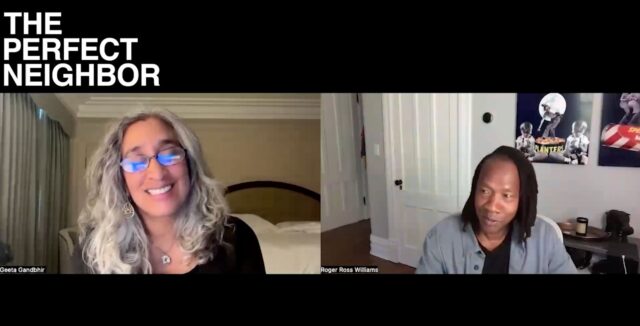
Roger Ross Williams (Stamped From The Beginning) spoke to Geeta Gandbhir about her feature doc The Perfect Neighbor, which presents a devastating critique of race, inequality and the vigilante-style ‘stand your ground’ legislation in operation in the US today, and which details the events leading up to the murder of Gandbhir’s friend Ajike.
“Ajika Owens was a family friend, and we became involved in her case when she was murdered… working with the family to try to advocate for them, and to keep the story alive in the media,” Gandbhir explains her film to Williams.
“That was what we were asked to do by the legal team, because…everyone was worried about the fact that the perpetrator, Susan Lawrence, might walk due to claiming ‘stand your ground,’ and there were ‘stand your ground’ laws in place in Florida… that make it easy for people to get away with murder. They [the perpetrators] will commit a crime and then claim self-defence.”
Gandbhir, who edited Williams’ first film, Music by Prudence, explained the complexities of the editing process on The Perfect Neighbor.
“About two months in, we got our hands on the body camera footage. We were asked to look at it to see if there was anything that the news could use,” Gandbhir says. “It was a mess. It was a total disaster. It came in pieces. Nothing was synched. You didn’t know which camera went with which piece of audio. There was a plethora of stuff. There was body camera footage, police body camera footage. There was ring camera footage. There was cell phone footage. There was audio from phone calls that Susan, the perpetrator, made to the police over and over again, as well as 911 calls that the community made.”
“Then there was also, on top of all that, detective interviews that happened after the fact. So none of it was really in any order.”
“I managed to figure it out in a sequence. It was like detective work. It was also grief work,” Gandbhir adds. “I felt like it was something we felt compelled to do because we needed to understand how this could have happened. And then we realised that it went back two years. So leading up to the incident, there was two years’ worth of [police] body camera footage, and that is unprecedented.”
“With these kinds of crime, maybe you have something the day of, if you’re lucky. Maybe you have the day before. But to have two years of incidences that allow you to see the community as they were before, and what triggered the chain of events, again, made me realise there might be a film here.”
The director further recalls the conversation she had with Ajike’s mother Pam Dias in terms of the outreach support she could offer after the tragic loss. “I have no money to give you. I’m not a doctor. I’m not a lawyer…but I think I can make a film,” she underlines the necessity of the project.
Click on the link above to watch the whole interview between Geeta Gandbhir and Roger Ross Williams.