

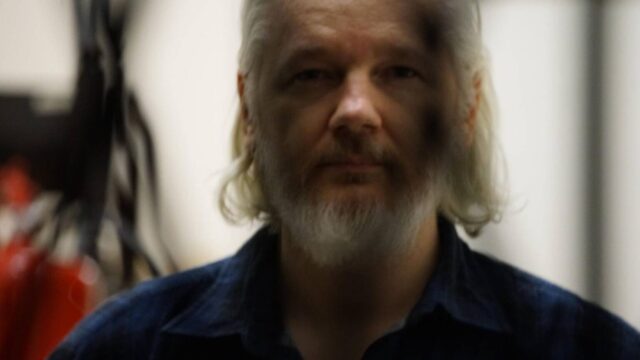
Ask Eugene Jarecki how he feels about Wikileaks founder and publisher Julian Assange, the subject of his new documentary The Six Billion Dollar Man, and he parries the question.
“He was in jail for most of the time we were making the film and so for me he was inmate number ‘blank blank blank’. I was there to investigate the substance of the case that had him in jail in that way, in Belmarsh, London’s Guantanamo Bay, but also facing a possible 175 years in the United States, in a maximum-security prison.”
Jarecki had interviewed Assange in the Ecuadorian Embassy in London over a decade ago – but that wasn’t for the documentary, and his film isn’t really about him as a personality, journalist or whistle-blower. Its core subject is what was done to Assange – how the US government systematically set out to destroy him because he was revealing some very uncomfortable truths.
“What’s happening to Julian is a very sinister, slow-motion execution,” Assange’s wife Stella observes in the film of the increasingly vicious treatment meted out to her husband over the many years of his captivity. The comment was made before Assange’s release from Belmarsh in June 2024.
“We have the tapes, we have the receipts,” director Jarecki says of the information painstakingly assembled in the documentary, which won which won the L’Oeil d’or and Golden Globe Award for Documentary at Cannes 2025, and is now an awards front-runner. The film will be released theatrically in the UK/Ireland on December 19 by Charlotte Street Films.
It’s all there: how the Ecuadorean government allegedly sold the Wikileaks founder out in return for a $6bn IMF loan; how he was victimised and psychologically tortured, even when he was within the embassy; how he was betrayed by ‘Siggi the hacker,’ the young Icelandic petty crook and sexual offender who became an FBI informer; how he was left exposed by a Guardian journalist who revealed the password to over 250,000 unredacted US embassy cables; the true story behind the allegations of sexual offences against him by two women in Sweden.
Jarecki had gone to Moscow to speak to Assange’s fellow whistle-blower Edward Snowden the week before Putin invaded Ukraine. “There have been so many attacks on Julian Assange that it is impossible to list them,” Jarecki remembers what Snowden told him in 2022. “Julian Assange is not an angel carved from marble by the hand of kindness, but neither is he a vial of poison that is shaped by the devil. The reality is something much more complex.”
As Assange’s lawyer Jennifer Robinson puts it in the film, “there was a person working with a couple of volunteers and an internet connection, and yet he was being described as the most dangerous man in the planet.”
The moment Robinson makes the remark, Jarecki cuts to a shot of Assange fast asleep on a train, without any shoes on, and with his rucksack beside him, looking more like an Aussie backpacker than an agent of chaos.
Jarecki has pulled together a colourful and sometimes surprising group of interviewees. Former British foreign secretary Alan Duncan once called Assange “a miserable little worm.” Nonetheless, Duncan features in the documentary.
When Duncan insulted him in 2018, Assange was still holed up in the Ecuadorean embassy in London, defying the British authorities’ attempts to arrest him. “Well, I think historically, in my films, I have often been able to consult with people who might be perceived to be from the ‘other side.’ I don’t believe in these ‘sides,’” says Jarecki.
“I think that people are not monolithic. People who are public servants, like Alan Duncan, they may take certain positions at certain times…[but] very often if you respect people as human beings and show respect for their intellect and commitment, you can get very interesting answers,” he adds of the Conservative politician who now shows some sympathy for Assange, and who reflects honestly on the embarrassment the whistle-blower was causing for the British government during his stay at the embassy and subsequent imprisonment.
Jarecki intends his film to be an informative, “honest” and “ethical” account of the campaign against Assange – but it is also meant to be entertaining. “I hope it feels a bit like a spy thriller. I think it was one.”
Earlier this month, Watermelon Pictures took North American rights to the film. The aim now is to get it seen as widely as possible. “I think a great story is a great story. If you can blow people away, then all those petty arguments about what is happening in the field stop mattering,” Jarecki reflects on the current anguished debates about falling audiences for theatrical documentaries. “I think there is a story here that is so explosive for the public, so revealing and so much about today, that there is going to be a massive appetite for it.”
Snowden had told Jarecki that he found it “strange that people had difficulty looking past the sharp corners of a person,” and that they couldn’t accept what Assange had done “for humanity.” The film is bound to make the public look again at the Assange story.
In the meantime, the subject is rebuilding his life. “You can’t get further from Belmarsh than Cannes,” Assange’s wife Stella Assange joked to BDE before the film’s premiere in May this year. It was then less than a year since Assange had been released from the high-security British jail in June 2024.
Assange’s lawyer Robinson was told constantly that he would never get out. She has herself faced surveillance, death threats and harassment at airports over the last 14 years.
“I don’t want to live in a democracy where an award-winning Australian journalist is in prison in the UK at the behest of the United States,” Robinson said in Cannes. “That is what kept me going, and the courageous people that I got to work with, including Stella….I always believed we would get him out.”
Assange is now living in Australia, in “open nature, seeing kangaroos every day, being able to go to the ocean easily,” Stella noted of her husband. “It’s been remarkable how he has recovered,” she adds. “Physically, he is almost fully recovered, He jokes that his best disguise is his tan!”





