Lift Like a Girl by Mayye Zayed
‘Cinematic panoramas of the state of the world, defiant protagonists, visually engaging works and philosophical views of humanity and the environment,’ is how Dok Leipzig categorizes the films selected for the 2020 feature-length and short competitions. (Full selection follows below.)
“For the programme of the German Competitions, we’ve been able to draw from a variety of themes and perspectives on the world. Most of all, the range of cinematic styles is highly gratifying; it demonstrates the artistic possibilities of today’s documentary filmmaking. Young talent eager to experiment encounters established artists in the competitions,” festival director Christoph Terhechte says about the selection. “It doesn’t stop at a close look at Germany. A far-sighted cross-border vision of the world testifies to an intense curiosity about international locations and local stories outside of Germany. Some of the films are profoundly exploratory, some are panoramas of vast landscapes, some are strong portraits and explorations of family ties, and a few are simply hilarious.”
The selection committee has chosen a total of 17 productions for the German Competition Long Documentary and Animated Film and the German Competition Short Documentary and Animated Film. Among them are twelve world premieres, one European and four German premieres. In both competitions, the gender ratio of the directors is balanced. The other competitions of the festival, to be announced in the coming weeks, are also gender-balanced in terms of directors.
Some of the films deal with pressing issues of our time, such as the approaching end of nuclear power generation in Germany and the question of permanent storage, the urbanisation of African societies and the perilous flight across the Mediterranean Sea to Europe of people seeking refuge. The latter topic is of current political relevance, as the Sea-Watch reconnaissance aircraft Moonbird, from which the film Operation Moonbird was filmed above the Mediterranean Sea, was grounded by the Italian government this month. This is hindering the continuation of the reconnaissance and rescue mission.
Other works encourage reflection on identity, prejudice and discrimination. For example, problematic aspects of the German fascination with North America’s indigenous population, the so-called “Indians”, and the cultural appropriation associated with this are discussed. A satirical look at the art business calls existing gender roles into question. Stories of emancipation and empowerment emerge for young Egyptian women who lift weights and a Syrian Orthodox nun who asserts her identity in a Muslim environment.
Some of the directors participating this year have previously had films screened at DOK Leipzig. Andreas Voigt, for example, returns to Leipzig with a film about people in the border area between Germany, Poland and the Czech Republic. In 2015 he opened the festival with his long-term observation Alles andere zeigt die Zeit. Carsten Rau was last represented in Leipzig in 2014 with his very popular film Willkommen auf Deutsch. Martina Priessner attended the festival’s industry platform, DOK Industry, last year with her current production: her film was one of the rough cuts presented at DOK Preview Germany. And animated filmmaker Anne Isensee received the Golden Dove in Leipzig 2017 for her film Megatrick.
This year’s award-winning films will be ceebrated on the Sunday of the festival (1 November 2020). The films in the German Competition Long Film are nominated for a Golden Dove, the films in the German Competition Short Film for a Silver Dove. Members of the jury are film editor and filmmaker Bettina Böhler, actress Anne Ratte-Polle and Alex Moussa Sawadogo, artistic director of the Afrikamera festival.
Some of the films are also nominated for partner awards: the DEFA Sponsoring Prize, the Goethe-Institut Documentary Film Prize, the Ver.di Prize for Solidarity, Humanity and Fairness, the MDR Film Prize, the Gedanken-Aufschluss Prize, the Young Eyes Film Award and the Mephisto 97.6 Audience Award.
German Competition Long Documentary and Animated Film
80.000 Schnitzel. Dir: Hannah Schweier. Germany. German premiere
Monika has a new dream: She fights tirelessly to preserve her grandmother’s ailing inn and farm. The film confronts us with the universal question when it is the right time to live one’s dreams and how quickly this time may pass.
Atomkraft Forever (International title: Nuclear Forever). Dir: Carsten Rau. Germany. World premiere
This look at the issue of nuclear power begins where Germany is currently standing: with shutting it off. A safe final nuclear waste repository is not in sight. And yet, boosted by the coal phase-out, many people seem to see “clean” nuclear energy as an option again.
Grenzland (International title: Borderland). Dir: Andreas Voigt. Germany/Poland. World premiere
Movements and stories in the border region between Poland and Germany – Andreas Voigt’s new film takes up the themes of his 1992 work Borderland – A Journey. The charged term “homeland” stirs up (trouble in) the minds and hearts of the people.
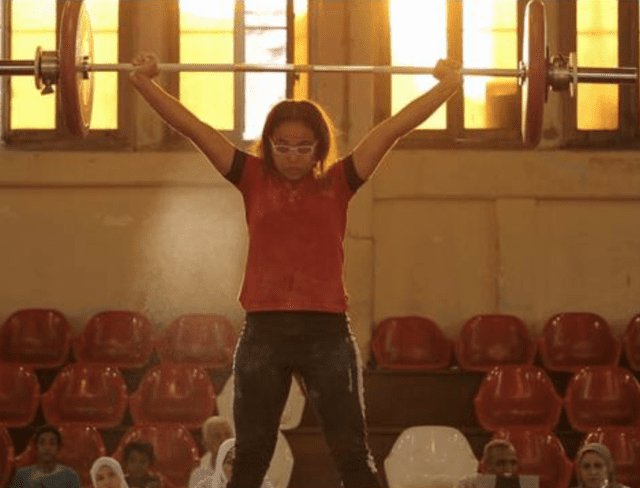
Lift Like a Girl. Dir: Mayye Zayed. Denmark/Egypt/Germany. European premiere
Mayye Zayed has followed the Captain’s student Asmaa, who was fourteen at the start, for four years. Asmaa fights her way to the top global league matches of weightlifting.
Rift Finfinnee. Dir: Daniel Kötter. Ethiopia/Germany. World premiere
At the periphery of the rapidly growing East African metropolis Addis Ababa: a composition about the dynamics of an urban turbo modernisation and people who are forced to experience the impetuous urbanisation of African societies the hard way.
Die Wächterin (International title: The Guardian) Dir: Martina Priessner. Germany. World premiere
A Syrian Orthodox nun lives in a dilapidated estate in south-eastern Turkey. Despite hostilities from the Muslim neighbourhood: she won’t be driven out, for she has sworn to protect the church and not to leave the sacred place.
Wir wollten alle Fiesen killen (International title: We Wanted to Kill All Nasty Ones). Bettina Ellerkamp, Jörg Heitmann. Germany 2020. World premiere
Rothenstein, south of Jena. A mountain, hollowed out, built on and impossible to sell. Bizarre energy fields and plans of U.S. preppers meet National-Socialist exploitation and forced labour, stories of flight from the 1930s, and the military history of the GDR.
German Competition Short Documentary and Animated Film
AIVA. Dir: Veneta Androva Germany.World premiere
AIVA is an artist, animated by algorithms. But above all she is the soberingly limited male tech vision of what more diversity in the arts could look like. A naive and cliché-ridden “art documentary” lets us participate in her work.
Appropriation Takes You on a Weird Ride. Dirs: Nina Fischer, Maroan el Sani. Germany. World premiere
A media-historical interrogation of the German fascination with the colonialist construct of “Red Indians” which leads right up to its instrumentalization by the “New Right”. The backdrop is the ruins of the former U.S. embassy in East Berlin, where an exhibition on the subject took place in 1986.
Dark Matter. Dir: Viktor Brim. Germany/Russia. German premiere
Quiet, dark shots of nocturnal fog, of a mine, a dump truck or a wreck, of huge earth craters and new surface contours created by excavation tell of raw material extraction, economisation and exploitation of nature. Post-industrial landscapes become post-apocalyptic.
Dieser Film heißt aus rechtlichen Gründen Breaking Bert (International title: Due to Legal Reasons This Film Is Called Breaking Bert) Dir: Anne Isensee. Germany 2020. World premiere
Most accidents happen at home. Thus the appeal to one’s personal political responsibility comes as a surprise. Randomly reading a Brecht text inspires to take action – a pointed film full of humour.
Elefantin (International title: Bibi Must Go) Dirs: Marie Zrenner/Johanna Seggelke. Germany. World premiere
A trauma therapy on film for an uprooted elephant cow, born in Zimbabwe, imported by the East Berlin zoo and deported to the Halle zoo. The story of a social creature that, like all of us, needs security and a home to form stable relationships.
Erwin Dir: Jan Soldat. Austria/Germany. German premiere
58-year-old Erwin introduces himself as “old but horny”. He has declared the mobile home in his front garden his favourite refuge, where he has everything he needs: a computer, a bed, a coffee machine. Two webcams link Erwin to other men who satisfy his carnal desires.
Haeberli Dir: Moritz Mueller-Preisser. Germany. World premiere
Is he insane or a genius? An impoverished messie or a millionaire? Many legends surround Adolf Haeberli, who is over eighty years old. In the middle of the luxury spa town of St. Moritz he lives in his dilapidated and cramped house. A humorous, but never compromising portrait of a lateral thinker.
Operation Moonbird Dir: Dustin Lose. Germany. World premiere
A gloomy filmic contribution to sea rescue and a concentrated revelation of the mechanisms of systematic flight prevention in the Mediterranean and the people responsible for it. This is not a film about the alleged refugee problem but one about the problem called Europe.
Der Schornsteinsegler (International title: The Chimney Swift) Dir: Frédéric Schuld. Germany. German premiere
England, mid-19th century: children keep the flow of air going in narrow, sooty chimney flues. Their fear of falling is as strong as their fear of the master’s punishment. The report of a chimney sweep of the time is brought to life by pencil drawings.
Verwundene Fäden (International title: Riven Threads) Dir: Deborah Jeromin. Germany. World premiere
What’s the parallel between a Leipzig allotment club and the Wehrmacht’s invasion of Greece? This cinematic search for traces takes us from silkworm breeding in a Leipzig allotment garden to the island of Crete and German war crimes.