

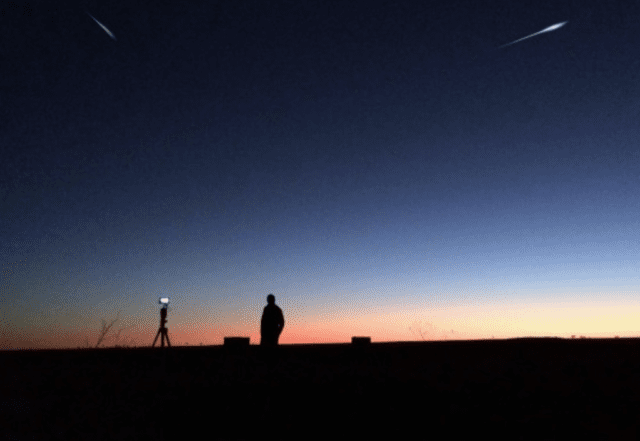
In Fireball: Visitors from Darker Worlds Clive Oppenheimer and Werner Herzog reunite, this time to examine meteors and meteorites (those that make it into the Earth’s atmosphere) from scientific, ethnographic, religious, historical and aesthetic perspectives.
Filmmaker and scientist Clive Oppenheimer stresses how, as soon as he made an unscheduled detour to the Korean Polar Research Institute while on a trip to South Korea, he knew he had found the subject for his next film. Scientists there were collecting meteorites they had found in Antarctica, around a thousand, he says, each placed in a nitrogen-filled cubicle behind a glass panel within an ultra-clean lab.
“I was very struck visually by this and by this scientific veneration of the meteorites, and while I was talking to the meteoriticist it just struck me then and there that this would be a great concept to take forward.”
“So I wrote a concept for a whole film and I sent it to Werner [Herzog, with whom he had collaborated on the volcano-themed Into the Inferno, 2016],” Oppenheimer continues. “He liked it at once, so we set in train again our colleagues at Spring Films in London and Werner’s brother Lucki [Stipetić, half-brother] in Vienna to start working on financing the film.”
“I kind of mapped out what the main themes were, the origins of life, the existential threat of incoming objects, the cultural side, the veneration, understanding the early solar system,” Oppenheimer adds. “I also had, from early on, a concept of the whole film, how it would open, how it would end, how things might fit together, and then once we had the funding locked in then that’s when we all engaged with the team.”
The resulting Fireball: Visitors from Darker Worlds is a film book-ended by aged ceremonies in which meteorites are celebrated by indigenous people from opposite sides of the planet, opening with the Day of the Dead ceremony in Mérida, Mexico, and closing with a tribal ritual among folk on Mer Island between Australia and New Guinea who believe that the souls of the dead are carried away on shooting stars.
In-between we see worshippers at Mecca straining to touch the black Stone of God, encased in silver and almost certainly a meteorite, and we hear of the heavenly body that fell at Ensisheim (Alsace) in 1492 and which served as a portent to emphasise the legitimacy of the Hapsburg Empire.
Meanwhile In Norway noted jazz musician and lay astronomer Jon Larsen studies cosmic dust, which he refers to as “the currency of the cosmos”, and micro-meteorites, which he magnifies to reveal an extraordinary beauty. In Princeton, Professor Paul Steinhardt discovers how quasi-crystals found in meteorites have solved naturally the enigma of 5-fold symmetry.
Geo-scientist Nita Sahai gets to the nitty-gritty of how astral bodies may have brought life to the planet, explaining (from the Ramgarh Crater in Rajasthan) how all of the building blocks of life have been found in meteorites, such as amino acids, lipid molecules and the sugar ribose. “Meteorites can wipe out life but also provide the seeds to create life in the first place,” she observes.
And we get to see the mother of all meteorite craters, Chicxulub Puerto in the Yucatan, Mexico, where landed the monster rock that wiped out the dinosaurs and paved the way for mammals. Estimated in the film at 10km in diameter (although Wikipedia suggests up to 81 km) it hit Earth at 20km per second, formed a crater 30km deep and 200km wide and in a heartbeat extinguished three quarters of all living species.
For much of the film, Oppenheimer is in frame, but Herzog is a constant presence in narration. We also know he is continually behind the camera because at one point in the film he voices, in response to Carl Sagan’s observation that we are all stardust, how he is anything but. “I am Bavarian,” he underlines.
“We divided labours to an extent but we also covered a lot of basis,”
comments Oppenheimer of their working relationship. “But both of us know what we’re at and what we are doing, and most of the time we have a pretty common vision.”
The film’s visuals are, at times, stunning, such as the magnified micro-meteorites, the temple on the crater floor in Rajasthan and the helicopter shots on an Arctic plateau where meteorites that have hit the earth’s surface over millennia are revealed by glacial movement. Every stone there is a meteorite and Oppenheimer has the good fortune to spot the biggest one found this year. (Herzog assures us on the soundtrack that this wasn’t set up for the film.)
If all of this generates a sense of panic in a viewer who may worry both for their personal safety and that of the planet, Oppenheimer and Herzog also introduce us to personnel at the Hawaiian Pan Starrs observatory and the NASA Planetary Defence Co-ordination Office, whose task it is to spot life-threatening incoming rocks. And yes, there is the potential to deflect away meteors and asteroids from their Earth-bound trajectory with the use of powerful explosives.
Oppenheimer stresses how he would like to make another film with his esteemed German colleague, noting how together they create a satisfying alchemy. “I think he would be open to that. Werner has made an awful lot more films than I have. If we made these films on our own they would have been different films. These two films are the way they are because we have both collaborated on them. That has worked very well and I think there are other topics that we could cover.”
He says that next time he would look to move away from geo-science to aspects of human behaviour and history, although he freely admits that future plans are “half-baked.” But the intent is there. “I think it’s a question of just finding a bit of head space and really having a spark… But yeah, I would love to make another film. At the very least we need a trilogy.”
Fireball: Visitors from Darker Worlds world-premiered at the Toronto Film Festival 2020 and will screen on on Apple TV+ on November 13.





