

“She lived only for her wheel and on it,” reads an extract from an 1896 edition of the Wichita Daily Eagle quoted at the beginning of archive-based documentary The Freedom Machine (screening on Sunday 12 March at the Glasgow Film Festival).
A 23-year-old woman called Elma J Dennison was accused by her husband of developing “the bicycle fever to such a degree” that she neglected everything else in her life. Another way of looking at it is that her new-found passion liberated her from domestic drudgery.
The new film, commissioned by the GFF and put together by curator Jo Reid, is a celebration of women and bicycles.
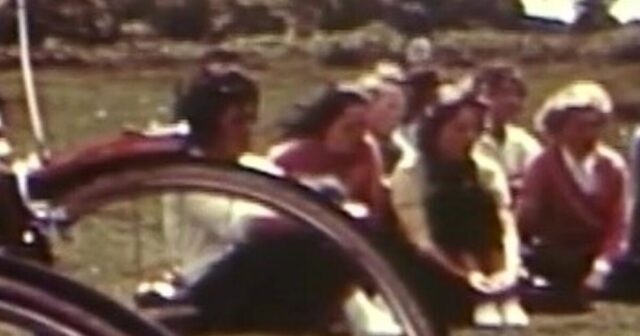
From black and white footage of lady cyclists in the 1890s to home movies of little girls getting their first tricycles, from the production line at the Raleigh factory to a female postie delivering letters, The Freedom Machine shows “women wheelers” of all ages and backgrounds.
One of the main hooks for the film (which will travel round Scotland after the festival) is the fact the 2023 UCI World Cycling Championships are taking place in Glasgow later this summer.
“That was my brief, to make an archive film about women and cycling,” Reid explains the remit she was given. “It’s nice and broad which meant I could make it my own.’
The Glasgow-based curator was determined not just to show “young fit women” racing but to look “at all the different ways women have used bikes.” She began her research at the Scottish Moving Image Archives but also explored holdings at the BFI and at the Media Archive of Central England.
During her research, Reid read widely about the history of women and cycling. That’s how she stumbled on the phrase coined by American Nineteenth Century suffragette Susan B Anthony about the bike being a “freedom machine” and a tool for emancipation.
Some of the material included in the new documentary is very personal. The fuzzy video of the girl and a red bike is Reid’s older sister. “My mum showed me that and I [thought] that has got to go in.”
There is plenty of other home movie footage in the film. “I love it when it is a bit rough – when you can tell it is filmed by an amateur and things aren’t focused on what you think they should be focused on. I love seeing the graininess of the old film. I really try to keep the imperfections where possible….the unpolished [footage] captures something in my mind that feels more authentic than professionally shot things.”
Reid was three or four when she got her own first bike. It was a hand-me-down from her sister and she remembers riding it with stabilisers. “There were a lot of quiet roads to practice on and big greens to fall over on,” she says of her childhood home in a small village in the Scottish Borders outside Edinburgh. She’d pretend she was on a dragon or a horse.
In the film, we see nurses from Nigeria and commuters from Vietnam. There is a toddler from Hong Kong. One sequence shows a woman in the 1920s using an ingenious home-made paddle device to cycle across the Thames. There are Victorian-era cyclists in long skirts performing synchronised manoeuvres. However, most of the material is Scottish. We see women riding through spectacular Highland landscapes.
“At this time, it is still really only upper-class or middle-class women who can afford bikes,” Reid notes of the early days of cycling, but she adds that the bikes were seen as symbols of the “new woman interested in suffrage.”
One challenge for Reid was not to make the film “too nostalgic.” She was keen to emphasise that many – including the post women – used their bikes for work. She also wanted to show how the bikes were made, with women often involved in the manufacturing.
In some of the archive material, the women cyclists were treated as “incidental” figures with much greater emphasis on the male cyclists.
“There is tons and tons of footage of little boys messing around on bikes. With women, it is harder. You have to think a little more sideways when searching…you’ve got to really look at the footage when picking them out or you have to put more effort, thought and care into looking for it.”
The curator eventually tracked down the footage she needed. The challenge was coming up with a structure with which to show it off to best effect. She credits sound designer and composer Cat Hawthorn’s atmospheric soundtrack with helping draw the viewer in to the film. “It really elevated the footage in my mind. It made the project seem a lot more complete and it really inspired me when I was finishing off the edit.”
Reid would love to have a pedal-powered screening of The Freedom Machine. (Some community cinemas now use bike generators to keep their projectors working.) She also hopes the film will encourage yet more women to get on their bikes. Not only is it one of the most eco-friendly forms of travel. It’s good for their health too. It’s a sociable activity too.
“Even just in Glasgow, where I live, there are so many great female-based cycling organisations, like Women On Wheels and Bike For Good that do focus on making cycling accessible and liberating. I think there is something really liberating about going out as a group, on a cycling adventure, just as they used to do in the 60s, of going out camping somewhere and then cycling home,” Reid enthuses.
And, yes, she cycles to work herself. “It’s the joy of moving, the joy of exercising and the joy of just going places. I think there is just that immense freedom which the film shows. You don’t have to rely on cars or buses or trains. You can just get on your bike and get out there!”
There will be a Pay What You Can screening of The Freedom Machine at the Glasgow Film Festival on Sunday 12 March. This will be followed by a Q&A with Jo Reid.





