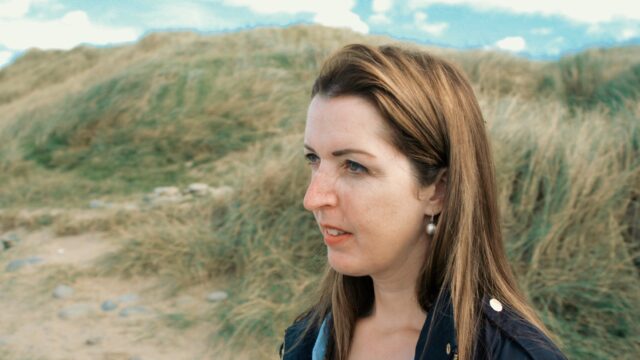
For Vicky Phelan, all seemed fine in 2011 when she was given the all-clear after a cervical smear test. In 2014, however, she was diagnosed with cancer after a further examination, but it wasn’t until three years later, in 2017, that she was told that she’d had pre-cancerous cells all along back in 2011. Then in 2018, she was told she had developed a 10cm malignant tumour and was given six to twelve months to live. How and why had she been incorrectly diagnosed back in 2011? And who was responsible for the cover-up?
Vicky was only 43, happily married and the mother of two kids, and she desperately wanted to live. So she went on the offensive. She sourced the immunotherapy drug Pembrolizumab which, despite severe side effects, could significantly reduce the size of her tumour. She also discovered how, back in 2008 and in the midst of the economic recession, the Irish government began to outsource cervical smear checks to labs in the US for a third of the price in Ireland. It was a grossly naive decision made out of obvious economic expediency and with scant regard for outcome.
As Vicky’s diligent lawyer Cian O’Carroll puts it in the film: “You [the Irish health authorities] are handing over all the responsibilities for checks and balances to the very company that has a vested financial interest in doing this job quickly, dong it cheaply and maximizing profit.”
When Vicky managed to source the results of her own 2011 smear test, she saw, even among the incomplete documentation (one important page had been removed), the obvious evidence of severe cell abnormalities.
The day after she started her Pembrolizumab treatment she went to court and won a settlement of €2.5m, without admission of liability, from the Irish HSE (Health Service Executive) and Clinical Pathology Laboratories, the Texas-based company subcontracted to assess her test. Most importantly, she refused to sign a nondisclosure agreement about the evidence that she had unearthed which, when disclosed outside the court to the waiting press, would shock all of Ireland.
Inaccurate results had been given to at least 208 women during this period, most of whom knew nothing of the inadequacies of the testing system they trusted, and who were later diagnosed with cervical cancer. Seventeen of these woman had (at that time) already died.
As lawyer O’Carroll further stresses in the film: “We don’t seem to be able to do women’s healthcare [in Ireland], especially anything to do with the area of reproduction.”
This is a point elaborated upon by director Sasha King, who equates the actions of the Irish government with those of another revered institution, the Catholic Church whose ‘adoption for profit’ practices were depicted in the film Philomena (2013, directed by Stephen Frears, based on the book by Martin Sixsmith). “Do you call it ‘murder’ or not?” King muses after I suggest that word may be applicable in the case of the cancer misdiagnoses. “I mean, women were dead. When Vicky started to reveal the facts of the situation, which was really just the tip of the iceberg, the information was that 17 women living in Ireland were already dead. That was shocking to the nation.”
King further tells how she came to tell this story. Like many other folk, she first heard about Vicky when she saw her on the evening news standing on the courtroom steps, at liberty to disclose the evidence of gross medical malpractice. “That was the first time any of us heard anything about this. So I was floored, kind of shocked actually. I was literally fascinated and horrified with what I was hearing,” says the director, who was determined to document Vicky’s story. “I couldn’t get her out of my mind.”
“As a filmmaker, my mind was processing how this was a story literally unfolding before our eyes,” King continues. “So I just contacted her and I asked her could we meet… She knew who I was. I sent her my other film I had directed [Akron, 2015], and we met for lunch, and we hit it off. And I explained to her, ‘look, this is gonna be a real adventure, but we won’t compromise on the story. We won’t sign up to anyone who’s going to limit what we can say. And we just got stuck in. She was an amazing lady to work with.”
King was determined that she was not going to “drop the ball” on a film of such importance, one on which she felt a personal sense of responsibility. Aside from that the pair had become close friends as well. “She’s adorable, and we just had this great relationship, and that’s what made the whole thing work.”
That said, King had to obey her filmmaker instincts. “Not to sound too cold, but you have to stay slightly detached as well or you can’t do your job…It’s kind of like this tapestry because my job was to do the best I could to pull all of the footage and information together and tell the story, but also just to do her justice as well.”
There is, of course, a tragic sense of inevitability to the film. It is a chronicle of a death foretold, although the documentary was completed before Vicky’s death in November 2022. Yet her passing came after her astonishing campaign to help right the wrongs of the Irish authorities, not least in “normalising the conversation” around women’s health, advocating for fellow victims and campaigning to ensure that more girls and boys have access to the HPV vaccine, as well as ensure that cervical cancer patients have access to Pembrolizumab, designed to enhance the quality and length of life. (Vicky lived for a further four years on the drug).
Director King stresses how a cultural reticence to questioning institutions of authority in Ireland is a characteristic more and more consigned to the past, with much of this new attitude down to the likes of Vicky and fellow campaigners Stephen Teap, whose wife also died of cancer after a corrupt smear test analysis, and Lorraine Walsh who was left unable to bear children after her late cancer diagnosis and treatment.
“What it highlights for us is that we are surrounded by these kind of hierarchical powerplays, and the medical system is definitely one of those. You’re not supposed to question your doctor. We were always taught and told not to do that, that what the doctor said goes,” says King, adding that the Church was another such authority against which people were fearful of speaking out.
“But you have to trust your gut. If you think there’s something wrong or if you need to question something further, you need to do that. So I think that’s ultimately the message of Vicky. Part of the legacy she has definitely left with people in Ireland is ‘don’t just settle.’ You have to fight for your rights, and you have to fight for what you believe to be the truth. And especially, you have to ‘own’ your own health.”