In 2020 thousands of Indian farmers took to the streets in a mass protest against new farm laws introduced by the Indian government aimed at modernising the agricultural market by allowing private companies to buy and store farm produce in unlimited quantity, all the time revoking the rights of contract farmers. Nishtha Jain’s absorbing documentary Farming the Revolution charts the march on Delhi, but also takes time to detail the experiences of the farmers, and outlines the politics and reaction to the march.
As the film states, the laws were drafted without consultation with farmers and were passed despite opposition in the Parliament, putting the livelihoods of 800 million people at stake. The decision led to protests all over India, most notably in the state of Punjab, known as the country’s ‘food bowl.’
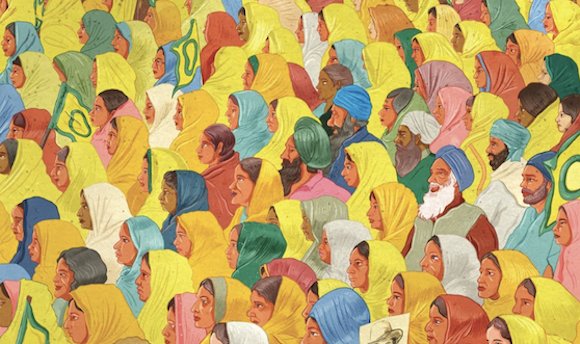
After two months of protests, farming unions—mainly from Punjab and neighbouring Haryana—began a movement named Dilli Chalo (which translates as ’Let’s go to Delhi’) with protestors doing just that. Starting up their tractors and trucks, or simply walking on foot, tens of thousands of union members headed towards the nation’s capital.
“Give us back our rights,” shout elders from the back of lorries, as support and enthusiasm for the campaign increases. But when the protestors from the Punjab reach the border with neighbouring Haryana they are met with barricades and police with water cannon and tear gas.
Utilising plenty of drone shots to underscore the scale of the protest, as well as footage from within the march and archival television material, the film follows the farmers as they eventually make their way past the border and arrive at the outskirts of Delhi only to be met with more (and more substantial) barricades which eventually halt their progress.
More than 40 farmer unions occupied four entry points into Delhi, resolute in their key demands that the farm laws be repealed and also calling for the Minimum Support Price (MSP) for all crops. The protest camp of the oldest and largest farm unions of Punjab – the BKU – extended for over 25km along one of the highways on the outskirts of the city.
Joginder Singh Ugrahan, President of BKU, speaks at the rally, saying: “We have to demand jobs, better our economic condition. We need to assert ourselves. Why must we borrow money for every task? Why is our profession not profitable? Why do our youth not take up farming?…These rules have added fuel to the fire. Farmers were already angry. Too many farmer suicides have already taken place. The challenge is to prise the bone from the hungry wolf’s jaws.”
The film is punctuated with sound-bites from the eloquent Joginder Singh Ugrahan during different stages of the campaign, but is particularly engaging when balancing high-end politics with footage from inside the protest camps, as men prepare rotis for fellow campaigners and women talk about the impact the campaign has had on their lives. The voice of the ordinary man here is represented by Gurbaz Sangha, a 26 year-old farmer with a small landholding who has found himself doing things he never did at home – cooking, building shelters, managing a protest stage, learning to give a public speech, mobilising and organising. Also prominent is Veerpal Kaur, a 34-year-old farmer-activist. She and her older sister Beant Kaur have made the protests their priority. Associated with the farmers’ unions for years, they help mobilise women from their area.
When the barricades are eventually removed, the march continues with the police watching on and as the roads are filled by the protestors. Despite accusations of a religious agenda, the call for the government to “repeal the black laws” has prominence, and day after day the protesters embody India’s pluralistic, defiant and resilient spirit. As the movement gains further momentum, farmers across the country and trade unions of industrial workers rally in solidarity.
This is a film with a happy ending of sorts as, on November 19, 2021, the government decides to repeal the bills, although there are renewed demands for a guaranteed MSP.
Farming the Revolution can be a little repetitive and matter-of-fact at times, but it nevertheless offers a rare insight beyond campaigning politics into life inside the protest camps where people from all castes and backgrounds gather with a shared purpose. Old and young, men and women, their sense of camaraderie is what gives the film a real sense of heart and purpose.
India-France-Norway, 2024, 100mins
Dir: Nishtha Jain
Production: Raintree Films, Little Big Story
International sales: Cinephil
Producers: Nishtha Jain, Valérie Montmartin
Cinematography: Akash Basumatari
Editors: Giles Gardner, Nishtha Jain, Anand Gautam
Music: Florencia di Concillo
With: Gurbaz Sangha, Veerpal Kaur, Joginder Singh Ugrahan