In Long Live Love, screening in Best of Fests, Danish director Sine Skibsholt records the loving but tempestuous relationship between a mother and her teenage daughter.
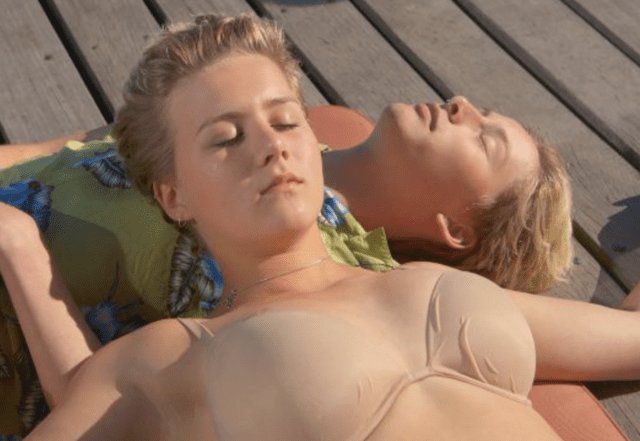
Long Live Love is a coming-of-age story, of sorts, about the confident and mouthy teenager Rosemarie, who has twice overcome cancer, and her equally mouthy, but slightly more vulnerable, mother Katrine.
Katrine is a dedicated mum, but she is also fun, with more than a touch of glam, and a penchant for smoking cigarettes. Of course, so does Rosemarie, which is not at all to her mum’s liking.
Rosemarie wants to party (and smoke) and put her illness behind her. She is in a school where her former illness is not an issue, and she continually seems to attract the attention of boys.
But when mother and daughter occupy the same space, whether it’s the car, the kitchen or the bedroom, there is no telling in which direction the conversation is likely to turn, or whether their exchange will end in tears, in laughter or in hugs.
Director Sine Skibsholt had known the family for years, being a very good friend of Katrine’s older “go-to” sister Laura, who also features in the film. Rosemarie’s period in hospital as a toddler coincided with Skibsholt’s filmmaking studies, and the director’s camera was trained much of the time on her young niece, producing footage that Rosemarie came to love.
“Rosemarie has been so happy about the film that I shot when she was a kid because she can’t remember everything, and it really helped her in putting together the pieces of the puzzle of what she went through,” says Skibsholt, adding how, “I kept on filming her just because I liked to look at her through my camera.”
Years later, Rosemarie’s family contacted her again. “When she was diagnosed with cancer the second time, her father called me and asked if I would like to meet up with Rosemarie – and to bring my camera.”
But very soon, it was evident that the teenager’s illness was never going to be the focus of the story, even though we see difficult scenes of her in pain and receiving hospital treatment, and without hair after chemo. “I wasn’t that interested in making a film about a kid who has cancer. I was from the very beginning looking for something else,” the director concedes. “And that was the love story between Rosemarie and her mum – that became the main story.”
With such dynamic and vocal leads, this was never going to be a soft-focus family portrait, rather a warts and all study or, as Skibsholt puts it, “a film without make-up.” So she installed herself in the house and pressed ‘play’. Yes, Rosemarie and Katrine were continually aware of her presence, but that seemed to have little bearing on how the pair were likely to behave.
“I don’t believe in fly in the wall,” says the director. “Once you enter a room with a camera you will have an impact on the room and the people in it. People have actually asked me ‘are they are really at each other? They are so passionate and they say all these harsh things.’ And they are like that… They would not be ashamed of having an argument with a lot of people over for a party. They are not that kind of people, so it was not such a big stretch for them, to allow someone to be with them in that…I have experienced it. I have known the family for many years.”
Skibsholt tells how she was pregnant with her second daughter when filming Rosemarie’s second phase in hospital, “I was throwing up while Rosemarie was throwing up, so that whole time at the hospital was very harsh both of us.”
She also reflects on the tragedy of grave illness in somebody so young. “I was very young when I lost a person very very close to me with cancer. She was 22, I was 24, so to some extent I have a knowledge of losing, whether it is your life or a time in your life,” Skibsholt stresses. “Or it’s that innocence you have when you are a young person, and everything was supposed to just be parties and kissing different people and not worrying about illness and the possibility of dying.”
Another core aspect of the film is Katrine’s clear struggle with depression. “It was very difficult for her to watch the film when we had her in the editing room for the first time, because she has tried to deny herself the feelings that she has had,” says Skibsholt. “When they got through the whole first cancer period she had a very severe depression, so she also had this reaction when Rosemarie got well the second time.”
“She has had such a difficult time admitting it to herself because everybody was like, why are you sad? Rosemarie is well now,” the director adds. “And so through the process of making the film, watching the film, sessions with therapists, talking to me, talking to Rosemarie, she now completely knows, ‘yes, I had a severe depression and this is why.’”
I ask Skibsholt how she perceives herself as a director. “I would say I really like to get to know the people I am filming, but I do it with my camera,” she responds. “I very quickly pick up the camera so the whole set-up is ‘this is the relationship we have’. I am carrying the camera and you are in front of it.”
Oddly, she also perceives herself to be a director who likes to make ostensibly visual films in which dialogue is kept to a minimum. “And now I have made two films and all they do is talk,” she laughs. (She made the feature doc Who We Werein 2016.)
“So, I guess you can try and figure yourself out, and then you just can’t, but I am still a young director in that sense,” she continues. “I think, if I should guess how people would describe me, with a camera in a room I have an ability to show empathy and to make people feel at ease, especially with whatever sorrow or grief or existential crisis they may be in.”