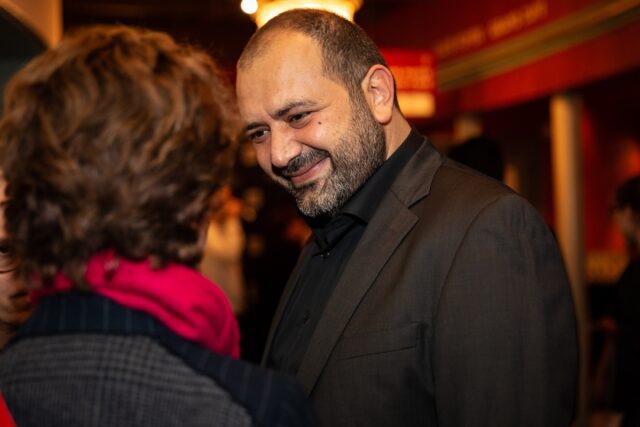
After six years at the helm of the Amsterdam docfest, Orwa Nyrabia recently announced his decision to stand down as of 2025 (see statement below), which means that IDFA 2024 will be his seventh and last.
Nyrabia’s time in charge at IDFA has been characterised by change. When he joined the fest in 2018 he promised, and subsequently delivered, root and branch reassessment of programming in order to discover global voices from all corners of the planet, as well as demand equal gender representation across all festival sections.
He led IDFA during COVID, when the world seemed to be in meltdown, but it was also a period during which the doc sector remained resolute both in chronicling and working through the pandemic.
In its recent announcement, the festival recognised Nyrabia’s significant role in IDFA’s restructure as an “institute for documentary culture,” as well as the opening of the Documentary Pavilion, a year-round space in the heart of Amsterdam.
There is no denying that IDFA 2023 was a difficult and painful period both for the Artistic Director and staff in general following the pro-Palestinian demonstration at the opening ceremony, and the subsequent escalation of tensions among filmmakers and spectators.
Nyrabia was keen to address this episode when talking to Business Doc Europe, especially when asked what measures (if any) he and the festival have put in place to avoid similar situations arising this year.
“I do not believe that we should ‘avoid’ the world’s pain seeping into our space,” he responded. “What we can do, and what we did, is sharpen our regulations and procedures to make sure, to the best of our ability, that guests and audience experience IDFA as an inclusive space for freedom of expression. The experience of last year sent us back to our own original mission…of documentary film being a dissident art, an art of the uncomfortable. Documentary is not a conformist art. Documentary film does not go well with ‘avoiding’ a fallout. This is the one art that has political and social engagement imprinted in its very soul.”
‘No matter our good intentions and misunderstandings, we made mistakes last year,” Nyrabia acknowledges. “Now we will try to foster a safer atmosphere for difficult discussions. We are asking everybody, and ourselves, to exercise their right to express their opinions with respect, to remember that we are not of equal power in this world, that some of us are more vulnerable than others, and that everybody should leave space for others.”
It is the festival’s mission, he adds, “to keep on challenging ourselves, the film industry, and society, with complex artistic questioning that is necessary, even if uncomfortable. This position should not be undermined or mistaken for the traditional and manipulative claim of objectively ‘highlighting excellence.’ We have our own interconnected subjectivities, and our positions and beliefs are part of that, democratically and openly. For some of us to use our privilege, our superior power or our louder voice in this unjust world, to try and criminalize or scandalize compassion, empathy, or solidarity, is not what we hope to go through again. Offering a hug to a bereaved colleague at a moment of extreme pain, a hug to a Palestinian colleague at an Industry event in the case of last year’s IDFA, is a basic expression of humanity that calls for respect and humility, and not a political institutional statement.”
“These are matters of decency first, although they might seem more complicated than that at times. So, making this edition ‘safer’ should not be understood as avoiding what is difficult or uncomfortable, but coming together, all of us, as a community of film professionals and film lovers, to make it so, to show what we’re truly made of, all of us.”
The choice of opening film this year, the Danish About A Hero directed by Piotr Winiewicz, seems appropriate, given the clamour, if not the furore, around AI and its seemingly unstoppable invasion of our culture. This film, Nyrabia argues, takes an altogether more grown-up view of the subject.
“I believe it is one of the few films, if not the first, to examine Artificial Intelligence in a profound manner, not fascinated by its virtues nor scared of it, with no easy judgements or conclusions,” he says. “AI is a key question of our day. It is all around us already, contributing to kids’ homework, to banks’ assessments, and even to genocidal warfare. At the core of this exciting/scary moment in our history, there is the question of creation, of art.”
“In About A Hero, the iconic filmmaker, Werner Herzog, stands strongly as the representative of his generation, the face of an era. An era that is coming to an end today, and that is not because of AI. But because of the emergence of new ways of seeing the world and defining art. AI – with its good, bad, and ugly – is coming together with many other factors of change. With this film, we have a chance to go through this uncomfortable experience of thinking seriously about this historical juncture.”
Nyrabia robustly counters claims that, during his tenure, European filmmakers and industries have been overlooked as he sought to broaden the festival’s horizon in programming terms.
“To say that we aim at ‘better representation of the non-Western parts of the world’, does not mean ‘less representation for Western filmmakers,’” he says. “The math is not straightforward here. Western filmmakers – despite the declining funding and even freedoms – are still able to make many more films than those in any other part of the world. Furthermore, the various capacities at their disposal are incomparable to those for other filmmakers – be that funding, safety measures, rule of law, access to knowledge, education, technology, and thus, experience. This privileged position allows the production of great films that we always celebrate, and allows the co-production of films from around the world too.”
“It is a great role that the European film sector has been playing for decades and we need to develop it further today,” Nyrabia continues. “Many Western film people are aware of this and are invested in building a fairer film world. However, the over-commercialization of Western film is not a hidden truth, and it is not what the rest of the world needs from the West. In the rest of the world there is no less talent, albeit there is less capacity and less commercialization – i.e. a chance for artistic freedom and originality within harsh conditions.”
“The documentary film annual output of the entire continent of Africa is smaller than that of some small European countries. This is just another facet of the colonial history that one can examine further in many films at IDFA this year, films made by European and non-European filmmakers. Let me start by mentioning our guest of honour’s monumental Soundtrack to a Coup d’État. Over the past two years we witnessed a relative surge in the number of African documentary films released. This is directly linked to the project Generation Africa, produced brilliantly by Steps and backed by Arte, DW Academy, a.o. This year, I am glad to hear that there will soon be a second iteration of the program, a Generation Africa 2.0.”
“So, the idea that IDFA is less likely to program films out of Europe in its core sections has never been true. A simple count would show that. There’s no European victimhood here, and the majority of documentary filmmakers see that and speak of it.”
As ever, Nyrabia is loath to distinguish any one of his competitive selections over another, instead highlighting some of the “instant classics” that were made over the past year and which are selected for the some of the festival’s non-competitive sidebars.
“I believe Grimonprez’ Soundtrack to a Coup d’État is already a classic. I can also add Nicole Vögele’s The Landscape and the Fury, Oksana Karpovych’s Intercepted, and a few of the year’s obvious great titles such as No Other Land, A Fidai Film, The Battle for Laikipia, and a few more that skip my memory now.
Elsewhere, he is eagerly anticipating his conversation with Radu Jude whom he refers to as “one of the most intriguing filmmakers of my generation,” and whose work, be it doc or fiction, “is always open to the world around him to seep in, is never built around the common and deeply boring addiction to certainty.”
“I am also looking forward to a few of the talks we have planned: Lessons of Indigenous and Anti-colonial Practices, the talk with a group of Cuban filmmakers about their experience and about the great film school EICTV (International School of Film and TV, Cuba), the presentation titled Artistic Research: the Intimacy of Politics and the Politics of Intimacy,” he adds.
“And I think the conference we organize together with Arte around European documentary film realities will be quite interesting this year. Various delegations are coming with interesting projects to showcase again this year, and of course given the situation in Palestine today, I am very happy to welcome the Palestinian delegation returning with a few timely projects to present at IDFA,” he ends.
*******************
Earlier this month, Nyrabia announced he would be leaving the festival in 2025. He wrote: “I have always seen this great role as an artistic endeavour, as a responsibility much more important and critical than being merely a job. I recognize a natural ending for it coming up; a good moment for starting a new chapter. My decision is one more way of expressing my love to IDFA and its remarkable team. Change is necessary, especially when at the right moment.
“I am proud of what we have accomplished together, as a team, and with the global film community, over the past meaningful and challenging years. I am grateful for having been trusted to do this, to work with such a great team, and I will gradually, and happily, return soon to the other side, that of those sending their ideas, films, and funding applications and waiting anxiously, and critically, for answers. I am also full of optimism, and certain that IDFA will grow stronger and sharper with time, no matter from which direction the wind will blow. It is all about this great art, Cinema, about the filmmakers, and all those who need film to heal, to grow, and to see meaning beyond the immediate. I am looking forward to welcoming the world to the 2024 edition of IDFA, and dare to say that it will be one of the best editions ever.”