

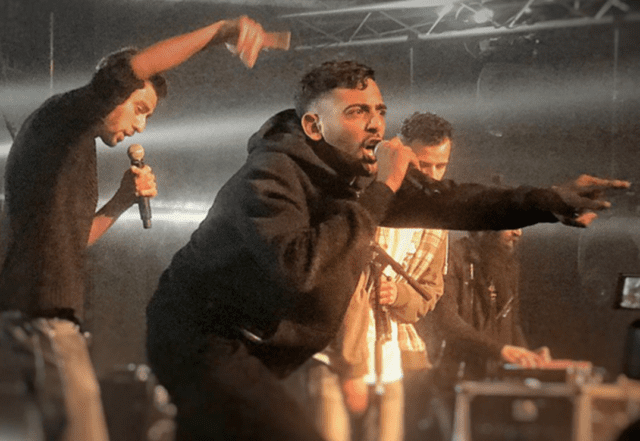
Indian producer/director Pranav Pingle attends Docs for Sale with a self-funded and fully completed 5-part documentary series on Palestine. If you’re looking for a retelling of the country’s tumultuous recent history, then look elsewhere. Pingle’s story chooses to focus on the young, disenfranchised Palestinians who have chosen the path of creativity over conflict as a response to the violent and frenetic world around them.
Over its five episodes the series presents “a collective reimagining of what resistance in the face of aggression can look like,” says Pingle. “Every account I read, every film [or] documentary I saw, anything I heard – it only made me want to learn more about the land and its people. It wasn’t enough to hear and see what other people thought of the conflict or the people that were living through it. I had to form my own opinions.”
In the series we meet Shadi Zaqtan, a Palestinian musician and owner a live music pub in the old city of Ramallah, where they say no to social and class borders. Hamza is a street artist and Nabil is a poet, working in the field of education. Sa’aleek is a group of rappers who voice their story, frustration and hopes through rap and music. Rand Ziad is a ballet dancer living in Jerusalem, studying at a Jewish university, and one the few Palestinians with the freedom to travel, while brothers Ala and Baha are (respectively) an artist who uses recycling material for art and a political tour guide who shows people the real side of Palestine – the difficulties, as well as the difference of how the world perceives it to be.
Director Pingle had always wanted to make a film about the country, and after a chance meeting in a Vietnam airport with a Palestinian who was eventually to become his “fixer,” he hatched a plan to fulfil his dream. His new friend was good on his promise of accommodation, and Pingle ended up staying at his house for 35 days in Palestine with an entire production crew. “What I keep saying is, what Palestine has given me, I will never be able to give back, the amount of kindness, the amount of positivity will always be in my being. There’s a big part of them in me…where we are today in life is because of all the kindness that they showered on us.”
Pingle further explains his upbringing in a household in Hyderabad which was geared strongly towards offering succour to the needy, and which subsequently informed his filmmaking. “I grew up in a space where my father and my grandfather always used to work for the underprivileged – for the poor. They set up hospitals for women whose husbands used to beat them,” he says.
“I’ve seen the kind of work that they’ve done for everyone else, and [they] have always been selfless. So I think that’s a big part of [my] learning and upbringing – to be able to create an impact…It sort of drew me towards telling stories that were pushing boundaries,” he ends.





