As in all her films Peruvian-born Dutch director Honigmann doesn’t waste time, transporting us straight away into her often slightly contrasting but always intimate and delightful worlds.
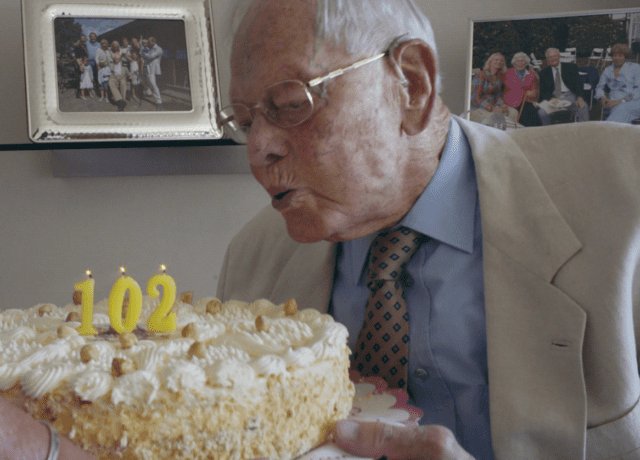
As we hear lyrical music that reminds us of fairy tales, we enter a world of centenarians, people over a hundred years old. In this film, Honigmann is curious about what it is that makes them still get up in the morning, and also how they got so old.
Interlaced with no frills interviews we see in 100 UP the daily lives of seven people with quite extraordinary life stories. Five women and two men, of whom three live in New York. The rest of them live in Los Angeles, Lima, The Hague and Norway.
We meet introvert Laila, the modern thinking sex therapist Shirley and Mathilde who now lives in New York but who fled Austria in 1938 after Hitler arrived. Also in the Big Apple we meet professor and former stand-up comedian Irwin sitting in his comfortable but worn-out chair with his caring son at his side, repeating Honigmanns’ questions. Irwin fondly talks about all kinds of life and wisely considers ‘human life to be a speck on the mosaic of life’.
In Los Angeles we get to know the oldest and most radiant of them all, ex-drummer Viola (1912) who still has discernable star quality. She was born into a musical family consisting of eight sisters, and for whom the continuous exercise of playing the drums (also for two years in the unique 8 Smith Sisters Orchestra) certainly added to her ongoing longevity. In Lima we get to know doctor Raúl with his expressive and melancholic face. Meanwhile in The Hague Hans is obsessed with an enormous issue, namely the future of humanity, all the time working on a website about human rights. However, in another telling scene we see that even he needs a rest from his weighty mission as he falls asleep while reading Yuval Noah Harari’s bestseller ‘Sapiens: A Brief History of Humankind’.
Honigmann, winner of the IDFA Living Legend Award in 2013 and two-time winner of the Golden Calf (Dutch Oscar) has MS and needs to use a walker herself, like most of the subjects in 100UP. She does not want to talk about it much but it is a harsh daily reality for her.
Still, with boundless curiosity and using a direct, yet modest approach towards her subjects, many of her films address how people from all walks of life cope with adversity, tragedy and trauma without losing their spark.
In these works Honigmann creates an atmosphere where anything could happen, but the bottom line is that she is always able to elicit intimate and honest responses. Without losing hope and always looking for life the cracks, often facilitated with music.
This time the stakes are high, as the people selected for inclusion in the film, painstakingly researched by line producer Monique Lesterhuis, are all dancing on the edge of life. (The final credits also mention two researchers for Russia, but for some reason a Russian centenarian never made it in the film.)
For Honigmann, research is a crucial part of making films. “The basis of everything lies there,” she told See NL, published for IDFA. This extensive research seems to be a strength as well as a weakness. Indeed she does find clues as to why some people grow so old. It is their continuing work, passion and curiosity for what happens in the present as well as the future that keeps them going with imperturbable zest. This may suggest why Honigmann herself keeps on keepin’ on; the perfectly rounded narrative is a well disguised, fanned-out portrait of herself. Her film simply chases away the demons by showing tough, inspiring and resilient people who are full of life, never giving up. A perfect counterpoint to a world that seems to become uglier by the day.
This also brings me to the weakness of the research. There are no wrong people in the film, people who contradict what the protagonists in 100UP say. Or at least nobody to tell a different story. Or centenarians who counter the preconceived intentions of the film, creating a welcome friction, or simply a contrast.
In this sense 100UP is telling just part of the story. Where are the old people who are disappointed in life but still get up in the morning? Another fair question is why the film does not include people who are not as educated, artistic or articulate as most of her current subjects. How do poor people and people from vastly different cultural backgrounds cope with life at such an old age?
It is Honigmanns’ choice not to show them, and one can understand and respect this for many reasons. Nevertheless, conflicts, tensions and contradictions are also realities, and are the great forces that make films richer, more layered and more nuanced. In 100UP there certainly is big drama, but it is eloquently told mostly long after the fact, and only by some of the sweet and charming protagonists. The small drama in the film consists of how the centenarians move and talk, sometimes with difficulty, shown with subtlety and great respect by DP Adri Schrover and his team.
Honigmann told See NL that in her next film she might focus on youngsters and what love means to them. Perhaps in that film it is time to leave the safety of a narrative that is too rounded, too sweet and too positive. Even in fairy tales there is darkness, and with good reason – to chase away the worst demons.
Director: Heddy Honigmann
Production: Rogier Kramer, Wilant Boekelman, René Huybrechtse of Dutch Mountain Film
Co-production: Savage Film, Tenk.tv
Cinematography: Adri Schrover
Editing: Jessica de Konin
Sales: CAT&Docs