A fascinating and at times extremely powerful examination into who benefits, and at what cost, from the success of art, Dutch filmmaker Renzo Martens’ provocative new documentary White Cube is a heartfelt film that veers between anger and frustration before ultimately succeeding as a story of an artistic campaign that bears productive fruit.
Set over a period of several years, with Martens himself a central character for chunks of the film, it asks plenty of questions and astutely comes up with some viable answers.
The film was sparked by the experience of screening his earlier film Enjoy Poverty (2009) at the Tate Modern in London. As he discusses in the film, the realisation that multinational giant Unilever was a major art sponsor at the time (the company sponsorship at the Tate ran 12 years, wrapping in 2012) struck a chord with Martens, whose earlier film saw him travelling throughout the Democratic Republic of Congo to question ‘who owns poverty’.
The fact that the Tate exhibitions were sponsored by a multinational with plantations in the Congo determined him to debate the paradox of art works (and to an extent his own documentary) not engaging with poverty and exploitation.
The opening third of the film sees Martens (sporting his signature white shirt) back in the Congo talking with palm oil workers who make a meagre $1 a day. His introduction to the film makes his position clear from the start. As he says: “I’m Renzo Martens…I’m an artist…and I have benefited from inequality and poverty all of my life.”
He talks to plantation workers and sets up an artistic conference deep in the rain forest (replete with a freezer full of soft drinks to help encourage the participation of workers, and a satellite link to academics around the world) but the plantation owners ultimately drive him and his good intentions away, leaving him in tears in one scene. But despite his good intentions the dichotomy of his plans still remain. As one of the impoverished plantation worker’s wives succinctly states: “Give us money to feed us…you leave us like this.”
Martens returns briefly in the second section to Lusanga, Congo, where (in 2014 ) he engages in more practical measures and encourages local people to give vent to their artistic skills. There is a degree of joy and passion as new skills are encouraged, and sees the film head off into a more triumphal final section as Congolese sculptor Matthieu Kilapi Kasiama attends the 2017 New York exhibition of his work, with the New York Times dedicating extensive coverage and rave reviews.
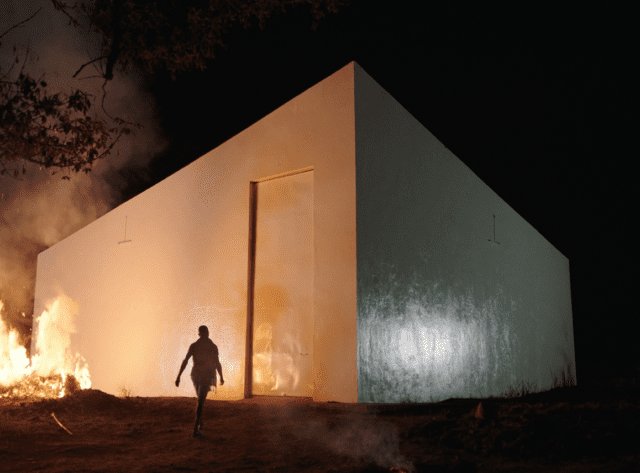
The ‘white cube’ of the title refers to an art space in the Congo, not just a striking visual landmark but also a dedicated place for art and reflection – a location where money from their art is used to buy back the land confiscated from them by Unilever, nurture their plans and hint at a better future. As Kasiama says when he returns from the New York trip and anticipates getting back to sitting down and sculpting: “If you don’t have land, where will you put the chair to start work.”
Astutely Martens features less on screen in these final sections, and lets the skill and passion of the Congolese artists take over from his own well-meaning intentions. Ultimately he has achieved his intentions and has found a way (of sorts) to reverse the flow of wealth.
Director: Renzo Martens
Countries: Netherlands-Belgium-Democratic Republic of Congo, 2020, 78mins
Production: Pieter van Huystee Film, Inti Films
Producer: Pieter van Huystee
Cinematography: Renzo Martens, Dareck Tuba, Hans Bouma, Maarten Kramer, Daan Wallis, Remco Bikkers, Louise van Assche, Eric Vander Borght, Jean Counet, Deschamps Matala, Lisa Perez, Boaz van der Spek
Editor: Boaz van der Spek, Eric Vander Borght, Jos de Putter, Jan de Coster