Directed, shot and edited by María Álvarez, Le temps perdu is the second part of a trilogy about art and ageing that commenced with her first film Las cinéphilas (2017) and will soon be completed by her third film Close.
Where in her previous film six elderly retired women went to the movies almost every day, we are now part of a regular reading group of elderly men and women who meet in the Café Tribunales in Buenos Aires.
Come rain or shine, for nearly twenty years this convivial group has been discussing ‘Remembrance of Things Past’ (À la recherche du temps perdu) by Marcel Proust. Considered by many scholars and critics to be the definitive modern novel, it made a decisive break with 19th-century realist and plot-driven works. The role of memory and involuntary memory is central and throughout the work sensory experiences such as sights, sounds and smells conjure important memories for the narrator.
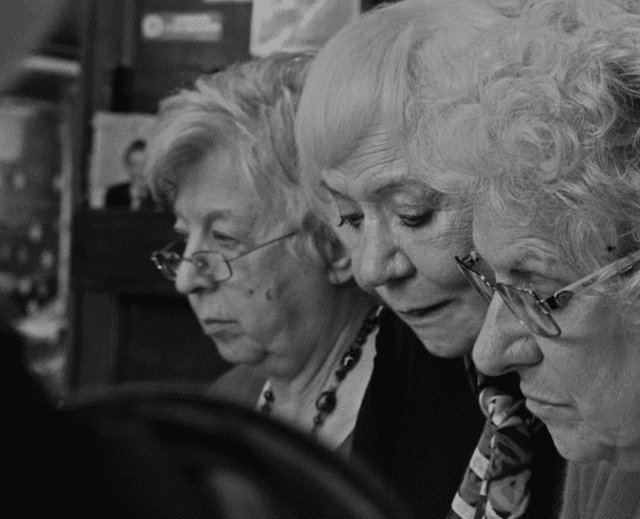
Álvarez’s observational black-and-white film, which itself shies away from a classic narrative three-act structure, intimately documents the intense sessions of the group, intercut with comments, approval, criticism and questions about the work. At the same time we witness informal chatter about hearing aids, hip replacements, ophthalmologists and wandering bags, as well as more serious issues such as chronic illness.
At one point, one of the women insists on starting a second reading group to analyze Dante’s ‘The Divine Comedy’ but to no avail; the group stays loyal to ‘Remembrance of Things Past’. Connected to Proust’s work, the film itself is also a sensory experience; we listen closely to the gravelly voices of people who have lived long lives, and we see faces in close-up that resemble furrowed landscapes. Although one easily falls in love with its protagonists, the humanistic and intimate film, shot in one location between 2015 and 2019, would have been even stronger had it been a little more concise.
At the same time it is a comfort to experience how, for 100 minutes, the ugly world beyond the café hardly enters the film. Although the discrete camera never leaves the interior, the subtle sound design renders the weather outside more tangible. The recurring theme of ‘Syrinx’, a piece of music for solo flute composed by Proust’s contemporary Claude Debussy, gives the viewer time to reflect on the often highly complex passages from the book. It is a film that will likely find receptive audiences at film and literature festivals, as well as entice new readers to check out the source material.
It is mentioned in the film that the act of reading and re-reading is a creative act. Even after five readings, new symmetries, asymmetries and alliterations are found, and ever new discoveries further illuminate Proust’s seminal work. However, the same can be said of cinema, and Le temps perdu will enable academics, literary critics and cinephiles alike to further understand and appreciate a book that will probably never reveal all of its secrets.
Director Maria Alvarez
Production Tirso Diaz-Jares Rueda, Maria Alvarez
Cinematography Maria Alvarez, Tirso Diaz-Jares Rueda
Editor Maria Alvarez
Sound Design Sofía Straface