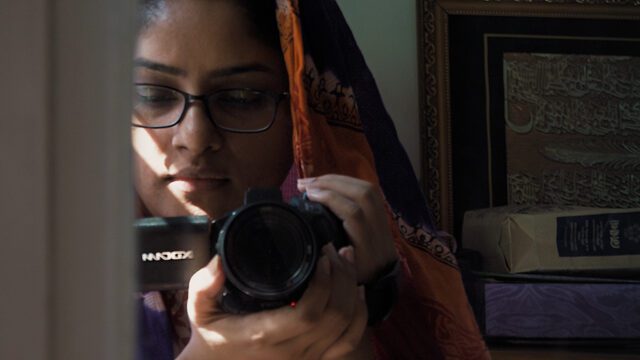
Antipode’s IDFA slate will be spearheaded by two titles, namely Humaira Bilkis’ Things I Could Never Tell My Mother(Best of Fests) and Kirill Nenashev’s Doc for Sales film Ice Under His Feet.
Things I Could Never Tell My Mother revolves around Bilkis’ forced cohabitation with her parents during the pandemic. Her mother used to be an independent-minded woman who defied Bengalese conventions, keeping her own name rather than taking her husband’s. Following a pilgrimage to Mecca, however, she became a devoutly religious Muslim. On the other hand, Bilkis is a free-spirited, secular woman. In her debut, the director draws on old photographs and her mother’s poetry in her search for what connects them, hoping to restore their bond.
Meanwhile, Georgian-German-Czech co-production Ice Under His Feet promises to be “a 20-year chronicle of the gradual loss of various types of freedoms in Russia.” The documentary zooms in on young Masha and Ilya, who organized discussion clubs and protest actions, participated in pickets and give lectures, supported their comrades behind bars and fought for a free, democratic Russia.
Originally based in Moscow, Antipode quickly relocated to Israel following the unfolding of Russia’s invasion of Ukraine. Along with Bilkis and Nenashev’s films, PR & Development manager Anisa Kazakova explained that the sales outlet’s catalogue includes several protest films.
Among these fresh titles is Famine, which she billed as “a grandiose document dedicated to a dreadful tragedy, [namely] the Volga region’s famine of the early 1920s.” “Sadly, the film confirms that nothing has changed within authoritarian states over the last 100 years. Back then, Americans invested a lot of efforts, energy and finances to help Bolshevik Russia to overcome this famine, and today, 100 years later, enthusiastic creators raised money for the film through a crowdfunding platform, while the Russian state prohibits its screening by all means,” she revealed.
The other protest films of Antipode’s slate are A History of An Assignment, (about “the overcoming of the Caribbean crisis” and “the nuclear scare that took place exactly 60 years ago”); Cotton 100% (shedding light on the slave labour in Uzbekistan’s cotton fields); Novaya Gazeta’s doc The Assassination of Anna. Crime Without Punishment (which investigates the murder of journalist Anna Politkovskaya) and an untitled film “about a lone rebel, a political blogger, and a taxi driver from Amursk who fights against the corruption of local authorities.”
“We are very much attracted to films about free spirits. Moving away from social and political topics, in our package we also have films about free people in the arts such as Pepperstein, the Surreality Show, helmed by artist and director Evgeny Mitta and focusing on the internationally renowned artist and writer Pavel Pepperstein, son of painter Viktor Pivovarov.”
Speaking about the current climate for doc sales, Kazakova explained how the pandemic affected demand since at the time “nothing depressing could be sold, only positive and life-affirming films.” Despite the concerns prompted by the war, she highlighted how “the market is now picking up,” seeing an increasing demand for more diverse content.
On the topic of the outfit’s approach to sales, Kazakova disclosed that the team normally looks for “big titles” to world-premiere, and then builds a strategy around them which includes festival screenings to attract local distributors: “We prefer to work with auteur-driven films, colourful ones, capable of presenting their unique perspectives, wherein the principle of ‘a known topic, totally unknown details’ can be applied.”
Antipode’s catalogues hosts 10-16 films each year, and most of these are non-fiction titles. The team regularly attends large events such as Cannes, Berlin and Toronto, as well as smaller industry gatherings such as Baltic Sea Docs and East Doc Platform.
“We would like to see big broadcasters such as ARTE, RTL, RTS, SVT and HRT take an interest in our films. We expect to find new buyers as well. It would be a victory if we finally get to the European TV channels,” she concluded.