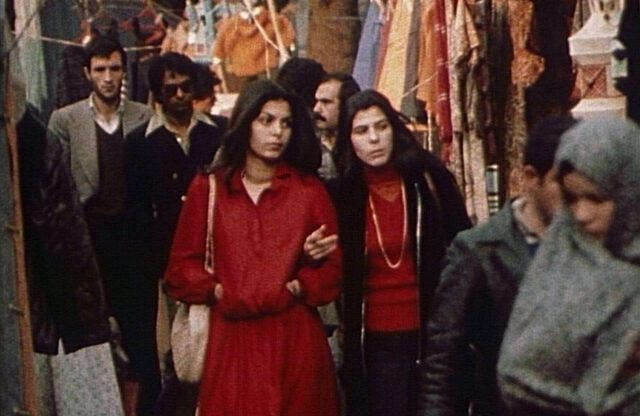
Still: Between Revolutions by Vlad Petri
Based in Prague, the dok.incubator think-tank was launched in 2010 to strengthen the creative doc industry by “bringing new impulses and top-class know-how including the use of the new media and internet platforms to the international community of filmmakers.”
As project director Andrea Prenghyová observes, maintaining the drive and impetus of a project can be taxing for the filmmaking team. As a release date or festival deadline approaches, the pressure only increases, which can have severe effects on the health and quality of the end product.
The initiative grew out of a conversation that Prenghyová had with the then director of DOK Leipzig, Claas Danielsen, when the latter observed how so many more films could have been considered for selection had they not been rushed, if only the filmmakers had more time and guidance to elevate then from the status of ‘good’ to something closer to ‘exceptional.’
“If they [filmmakers] would stay longer in the editing room, if they would support more the overlap of the film, if they would also show something more about the second character,” remembers Prenghyová of the pair’s observations. “We were thinking it was such a pity. They’re searching for the story for so long and at the end of the day they’re in big pressure to finish. They have the deadlines, but they have no money and they also are losing the ‘distance.’ They’re losing this initial energy, and so we wanted to make a workshop which gives them back this first energy and this first passion they have for the film, and to maximize the potential of the material that they have.”
So she launched dok.incubator in 2012 to address these issues, not only from an editing perspective, but in terms of funding and marketing as well. “There are many good films, but we help people to make their films outstanding,” she says. “If they change the mindset, their way of creative process and development, it brings higher quality.”
Four films that received the expert support of dok.incubator personnel are selected for IDFA 2022. In International Competition is Mila Turalić’s Non-Aligned: Scenes from the Labudović Reels (Serbia, France, Croatia, Montenegro, Qatar +world premiere) which explores the never-before-seen footage of Tito’s cameraman documenting his trips to Africa and Asia to promote a third way amidst the Cold War.
“Mila got very, very unique material about Stevan Labudović. And at the same time she wanted to follow the personal life of this man,” points out Prenghyová. At the workshop Turalić assessed, together with the experts in tow, what was “the more important formula,” which resulted in Turalić making two films. The other one, Ciné-Guerrillas: Scenes from the Labudovic Reels, world-premiered at TIFF in October. “Actually Mila is a very clever director,” observes Prenghyová.
In Envision Competition is Efthymia Zymvragaki’s Light Falls Vertical (Spain, Germany, Netherlands), also a world premiere. The film lyrically combines the story of a manipulative perpetrator and Zymvragaki’s own experiences with violence, offering insight into the causes and consequences of abuse.
“Efthymia didn’t know how to approach the story and what to do, and she was not very clear why she’s doing this film,” Prenghyová explains of the workshop’s involvement. “She knew it was because of her past, [so] the workshop supported her to step into the story because also it was very difficult to follow only that man. The film was so dark. So we supported Efthymia to step in as a character into the story and express her position and her story, and to [indicate] the dark side of [the perpetrator]. We have been very much working on the structure and on the way of storytelling… how to build this very difficult character with a very dark background and very dark things. And sometimes Efthymia is also showing very dark things in the film. And how to build it the way that the audience will accept it.”
The other previous dok.incubator films in official IDFA selection are The Pawnshop by Łukasz Kowalski (Poland) and Fragile Memory by Igor Ivanko (Ukraine/Slovakia).
DOK.INCUBATOR 2022 PREVIEW SELECTED PROJECTS, NOVEMBER 12:
- BLIX (CZ, DE, SE). Director: Greta Stocklassa, Editor: Jorge Sánchez Calderón, Producer: Petra Dobešová. Photos in Hans Blix’s apartment reveal that this unassuming Swedish pensioner stood at the epicenter of geopolitical turning points that impacted the politics of today. Twenty years ago, Hans received the most important task of his career. As the UN chief weapons inspector he was sent to Iraq. After three months he presented a final report: his team did not confirm the existence of nuclear weapons in Iraq. The Western leaders decided on military intervention, nevertheless. If he had been able to convince the leaders, could he have prevented the Iraq war that shaped the world we live in? Is doing nothing wrong the same as doing the right thing? In the light of the current geopolitical situation, what can we all learn from his expertise? Hans knows that his time in this world is nearing the end. So, he begins to clean up not only his possessions, but through the intimate dialogue with the young director, his past, too.
- Between Revolutions (RO, HR, IR). Director: Vlad Petri, Editor: Cătălin Cristuțiu, Co-editor: Andrei Gorgan, Producer: Monica Lăzurean-Gorgan, Executive producer: Elena Martin. Two women, former university classmates and friends, one Romanian and one Iranian are writing letters to each other, reflecting on their lives and the events they go through, between two revolutions that changed their lives and societies forever. Maria and Zahra studied medicine in Bucharest in the 1970s. In the summer of 1978, before her final year at university, Zahra went on holiday in Iran and decided not to come back. The revolution there had just started, and she was immediately immersed in the events that followed. Her distance from former friends and colleagues, from the Romanian society that she’d grown to embrace, was bridged by the letters continuously sent by Maria. The film opens just before the 1979 Islamic Revolution in Iran, carries through the Iran-Iraq War, the austere decade of the 1980s and the Romanian revolution of 1989, composed exclusively of archival images, most of them never before seen, mixing personal with official archival materials.
- Who I Am Not (US, DE). Director: Tunde Skovran, Editor: Marianna Rudas, Producer: Andrei Zinca, Co-producer: Patrick Hamm. As a national beauty queen, Sharon Rose Khumalo lives a life most South African young women only dream of, until her secret is revealed: she is intersex. When stigma and gender uncertainty overtake Sharon, Dimakatso Sibidi, a passionate intersex activist, storms into her life, propelling her on a journey to discover for herself what truly makes a woman. Sharon and Dimakatso’s stories emphasize the diversity of human existence, offering a new depiction of womanhood and femininity that speaks to people of all genders. Who I Am Not sheds light on what it feels to be one of the almost 130 million people worldwide born intersex, living in fear of family shame, social stigma, and facing identity struggles in light of pressure to be binary, and “normal”.
- Pure Unknown (IT/CH/SE). Director: Mattia Colombo, Editor: Valentina Cicogna, Producer: Sebastiano Luca Insinga. Co-producer: Amel Soudani. Every year, dozens of “nameless dead” arrive on Cristina’s autopsy table and they would remain without a name if Cristina, medical examiner, and Professor at the University of Milan, hadn’t taken on a battle to push the institutions to find their identity. Finding the identity of an undocumented body requires human resources, logistics, time, and money. But often the so-called Pure Unknown belong to the fringes of society and to the most fragile categories of citizens, such as the homeless, prostitutes or illegal immigrants. For this reason, prosecutors and politicians don’t do everything in their power to return those remains to families that, somewhere in the world, are looking for their disappeared loved ones. Cristina’s battle, at times visionary at the point of resulting hopelessness, will lead her to the doorstep of the European Parliament, to ask a simple yet complex question: “Who do we want to be?”
- My Missing Aunt (KR). Director: Juyeon Yang, Editor: Duhyun Ko, Producer: Sarah Kang, Producer: Duhyun Ko. The night before the college graduation, Juyeon, the director, receives a call from her dad, drunk. That day, she discovers for the first time that her dad had a sister who had committed suicide. Juyeon asks for her aunt’s name, but her dad only repeats, “don’t become like her.” Juyeon spots traces of her aunt from an old album her grandmother kept. After meeting with her aunt’s friends, Juyeon believes that the testimony that her aunt killed herself is no longer reliable.
- Man of Marble (PL). Director: Szymon Kuriata, Editor: Michał Poddębniak, Co-editor: Patrycja Piróg, Producer: Aneta Zagórska. Magda and Remik got connected by adolescent love, then blown over by adulthood. We meet them when their son Franek is four years old. Remik trifles all days away enjoying beer while Magda gets more and more frustrated being the only one who does all the daycare responsibilities. She threatens to sue Remik for child support. This prompts the man to set up the YouTube channel called “Man of Marble”. He intends to build houses at hyper speed thus making heaps of money. He quits drinking too. They seem to be a happy family for a while, but then the old habits kick in again. After repeating disappointments, Magda moves with her son to another place. Remik is left with nothing but perhaps the ambitious plan of reviving the channel – so that one day Franek can see that his dad is somebody.
- The final project presented during the November 12 workshop is Efthymia Zymvragaki’s Light Falls Vertical (Spain, Germany, Netherlands), as mentioned above.