It’s Saturday lunchtime in Amsterdam and Sergei Loznitsa, a very regular visitor to IDFA, is preparing for the world premiere of his latest film, Mr Landsbergis, a world premiere in the festival’s international competition. In a few moments snatched away from his lunch break, the ever busy Loznitsa gives the story behind the new doc.
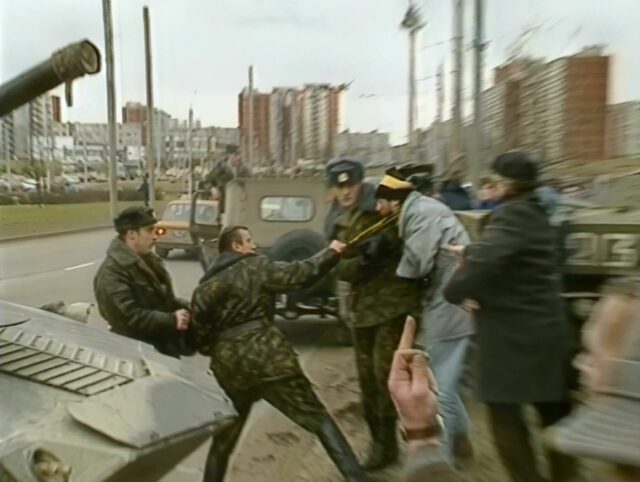
The film looks at the independence struggles in Lithuania in the late 1980s and early 1990s when inspirational leader, Vytautas Landsbergis, guided the country toward its freedom from under the yoke of Soviet Russia.
As ever, this is one of just many projects that the Ukrainian director has on the boil. Another of his films, Babi Yar. Context, which premiered in Cannes, has been screening in IDFA’s Masters section.
“He doesn’t eat, he doesn’t sleep, he doesn’t have holidays – he just works!” Maria Choustova, his producer and partner in company Atom & Void, says in admiration, and perhaps exasperation, of the tireless filmmaker.
Loznitsa’s films are invariably made with Dutch support – one reason why he is a regular visitor to festivals like IDFA and Rotterdam.
The decision to make Mr Landsbergis was taken in March 2020. “Why? I think it is a very important subject,” Loznitsa reflects on what spurred him to make a four-hour epic about a seismic moment not just in Lithuanian politics but in the political history of the Baltic states. “We still do not know what exactly happened in 1991.”
In the new documentary, Loznitsa is returning to a period he also covered in his 2015 film The Event, about the period in Russia in the early 1990s when President Gorbachev was almost toppled in a coup. The difference here is that Mr Landsbergis gives the point of view from outside Russia.
“Landsbergis’ case is quite unique because there are very few instances in history when the politicians who come to power fulfil their promises,” the director says of his subject. “Landsbergis is just this case because he promised to take his country out of the Soviet Union and he delivered on his promise. Even more than that, the three Baltic Republics are the only three countries in the post-Soviet area whose independence is genuine.”
What made the politician’s achievement all the more remarkable was that Lithuania secured its freedom without major bloodshed.
“This film can also be seen as a kind of lesson on how to achieve independence in an efficient and proper way,” the director says, joking that other countries looking to break away from colonial overlords will find useful tips here.
Loznitsa himself first became aware of Landsbergis in 1988. At the time, the Lithuanian leader was “one of the brightest stars” in the Soviet political firmament. They actually met face to face for the first time only four or five years ago. “I was so impressed by his knowledge, his rhetoric and his charisma. I was very surprised nobody had ever made a film about him.”
The central interview with Landsbergis took place over 15 days but was like “an informal chat.” The two men had a perfect rapport.
Landsbergis is the hero of the story. Almost everybody admires him, other than those old hammer and sickle die-hards who wanted to preserve the old Soviet Union and who miss the era of collective farms. However, Gorbachev doesn’t come out at all well in the new film. The former Soviet leader has been the subject of admiring recent documentaries from both Werner Herzog and Vitaly Mansky but it’s clear Loznitsa doesn’t see him as any kind of hero.
“The killings were also his responsibility. As far as Lithuanians are concerned, Gorbachev is a killer.”
As for the length of the new film, around four hours, Loznista isn’t making any apologies on that score. “I have a charismatic hero and it is very interesting to listen to him speak…in fact, the rough cut was much longer! I don’t think I could have compressed it any further. When you watch it, time flies! It [the film] is like a whirlpool that grabs you in.”
This article was originally written for See NL, published by Eye International and the Netherlands film Fund.