

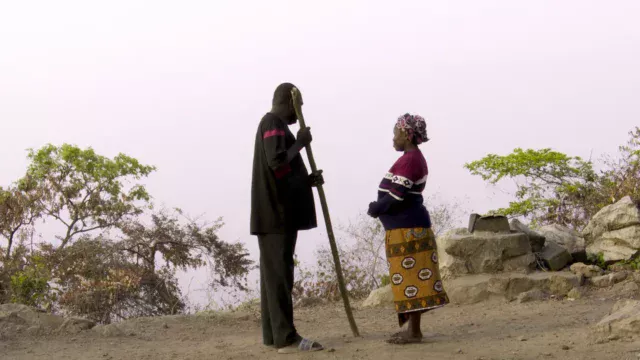
Rodrigue and Reine live with their three children in Bangui, Central African Republic. They make their living from their yield of cassava flour and are very active in the local church, where the battle between God and Satan is waged at a fundamental level, and where belief in evil spirits, curses and witchcraft is commonplace.
However, the couple lives with a big secret: they both have AIDS. This is the premise of Elvis Sabin Ngaibino’s sophomore feature The Burden, a world-premiere in International Competition at IDFA. BDE spoke to the director at the start of the festival, delving into the reasons why he decided to commit to this project and the challenges he managed to overcome along the way. His answers were in Frenck, and they are translated into English for this interview.
When asked to describe the origins of The Burden, the director tells BDE: “[I was brought to make this film by] God and the disease in Africa, and the idea of making a film on this subject has been in my thoughts for quite a long time. I live in a very religious country. Personally, I’m a fervent Catholic, but this doesn’t impede me from keeping an eye on the rites of Protestant churches, which [are] very peculiar.”
“Within these churches, women, men, young and older people are dedicated to the cult of prosperity,” Ngaibino continues. “This led them to fast for days or to embark on a quest for divine healing. Despite some exaggerations, they were armed with faith and devotion. I followed them from a spiritual point of view, as well as a cinematographic one.”
The documentary allowed Sabin Ngaibino to explore in depth the situation of AIDS patients, who are suffering stigma as a result of their disease. Talking about how he gained trust from the two protagonists, the director explained that Rodrigue is actually his cousin. “He revealed his disease many years ago without telling me why he did so, asking me not to tell anyone about his secret. […] He was the very first person I rang to find an HIV-positive person in his church who was seeking divine healing and who would agree to let me film them. His answer surprised me. [He said:] ‘Why not my wife and I?’ During these years of silence, Rodrigue and Reine had perhaps found me trustworthy.
Sabin Ngaibino admits he had to face significant human and ethical dilemmas in making his film. “For example, two relatives who were aware of the couple’s condition did not want the film to be made. For them, revealing the couple’s illness in broad daylight would mean that shame would fall upon the entire family, singling them out as a family of AIDS carriers. One [of them] went so far as to accuse them of ‘selling’ themselves.”
“It’s not easy or nice to film someone very sick in their bed, especially in Africa. ‘How could he keep on [filming] someone so sick?’ their close relatives murmured, and interpreted this in other ways [such as being] witchcraft or black magic. I was harmed by their interpretations, but I always knew how to move ahead, especially because I got the couple’s permission [to do so].”
The picture is co-produced with partners from France, Germany, the Democratic Republic of Congo and Italy. Commenting on the co-production experience, Ngaibino adds: “That happened thanks to my first feature, Makongo, which was well received by many festivals and won many awards. It’s a project that opened many doors. It was also made possible thanks to the collaboration with my old teachers, who became my partners.”
Touching on the distribution plans for the film,Ngaibino says: “The AIDS virus has wreaked too much havoc in Africa and it continues to do so. Among all the continents, Africa has paid the heaviest price. Therefore, I think it’s vital to present it in my country and at African festivals. I am thinking in particular of [screening it at] FESPACO, which is one of the largest showcases of African cinema.”
A passionate filmmaker and one of the few directors active and trained in the country, Sabin Ngaibino first studied geology before embarking on filmmaking in 2012 through the creation of the Académie du Cinéma Centrafricain, set up with some of his friends. The idea at the core was to create an association for “a passion that was almost non-existent” within the country’s borders.
In 2017, the Ateliers Varan kicked off a training programme in Bangui, and Ngaibino was one of the ten applicants invited to take part in the initiative. It was a turning point in his career as he felt at the age of 30 this was his last chance to be a filmmaker.
The director discloses the subject of his next endeavour: “I am tackling [the topic of] Western policy in Africa, and in particular Françafrique. It’s a theme that is close to my heart and which would cause a lot of ink to be spilled. I will address the subject that dominates Africa’s current affairs. In other words, [I will focus on] the anti-French sentiment in French-speaking Africa, and the anti-Western sentiment in contrast with Russian influence in Africa.”
“My country, the Central African Republic, is one of the rare French-speaking countries where there is the presence of Russian mercenaries from the Wagner militia, and also one of the few where anti-Western sentiment is increasingly outspoken. The battle for a new world order is being played out on our continent. I believe it’s important, also in historical terms, to talk about what’s happening.”





