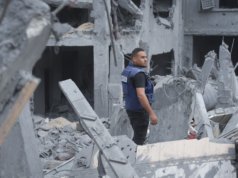
It is impossible to watch Life Is Beautiful, the second feature-length documentary of Palestinian filmmaker Mohamed Jabaly, presented in International Competition at IDFA, without relating it to the current war in Gaza.
Indeed, Jabaly himself does so in the press notes. He also stresses however, that he didn’t want to make a film about war. Instead, he includes scenes of how beautiful life can be in Gaza, with his family, on the beach, with his friends. Jabaly clearly loves Gaza, and for most of the documentary, there’s nothing he’d rather do more than return there.
But he wasn’t able to. In 2014, Jabaly was invited to the Norwegian city of Tromsø, situated above the Arctic Circle, after having met the head of the Nordic Youth Film Festival, Hermann Greuel, in Gaza. Tromsø and Gaza are twin cities, and Jabaly was granted a one-month visa to become, as he quips, “an Arctic Arab”, finding himself trudging through the Norwegian snow in sub-zero conditions. The contrast with sunny, sandy Gaza is so stark as to be comical.
And then the Rafah Border Crossing between Palestine and Egypt, the only one Jabaly is allowed to use, is closed indefinitely. Jabaly is stuck in Norway.
When we hear the words ‘Rafah Border Crossing’ today, we inevitably think of the current border crises, where news about the possibility of crossing – for Palestinians, for foreigners – changes daily and is the subject of major geopolitical concerns. In this way, the documentary reaches into the future, linking Jabaly’s worries at the time with today’s tense situation. But it also pulls the present back into the past. Because the current war didn’t happen in a vacuum, and every similarity between Life Is Beautiful and today’s headlines is a reminder that Gaza has been ‘the world’s largest open-air prison’, as it has often been called, for a long time.
This is also reflected in Jabaly’s first feature-length documentary, Ambulance (2016), which he began editing while stranded in Tromsø and which is based on footage he shot as an ambulance volunteer during an earlier period during the 2014 Gaza War. This documentary toured the festival circuit – even IDFA, where it screened in 2016, makes a brief appearance in Life Is Beautiful – and won numerous awards, including the One World Media Award for Best Feature Documentary at BAFTA in 2017.
And yet, although one could be forgiven for thinking otherwise, the title Life Is Beautiful is not ironic. Jabaly means it sincerely, despite all the hardships he has had to endure, especially missing his family, whom he does not get to hug for seven years. ‘My motto has always been life is beautiful’, he writes in the press notes. ‘It’s how I typically conclude my conversations and move forward, striving to see the light at the end of the tunnel. It is crucial for me to find that light, as it’s a way to stay positive in everything I do. I wish to see that light. I wish to persist in seeking hope, even amidst the current adversity.’
Somehow, even though minutes earlier we could see his despair and depression in the diary footage that forms the core of this documentary, Jabaly always manages to find his smile again. An infectious smile that also cheers and motivates those around him. Managing to make this documentary itself smile, and creating what might be the most unexpected feel-good film of this festival – without ignoring or diminishing the adversities he and especially the people of Gaza are facing.
Because whatever happens, Jabaly manages to make friends and find people willing to do their best to help him when Norway – a country which does not officially recognise Palestine and therefore considers him ‘stateless’ – refuses to renew his visa. It is truly heart-warming to see how much support and warmth the freezing city of Tromsø can offer this exiled Palestinian filmmaker. Although, to be fair, it also shows how much effort it takes from so many different people to help just one single immigrant. It takes a village to save an immigrant, has to be the cynical conclusion, given the legal and bureaucratic barriers that Western politics has erected. Even when, as in Jabaly’s case, the migrant has no intention of staying indefinitely, does not want to apply for asylum – contrary to the advice of many – because he does not want to lose his Palestinian identity, and simply has nowhere to return to as long as the borders remain closed.
Perhaps it is seeing how much love Jabaly has for Gaza which is ultimately the film’s greatest contribution to the heated debates the current war in the region has provoked worldwide, even this week in Amsterdam. So we can see, and feel, and be reminded that this conflict is not only about statehood, border crossings and enmity. It is about home.
Norway, Palestine, 2023, 90 minutes
Director Mohamed Jabaly
Production Stray Dog Productions AS
Producers KriStine Skaret and Sarah Winge-Sørensen
International sales First Hand Films
Cinematography Mohamed Jabaly
Editing Erland Edenholm and Anne Fabini
Sound design Anna Nilsson
Music Gaute Barlindhaug
With Mohamed Jabaly, Hermann Greuel, Martha Otte, Elsa Sundsvold