

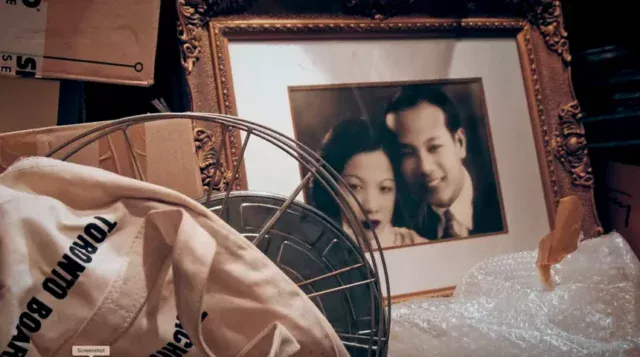
Debut docmaker Mary Stephen’s Palimpsest: The Story of a Name, which enjoys its international premiere November 17 in Amsterdam, draws on family secrets and outstanding archive footage to pose the universal question, what’s in a name?
‘When you see [the words] Mary Stephen on paper, you don’t expect to see me,’ says director Stephen, born in Hong-Kong to Hong-Kong Chinese parents, but raised in Montreal as a Canadian citizen.
Her film is, as the film notes elucidate, a delicate, fragmented mosaic meditation on reinvention, on the yearning to rewrite one’s story, and on the universal human impulse to fictionalise the self.
Stephen found decades worth of diaries, and a treasure-trove of 8 and 16mm film, carefully preserved and archived by her father, documenting a growing family through the 50s and early 60s – their picnics, work and holidays in beautifully digitised technicolour, an echo from the past brought vividly to life in Stephen’s film. The fabulous home footage is augmented by material from the Hong Kong film archives and private collections, notably that of Michael Rogge, a Dutch banker who kept meticulous archives from his time in Hong Kong in the fifties.
The film begins with the story that her father told her of his origins, of how he was born in Australia to Aborigine-Chinese parents. Starting with this wild premise, we are taken through a tangled web of familial links and obfuscations against a wider social backdrop of colonial Hong Kong, the Japanese occupation, through the 50s and into the 60s, and eventually to Montreal.
It is a very personal story, but one which speaks to all of us, to reflections on how the vagaries of fate and circumstance, and the lived experiences of previous generations, lead to our current state of being.
The director is at pains to emphasise that her motivations are far beyond her own story, however. The synopsis underlines how ‘Mary Stephen embarks on a personal investigation into her English surname—not to indulge in a narcissistic exploration, but rather to uncover the dissonances, the contradictions in our heritage that, in spite of our all-too human desire for harmony and continuity, are the fundamental elements that shape us. It is in this spirit that this intimate journey unfolds.’
‘Drawing from her father’s home movies, family photographs, her own travel footage, fragments of oral history, and official archives, Stephen constructs a layered, polyphonic narrative where personal memory and collective history converge,’ the synopsis further underlines.
As an editor who worked for decades with Nouvelle Vague filmmaker Eric Rohmer, this is a rare foray into directing for Stephen. How does her experience as an editor, therefore, inform her directing?
For Stephen, the story only emerges with the finished film, she tells BDE. “The real structure of the story really comes out when I’m editing, so that confirms that editing is my calling. That really is the guiding approach to this film. I kept saying to people that [the story] will come when I’m editing it. Try and convince an unknown funder with that! Luckily, we had ARTE come on board very early.”
It also became clear early on in the editing process that applying her own editing skills alone were not going to work in this context. “I’ve always advised young editors and young filmmakers not to edit their own film. And of course, I was, doing exactly that… I was not only editing my own film, but it was a film about my own family. So really, there was a big problem about distance.”
It was time, she realised, to find a fresh pair of eyes. She knew she wanted a female editor, and ideally someone who was not from her own culture, but someone who understood what it was to be an exile or an immigrant. She found Chaghig Arzoumanian, of Lebanese and Armenian origin, who is also a filmmaker interested in similar themes, to work with her as a consulting editor.
And so, the story unfolds with its myriad, and surprising, twists and turns, of her parents’ rise to prosperity and status against a backdrop of the social, and the political history of Hong Kong. What emerges is an essay on the Hong-Kong Chinese relationship with colonial powers, on how a name can influence your trajectory through life in a world of prejudice and power-play, on the story of the immigrant, and on her parents’ dreams and determination to make a better life for themselves.
The film draws parallels, too, between Mary Stephen and her sister, and two famous British Stephen sisters – Virginia and Vanessa – who went on to become Virginia Woolf and Vanessa Bell. Vanessa’s son Julian spent three years in China and this discovery was a major motivator for Stephen.
“My own project of Palimpsest was in my mind almost two decades ago when a writer friend told me about Virginia Woolf’s maiden name of Stephen, and I started reading about the Julian Bell story in Wuhan, and finding out the missing dots that connect the two Stephen stories in China.”
This strand of the film asks probing questions about the Hong Kong-Chinese relationship with the British, but ultimately, Stephen tells BDE, the film ended up being a much more personal one that the one she’d imagined when she initially set out.
“At first, I went through a whole, very long editing time… more than a year and a half, and it took me a long time because the first version was much more distant and much more academic. There were a lot of quotes from different books and films, and it was in chapters.
“Gradually, with the help of the consulting and commissioning editors, I was encouraged to trust my own story.”
The feature doc, which premiered at TIFF, has been enthusiastically received by the Chinese diaspora in Canada who, Stephen explains, were thrilled to see old footage of Hong Kong, and to reflect on the questions of where is home, what is identity?
But she was also concerned with how her film would resonate with wider audiences. “That answer came from within France, actually,” says Stephen. “I have three children and my daughter, who’s in the film, showed it to her closest friends who are mainly from an immigration background, from Maghrébin [communities] or from Africa. They reacted very strongly… somebody said, you know it’s like my grandmother…and so they really saw part of their own history in it, and that that really makes me very happy.”





