

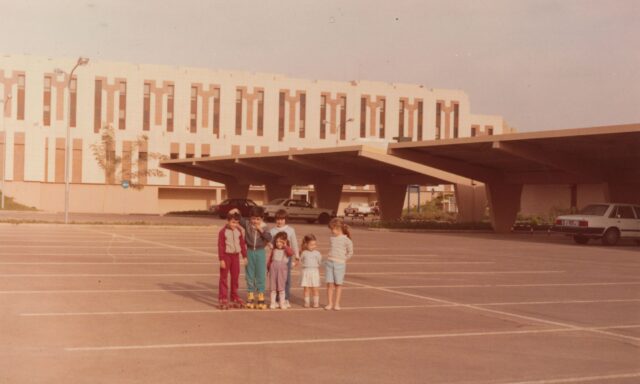
Do You Love Me is Lana Daher’s personal journey through the fractured historical, social, cultural, and political landscapes of Beirut. Using mainly archive footage, the film weaves together the past and the present in a quest to better understand Lebanon’s history and current status. Business Doc Europe sat down with the helmer, who presented her doc project at this year’s IDFA.
“I’ve been in Beirut for the last two months since this war started, and as hard as it has been to be there, it’s so difficult for me to be away. When I first started working on this project in 2018, it was motivated by a strange feeling that I had living in Beirut,” Daher tells BDE. “There was no actual war then, but I had a strong sense of unease most of the time. I was born in the 1980s during the Lebanese civil war, and I can sadly confirm that I have experienced more war than peace in my lifetime.”
“In the first years of working on this [project], I felt that, as a nation, we were very much in denial of our past and the internal fragmentation between us, and that if we did not acknowledge it, we would eventually pay the price. In Lebanon, we don’t have any updated history books in our school curriculum. They stop in 1948 because it’s impossible for us to agree over what happened since. So I found myself searching for this history in other places.”
Then Daher began “encountering voices and stories in cinema, music, and art” that not only raised the same questions she had but sometimes even provided answers. She describes her doc as a tribute to cultural heroes—filmmakers, journalists, musicians, and writers—who play a crucial role in preservation and education, especially when other institutions fail.
She notes that the filmmaking process has been a way of regaining memory, and not necessarily her own but a broader collective one.
Do You Love Me promises to be an archive-based documentary giving insight into the psyche and experiences of different generations living in Lebanon, more specifically Beirut, from the 1970s until today. Through the film, the viewer follows fictional and real characters from a range of mixed media, mainly sourced from Lebanese documentaries and fiction films, as well as some journalistic archives, TV, photographs, and home videos.
“The film’s rhythm organically mirrors the experience of living in Lebanon; an oscillation between times of war and disillusioned moments of calm,” adds Daher. “Featuring the stories, anecdotes, songs, and culture of the people who remain in Lebanon through the years, we begin to see and understand this society’s foundations, collective memory, dynamics, and psyche.”
“The narrative thread is not focused or structured on specific political and historical events but on the psychological and societal effects of these events, covering themes of violence, memory, trauma, identity, and home. Rather than recounting a more traditional history, the film attempts to portray an emotional ethnography of the Lebanese people in a country unable to agree on its own past, present, or future.”
Zooming in on her expectations and the doc’s participation at IDFA, Daher discloses: “It’s a very special moment for us because we’re opening the project to the market while being very close to the end of the editing, which has been quite a fascinating and challenging journey. First and foremost, we’re very much looking forward to feedback. On the production level, we’re looking for gap-financing partners, a world sales agent, and interested festivals.”
The last editing session, carried out with editor Qutaiba Barhamji (who also serves as a co-writer) will take place in January–February 2025. Post-production was supposed to be carried out in Beirut, but given the current situation, it was moved to France. “We still plan to finish the film by spring/summer 2025. The budget is about €550,000, and we have a gap of about €70,000,” Daher highlights.
Barhamji’s contribution will be crucial to the completion of this project, Daher says. “He might be one of the best documentary editors at the moment. Among other films, he edited Four Daughters, Little Palestine and How to Save a Dead Friend. Qutaiba is an amazing talent and a brilliant mind, and his connection to Lana and the project has been very productive, especially because he’s very keen on [working with] archive footage and [taking on] editing challenges.”
Do You Love Me is produced by Daher for the Lebanese My Little Films, and co-produced by Jean-Laurent Csinidis for France’s Films de Force Majeure.





