Prolific Icelandic filmmakers Anní Olafsdottir (IDFAcademy 2020) and Andri Snær Magnason brief BDE on their current, highly pertinent, creative docs whose content and production have been either informed or affected by lockdown.
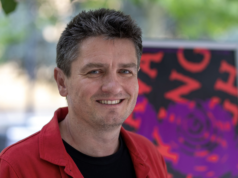
“Högni Egilsson is one of the biggest, most flamboyant characters on the Icelandic cultural scene. When we met Anna Tara and her ten elephants, suddenly we knew we had the character who could match him in the film,” is director Andri Snær Magnason’s understated opener to our discussion on the intriguingly titled The Hero’s Journey to the Third Pole: A Bipolar Musical Documentary With Elephants.
You could be forgiven for thinking that the film’s title tells the whole story, but that is far from the case. The doc is in equal parts road movie, cri du coeur, an examination of the mind and its dark recesses, and a putting-on-a-show extravaganza, starring Icelandic rock star Högni and Anna Tara, daughter of a latter-day Livingstone, whose exotic past saw her grow up in both Iceland and Nepal.
What unites the pair is their bipolarism, and Anna Tara’s desire to arrange a concert to raise awareness of mental health issues in Nepal, where suicide is a leading cause of death. Högni, decked out in a white suit like a bona fide rock god, brandishing his electric guitar, is her headline act.
En route, both tell of their, at times, tortured lives. For the highly expressive Högni, anything is possible when he is on a polar high, at which point insufferable ego begins to take over, he explains, before an inevitable plunge into depression. For Anna Tara, who for much of the film is reluctant to divulge personal details, a manic attack was always devastating, at least before she determined to seek medical help.
“We just went with the feeling, and we took each element as it came, as a contrast, each scene leading us to the next,” co-director Anní Olafsdottir explains of the film’s free-flowing, colourful and very cinematic progression and transitions. “We decided from the beginning that we wanted the film to reflect how we shot it, and also to reflect the bipolarism, the mania. We wanted to have that structure, for it to go high up and then way down.”
The mythical aspect of the tale is explained by Magnason, who is also a children’s book and fantasy author (and whose novel On Time and Water is coming out in 27 languages). “They have very different types of manic episodes, but both of them feel like they are on some kind of a quest, they have to reach some goal and feel like they are heroes in a bigger story during the height of mania. Högni referred often to the hero’s journey and, by coincidence, our story played out almost entirely according to that model.”
The film was selected for RIFF 2020 and played for a weekend in Iceland just before the cinemas closed. The directors are hopeful of high exposure at international festivals in 2021.
They are also in post-production, with completion expected December 2020, on their lockdown project Apausalypse, in which they asked great minds to grapple with the philosophical and cultural implications of COVID. As one character in the film stresses of the new reality and what it means both for humanity and the planet: “Are we going to use this opportunity of having found the ‘pause’ button?”
“Apocalypse does not mean end of the world but to uncover something, and the pandemic uncovers so much,” explains Olafsdottir. “So we spoke to writers, poets, philosophers, during the height of the COVID virus if they felt these times had a deeper meaning. We wanted to capture the moment, while everything was uncertain. What will it do to economic thinking? What does it prove we can do for global warming? What does a mentally ill poet say about isolation and loneliness?”
The film also offered up the empty spaces of Iceland for artists to fill with their creativity. “So one dancer is dancing through the [empty] airport, dancing on the runway where nobody has ever danced before,” says Magnason. “Also the airport staff, they were so helpful, they had never stepped onto it themselves, and suddenly we were all dancing there on this international airport runway.”
Concludes Olafsdottir of the pair’s surge of creativity during 2020: “It was tempting to prove that art and filmmaking was possible, during times when almost all projects in the world were cancelled. All creativity is shaped or limited by outer forces. It can be finance, talent, religion, law, resources, technology, so we thought, this virus is not an obstacle, it is an outer force that takes part in shaping what we make.”