

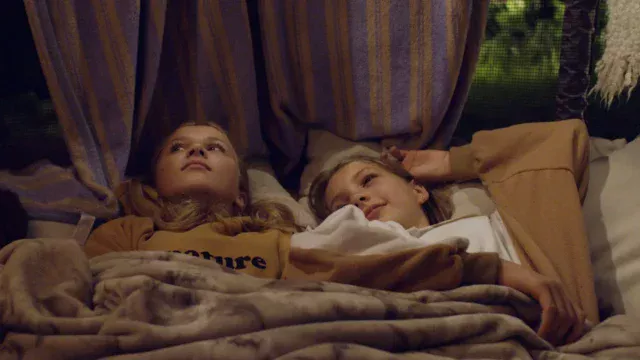
In Aga Borzym’s charming debut documentary feature, produced by Pinot Films, we witness one year in the life of two young Polish girls, Jagoda (11) and Zuzia (13), who are neighbours and best friends.
They perform, play, dance, sing, go clothes shopping, interview embarrassed adults and giggle their way through a series of home and school-based tableaux. They also articulate the thoughts ruminating around their heads on myriad subjects, such as periods, breasts (and bras), love, dating and, at school, women’s rights.
Funny examples of the girls’ wisdom abound, “Love is cool until you date somebody,” says Jagoda. “I used to think you get your period only once and that’s it. It turns out that’s only the beginning – a warm-up!” observes Zuzia.
Director Borzym thought long and hard about the story she wanted to tell – and how. “In the beginning, a lot of people were like, are you crazy? What do you want to show? And what do you want to talk about? And I thought, yes, these subjects are very fragile. And it’s a taboo in Poland.” So she contemplated telling the story in animation. Luckily, she attended a workshop populated by documentary makers who underlined that in an important and entertaining youth doc like this, “they want to see people, they want to see faces.”
So Borzym commenced a search for subjects, girls whose young lives she could chronicle in doc. She didn’t have to look too far for her first subject. She knew Jagoda from birth, being a friend of the girl’s mother. “I knew her from when she was born, and she knew me and she felt quite safe. Maybe it was also this age that she was really joyful. She really liked it when we were there with the camera. She really enjoyed it. She was excited. At the start it was quite easy, and she was very open. I didn’t push her to any subject,” says the director. When it came to finding a second protagonist, Jagoda’s next door neighbour Zuzia also happened to be her best pal…
The film has a delicious sense of joy and lightness, which Borzym refers to as a “freedom.”
“With Zuzia, I was just looking more for the places we could go and talk. I had notes, which subjects we could discuss. And I was looking for what’s going on there, what they are talking about now. Sometimes we did sleepovers, we would just meet at Zuzia’s place or Jagoda’s place. And of course, a lot of time we met in the playground. We did some walks in the neighbourhood, going for ice cream.”
“I was looking for situations. It could be that something could happen, Jagoda with her friends, with boys. I knew that they spent time with another girl, whom we don’t see a lot in the film. I knew that they were doing this stuff, more doing, not talking, stuff like skateboarding, going to the river…it’s very connected to this moment of life,” Borzym adds.
That said. the film isn’t all live-action. When a bit of cinematic punctuation is required to underline a point, then Borzym arranges for some clay animation accompaniment, whether to depict an ice cream, a squashed tomato, a cabbage or a skirt.
“The initial idea was that the animations would serve as metaphors and sometimes lighten the subject,” says director Borzym. “They could also address topics that were challenging to discuss directly, like changes in the body. At times, they would convey emotions. It was more about conveying feelings than telling a story.”
By her own admission, the director is something of a multi-hyphenate. She is, she says, “a director (once), animator (in-between), editor (usually), mother (by choice), engineer (by accident), and girl (from the beginning).”
She explains more. “I wrote [that] as a joke, but it’s true. The ‘directing’ is the first time I’m doing this in this project. I’ve been an editor for a long, long time, but I was editing shorter things. But my dream was to edit a documentary movie because I thought the editor has a lot to say in the creative process.”
The director underlines that her feature debut differs from most other Polish documentaries which “like to show really tough topics.”
“I came across this documentary, I was really interested in it. And for a Polish person, it was something really new, because we don’t have such films. It’s not so [usual] to have a documentary where the protagonists are kids.”
The questions for this interview were posed by Dimitra Kouzi.





