I have a confession to make: I don’t remember seeing any of Ömer Kavur’s films. Not his Gece Yolculuğu, his first film to be selected for the Cannes film festival, in 1988. Nor his Anayurt Oteli, which won the Fipresci price in Venice one year earlier. Nor any of his twelve other features.
So if Fırat Özeler’s Kavur, selected for Rotterdam’s Cinema Regained section would have been anything like a traditional biopic of the late director (1944-2005), who was one of the most internationally esteemed Turkish filmmakers of his generation, I would probably not have been part of its target audience.
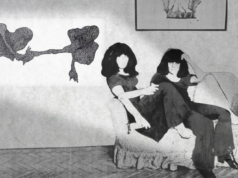
Luckily for me, Kavur is no such thing. For example, as far as I could tell, no clips are shown of his films. Also, we don’t see Kavur being interviewed, receiving any awards or walking through Istanbul, Cannes or Venice. There are only a handful of behind-the-scenes images, showing Kavur at work, which have been recontextualised in quite a different way than usual.
Because this is quite a different director’s portrait. And I enjoyed it immensely.
In a sense, you could argue it’s not really a portrait of the director as a director at all. Yes, his ideas about work play an important role, but not the technical, stylistic or thematic aspects of it. And not really in relation to specific films. Indeed, you could also argue Ömer Kavur isn’t even the main character in the documentary that carries his name. That would be the person who in the credits is only named ‘Woman’ and of whom we only get to hear the voice. She is the one guiding us through the film. Her existential questions, musings, and doubts are what move us along.
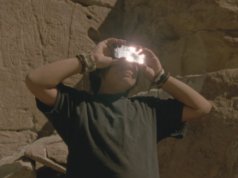
That and the gorgeous widescreen photography, by director Özeler himself, and the immersive sound design by Taylan Geçit and Yalın Özgencil, accompanied by a calm and catchy guitar theme by Başar Ünder. They create the background which, in many ways, is foregrounded in this film. Because as we don’t see but only hear the Woman, and as we hardly ever see Kavur talk but hear his words constantly, almost all the storytelling is delivered through the soundtrack. At the same time, while we’re listening, we are seeing these wonderful, almost timeless shots of mountainous areas in the snow, forests from a passing train, lonely city streets at night.
There are very few people in these shots. There are some short interview segments inserted – with an ex-lover of Kavur’s, with a best friend of yesteryear – and there are shots of Kavur’s notes, old photographs, black-and-white archive material of Istanbul (especially the demolition of anything old to make way for the new), unrealised scripts and even an old 16mm short, which had been presumed lost. The weaving sound design – full of drawn-out musical tones, waves of semi-conscious noise and sounds of birds and weather so subtly integrated that more than once I thought they were real, part of my world, not the film’s – does much to let these seemingly more factual and time-specific elements sink into the general current of timeless melancholia.
Because it is melancholia, not a dream state, that is called forth within Kavur. There is much talk of dreams, with all their connotations – from the dreams we have when we are sleeping via the aspirational dreams of careers and art, to the unattainable ideals that both motivate and frustrate us in everyday life. So this impression, that Özeler wanted to create a dreamlike documentary, does present itself at first. But the longer Kavur continues, the less like a dream it feels. Its exquisite framing puts the timeless images on a pedestal, as if hanging them on the wall, rather than dissolving and morphing them in continual waves of visual impressions – which is, to my mind, what ‘dreamlike’ implies. On the contrary, the images struck me as very precise in their beauty, often taken at just the right moment at dawn or dusk – there is more than one sunrise or sunset in the film – from exactly the right position and angle. There is a clarity to the visuals which create more an uplifting meditative state rather than a Morphean drowsiness.
It is a road movie, in a way. It follows parts of Kavur’s biography, retracing his steps to Paris, where he studied, Hamburg, where he stayed for a while, and Istanbul, where he inevitably returned. In the narration, the actor who voices him speaks of his wanderlust, his need to travel, conflicting with his longing for a home, the suffocation he experienced in Istanbul which drove him away, and then the sense of loss which pulls him back.
The female voice, in a different era and under different circumstances, struggles with similar kinds of alienation. It is, she says, what attracted her in Kavur’s films in the first place. But it is his writings, his notes, his former friend and lover, that she follows. His life, more than his work. And when Kavur does talk about his work, then it’s about the why (why make films?) and the how (how to remain true to yourself) and not so much the what. More than Kavur the filmmaker, she seems inspired by Kavur the thinker, someone who charted his own path through life, with conviction and authenticity, between loneliness and solitude. And although there is a strong sense of nostalgia here – as when she remarks, ‘everything had become a photograph of the past,’ or when he says, ‘maybe the moments that are not lived matter more than the ones that are lived’ – by connecting these disparate generations, the film also seems somehow to transcend the passing of time.
The Woman is fictional, a creation by Özeler who is especially interested in hybrid documentaries, mixing fictional and non-fictional elements. The things Kavur says are based on a large corpus of interviews, which scroll past during the end credits. In this way, Özeler wanted ‘to bring together two characters, one fictional and one real and to push them into a dialogue’, as he describes in his director’s statement in the press kit.
Because although at first we simply switch between the two voices and their thematically similar trains of thought, as the documentary progresses they start to interact more and more. Like a dialogue between two disembodied minds, unbound by constraints of time and place. Timeless. Which can mean both ‘here and now’ and ‘eternity’ – which, if you think about it, is the same thing.
Religion plays no role in the conversations (although death does), but the extraordinary mood created by Kavur reminded me somehow of the Limbo described in Dante’s Inferno. It’s where Dante put those famous people he admired, but who were never baptised. You find ancient philosophers and poets there, such as Homer, Aristotle, Socrates, Seneca and Averroes. They can’t see God from there, but their surroundings are beautiful and pleasant. It’s where they will stay for eternity, outside of time, slowly travelling around, surrounded by beauty, philosophising about what it all meant and means. It always seemed to me a better destination than Heaven itself, where you have to look at God and listen to angels singing for ever and ever.
So that’s how I felt, watching Kavur, this searching, melancholic travelogue in a world of beauty, somewhere outside of time: as if I had been sent to Dante’s Limbo in the company of Ömer Kavur and the Woman. I could think of worse places to be.
Turkey, 2023, 89 minutes
Director Fırat Özeler
Production LUNA
Producers Emir Melek
Script Fırat Özeler
Cinematography Fırat Özeler
Editing Fırat Özeler, Melis Terlemez, İdil Akkuş
Sound design Taylan Geçit, Yalın Özgencil
Music Başar Ünder
With Cem Yılmaz, Funda Eryiğit, Tilbe Saran