

It’s over 25 years since the then youthful British editor Giles Gardner was hired on the 1996 Merchant-Ivory film Surviving Picasso, starring Anthony Hopkins as the celebrated artist.
“I became wrapped up in the whirlwind of the Merchant-Ivory family,” Gardner explains how he first came to collaborate with venerable American director James Ivory and his flamboyant Indian producer, Ismail Merchant. He was so close to them that when he was working on their 2003 romantic comedy, they press-ganged his newly born child into playing a cameo. (The baby is seen in star Naomi Watts’ arms at the end of the movie.)
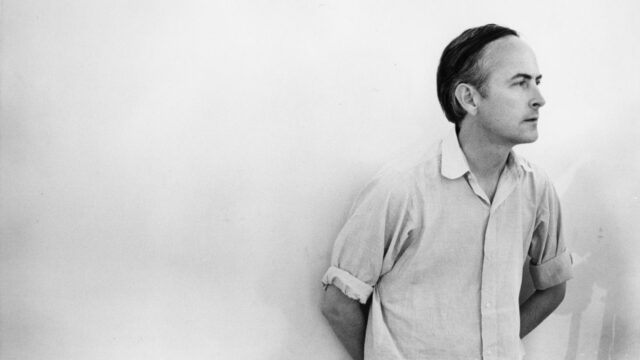
Paris-based Gardner has now collaborated with the now 94-year-old Ivory on a new feature documentary, A Cooler Climate, which uses remarkable footage Ivory shot as a young man in Afghanistan in 1960 when he was at the start of his filmmaking career, long before he directed classics like Room With A View or Remains Of The Day, or scripted Luca Gaudagnino’s Call Me By Your Name. The film, produced by Bertrand Faivre’s The Bureau, is a Dutch premiere this week in International Film Festival Rotterdam’s Cinema Regained sidebar.
On trips to New York over the years, Gardner would sometimes meet up with Ivory. On one occasion, they were chatting over lunch and Ivory asked what he was up to. Gardner replied he was editing a film about Afghanistan.
“That is how the subject came up. He [Ivory] just said ‘I’ve got some footage from Afghanistan. If you’re interested, take it back to Paris and have a look at it.” Gardner expected that this would be a can of film, perhaps a few minutes of material. In fact, there were over five hours.
“I didn’t have any budget. I was doing it under my own steam,” Gardner explains why he projected the footage on his kid’s bedroom wall, filmed it off that and started working on it. He was stunned by the beauty of the footage Ivory had shot. It was in 16mm Eastman colour and perfectly preserved. Over the years, Ivory would take a roll out every now and then, just to have a look at it. He had always wanted to do something with it but hadn’t known what.
The footage was fascinating on many different levels. On the one hand, it was a unique visual record of Afghanistan, in a period long before the days of the Soviet invasion, let alone the Taliban. On the other, it offered revealing insights into the life of its director as a young artist and gay man.
“Looking at the images, it was clear that we were looking at a lost world and [it was] filmed with an aesthetic eye which gave it a slightly mysterious, dream-like quality.”
Ivory allowed Gardner free rein over how he approached the footage. That, Gardner suggests, is typical of Ivory. “Jim has always been very generous and open…With actors, he lets them to do the job. With the camera operators, he lets them do their thing. He is always there to pick on little things sand say ‘this is good’ or ‘this isn’t good’ but he lets you run with it.”
Gardner worked on the project whenever he had time between other paid “gigs.”
“Somehow, I wanted to find out what he was thinking at the time, and who he was at the time,” Gardner recalls how the project began to grow in scope. Before going to Afghanistan, Ivory had made The Delhi Way. What took the illustrious director east in the first place, Gardner wanted to know, so he began to ask Ivory probing questions. He looked at letters Ivory had written to his family and began to understand the life the director had led as a boy and young man in the conformist America of the 1940s and 1950s, growing up in a small Californian town.
Through the footage, Gardner also learned the story of the Mughal emperor, Bābur (1483-1530). Ivory recommended that he read Bābur’s autobiography. “So I went out and grabbed a copy…there is this wonderful portrait of a very young emperor heading out into the world. I came across this passage where he is talking about falling in love with this young man he meets in the market. It was written with such beautiful, modern clarity and touching emotion. It just really struck me as being extraordinary.”
The passage was a catalyst. It enabled Gardner to draw parallels between Ivory and Bābur and thereby to probe deeper into his subject’s past.
Ivory was very forthright. He may have been in his 90s but he was still ready to talk openly and without shame about his sexuality. “It was great for the film that he did that.”
In the 1980s and 90s, Merchant-Ivory films were dismissed by some critics as being stuffy and hidebound costume dramas. Arguably, a reverse snobbery was at play. Ivory was a virtuoso director who worked in many different genres. The English period adaptations were “just a little piece of his career.” He worked in India and the US as well as the UK and made contemporary as well as costume movies.
“The young people I am meeting on the festival circuit are loving his films and really enjoying getting back to them,” Gardner says of how Ivory’s work is now being re-assessed. “He had a very, very dedicated audience. There are still people who come up to me today practically with tears in their eyes because they were so happy he had made another film and they had been missing his films.”
Gardner pays tribute to his producer Bertrand Faivre, founder of The Bureau. In the early stages, Gardner and Ivory were making A Cooler Climate on their own. Gardner had done a test shoot of Ivory, reading his letters. “I wanted to show it to Jim, who was coming to Paris.” By chance, Faivre had just completed building new offices which included a screening room. Gardner called him up to ask if he could use it. Faivre agreed. “He was very generous. He let us use the room…”
Several months later, Faivre watched an early cut of the film, was immediately enthused and offered his assistance. “He knew that I was struggling on my own without any backing.”
As soon as The Bureau came on board, “things started to happen.” Faivre and his team helped Gardener to travel to New York to shoot extra material with Ivory. The film was quickly mixed and graded. The world premiere was held at the New York Film Festival late last year. The film was also screened in Rome, with Ivory in attendance.
Gardener and Ivory are listed as co-directors. During production, the former was in Paris and the latter in upstate New York. The pandemic didn’t make meeting easy. Nonetheless, this was a very harmonious collaboration. The filmmakers didn’t go down the Zoom route. They did it by letter instead. “As you see in the film, Jim still taps away with one finger on his old typewriter. I love that…it was a slow process. It allowed this quite delicate knitting and tapestry effect we have. We have all these layers gently speaking to each other but it is very delicate and fragile. We worked very slowly, gently and thoughtfully.”
Now, A Cooler Climate is in the midst of its festival run. “I am following the film around and just thoroughly enjoying that it’s getting an audience,” Gardner says. The documentary is “shaking up” preconceptions that some older viewers may have about Ivory while also reaching a younger audience who want to see the next film by the writer of Oscar winner Call Me By Your Name.Gardner, meanwhile, continues to work as a mentor with Greenhouse Film and Dok Incubator. He is also busy with editing a new documentary which promises to be on an epic scale, Nishtha Jain’s new project, Farming The Revolution, about the farmers’ strike in India in 2021.





