

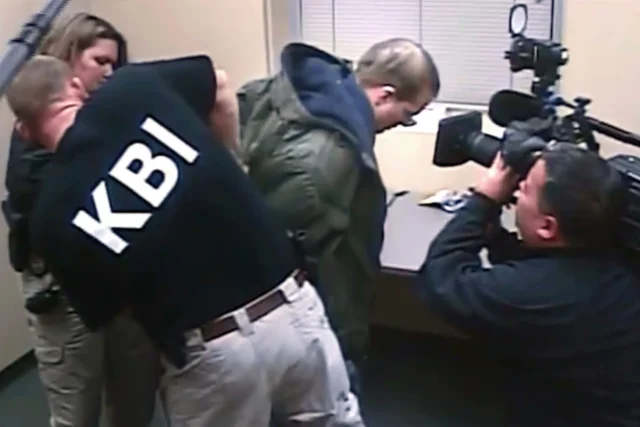
When, during the pandemic, US director David Osit forayed into the world of true crime, a sub-genre he admits he’s not a particular fan of, he remembered a certain programme that he grew up with, Dateline NBC’s candid-camera investigative series To Catch a Predator. The weekly show, aired between 2004 and 2007, was designed to ensnare paedophiles by luring them to a location, using a youthful-seeming decoy actor, then confront them, and eventually arrange their forcible arrest by the police.
Back then, it all made for great television. The set-up was always the same, the money-shot being the predator’s shocked reaction to the sudden appearance of the programme’s authoritative host Chris Hansen, who exuded a sense of righteousness as he moved in for the kill. The paedophile was free to leave the premises, but as soon as he did so would be pounced upon by law enforcement officers who were working in cahoots with the production team.
On the face of it, it was a win-win situation whereby a potential ‘crime’ was averted, and a serious child predator was revealed to the public. At the time, host Hansen was lauded by the likes of Jay Leno and Oprah Winfrey.
But then it all went wrong. During a sting operation in Texas, a supposed perpetrator shot himself dead before the operation could be completed. The decoy actor Dan, who played the ‘underage’ prey, was left traumatised for years by the incident. The show was taken off air soon afterwards, with this incident being cited as a major contributory factor. That said, it spawned numerous copycat shows, which continue to be aired. What’s more, Hansen remains convinced of his show’s positive contribution to the processes of law and order.
Talking to Business Doc Europe about his new feature doc Predators, which world-premiered at Sundance 2025 and seems set to be a strong contender during the upcoming awards season, Osit is quite happy to admit that he doesn’t enjoy “the binaries of true-crime” with its heroes and villains, and “the police always being at the centre, on the side of good.” But as true-crime jobs were the only ones he was being offered during Covid, he was therefore granted an opportunity to mine and explore this ‘predator’ seam, especially as he knew Hansen’s show so well.
“But I remember thinking it would be interesting if there was a hook there, aside from it just being another true-crime story,” he tells BDE. “I was doing research and finding the online fandom community of the show which, for years, had been collecting, through FOIA [Freedom of Information Act] requests and depositions and defence packages from clients, all this raw footage that hadn’t been seen before.”
Assessing this raw, slow unedited material was a process both disturbing and instructive, especially when Osit compared it to the programme’s short-burst edit style. “Watching a [non-broadcast] 75-minute shot, from a single camera, of a man’s life end in slow motion, from high up in a [police] interrogation room, versus the rapid-fire, almost darkly comic way that the show would present these stories in four or five-minute chunks, designed to elicit laughter, but not emotion – that was the hook for me.” Osit realised he could make a film not so much about To Catch A Predator, rather how shows like this could make us feel or, as importantly, not make us feel. “And that’s what compelled me ultimately.”
To Catch A Predator played into people’s (unforgiving) prejudices. “It’s a true crime story where there’s a clear villain. And in confusing times, we crave those types of narratives, so these shows get to do so well as a result,” Osit underlines.
What’s more, Hansen’s show was slick and performative, and designed to present the whole repugnant process as entertainment. Director Osit refers to this as “the ecosystem of ick.”
When we see the perpetrators within the raw footage, as opposed to the “four or five-minute chunks” that were broadcast, it is hard, therefore, not to see them, in small part, also as duped prey – which was problematic for Osit, whose film exhibits a modicum of empathy for the men.
“Does that mean that they surrender their humanity? Does that mean that we accept their humanity being sundered in that way?” he asks. “I don’t know what the answer is. But what I know is that I would watch that raw footage, and I would watch these men having their lives end, and feel something for them….Are they the victims? Not necessarily, but there’s something in-between. And true-crime entertainment doesn’t really allow for there to be something in-between.”
Osit further elucidates on the psychological complexities at play in his film. “The original To Catch a Predator was documenting a victimless crime because there were no actual victims, right? It’s all decoys. There’s no actual child being caught.”
“To look at it in a slightly more ironic and interesting way, there are also no victims in a sting that’s catching predators, because how can you see a child predator as a victim if they are embodying the ultimate evil, and if they’re doing these awful things? So it taps into something that in our society we haven’t ever really tried to deal with, or interrogate very deeply, which is [the perception] that these men don’t deserve balanced interrogation. I’m saying that this is how our society looks [at it]. I personally feel something different.”
Journalist Chris Hansen is front and centre of To Catch a Predator, whom we see both during the height of the show’s success, and now, as he continues to explain and justify his work.
“The most important way to look at Chris, from my perspective, is that there’s very few people who do what they do, believing that what they’re doing is wrong,” says Osit. “And he’s someone who believes that what he’s doing is good, and he’s told frequently that what he’s doing is good. And he has, in essence, curated his own world of people telling him that what he’s doing is good.”
“He’s also an enterprise journalist,” Osit continues. “So he’s incentivised – like documentary filmmakers are, to be clear – to make his investigations and his reportage more entertaining and more palatable because he makes money off of them.”
“And so do I. So if I’m being really honest with myself, Chris is in a lineage that I am also in, that a lot of modern documentary film is also in, which is we use people’s lives to tell stories. The difference is, where do we cross lines and where do we choose not to cross lines? Chris doesn’t see, I think, a problem with the lives of these men, or their families, being ruined for the sake of his reportage. Maybe I do.”
Osit further opines that much documentary viewing is predicated on reaffirming what we believe from the outset, and that by the end we feel even more “sedimented into place” by the experience.
“I wanted to make a film that actually did the opposite, that really tried to unsettle you, to unmoor what your convictions were, and to make you have a different kind of experience with what you were watching,” he says, adding how the public reaction to the film has been what he has hoped for, “that it crawls under your skin.”
“I mean, there were times when making the film, I really had to challenge my own opinions,” Osit continues. “I was talking to my producer, Kellen [Quinn]. We did a screening the other day, and he was saying during the Q&A that he still watches the film and doesn’t know how to feel sometimes.”
“And that’s something I crave more of in the society I live in, frankly. More things to engage with that don’t feel like are settled, that I don’t feel like my mind has to be made up before I turn on the television, before I open the browser. I get exhausted by the ideological segregation that we all live inside of at this point. And I wanted to make something that unsettles me, and unsettles you.”
Business Doc Europe interviewed David Osit from Ji.hlava IDFF, where the film was selected within the festival’s Testimonies section.





