Mark Cousins’ Karlovy Vary Crystal Globe winner A Sudden Glimpse To Deeper Things, in part narrated by actor Tilda Swinton, is less a study of an artist, more a study of an artist’s brain, in this case the one belonging to Scottish Wilhelmina Barns-Graham.
“This is the story of the brain of a forgotten visionary, a feisty, undervalued, driven, obsessive, sickly, 20th century artist, painter, drawer, abstracter and traveller,” Cousins says early in the film. “Wilhelmina Barns-Graham [Willie]. From her earliest years, she was compelled by visual things. She was unstoppable. She saw unusual connections in the world.”
Barns-Graham had synaesthesia, whereby her senses were wired differently than most other folk. She found dramatic associations between unconnected objects, whether solid or abstract, and applied these associations both to her art and her thought processes.
In the film we see how she assigned each letter of the alphabet a different colour, and subsequently created a “grid of hues” in reformatting the Agnes Dei (Lamb of God) prayer.
She designed works of geometric verve in which motifs were repeated, in a manner akin to the drawings of Escher. And like Leonardo da Vinci, she practised mirror writing and drawing. “Maths gives you a certainty. It gives you an armature. It gives you a pattern that you can then work against or with, or within, or you can break out of it,” we hear her words in the film. “Painting is pattern, and paintings should be just as good, upside down, sideways via a looking glass. I use a looking glass constantly. In painting, I often turn my compositions upside down and on end when I’m working.”
After she left Scotland (and an austere father), St Ives in Cornwall offered her sanctuary, inspiration and romance. She was vivacious, we are told. She knew her power and was quite happy to use it. All men were attracted to her. Being with her was “captivating.” And St Ives had the same magnificent light as the St Andrews of her childhood. Its coves became, for her, half-moons. “She loved its heights, its vistas, its shapes…St Ives needed to be drawn, or liquified, flattened,” Cousins tells us.
But Barns-Graham’s brain was about to “meets its match,” and be utterly changed in the process.
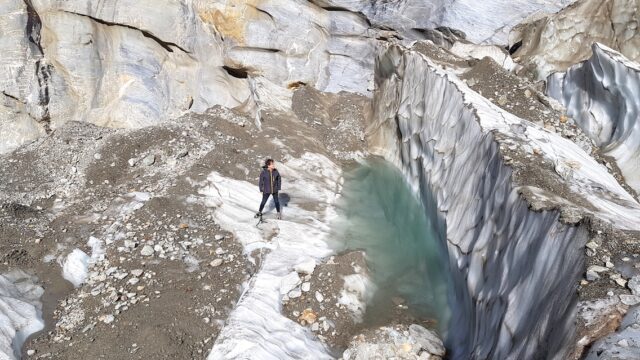
In 1949 she climbed the magnificent Grindelwald Glacier in Switzerland, and her world was transformed. She describes how the “likeness to glass and transparency, combined with solid rough ridges, made me wish to combine in a work all angles. At once. From above, through and all around. As a bird flies. A total experience…a sudden glimpse into much deeper things.”
“Hers was a life of brain building. Her brain was changed by the Grindelwald Glacier – by the thinness of its air, the thickness of its effect,” Cousins says of how the experience defined her output over later decades, dominated by her myriad representations of the glacier. “She pushed the limits of her mental world, or maybe her mental world pushed the limits of her. Her vast body of work was her bird’s nest. In a way her eyes were not involved. Her retinas had done their work. She built her nest from thoughts about form, joy, God, landscape.”
Barns-Graham worked frantically in the 1950s – “she was so many things in the fifties, wildly productive, unwell, depressed, exhausted, unstoppable,” says Cousins. She fell out of favour in the 60s, was totally ignored in a 1970s Royal Academy retrospective of British Art of the past 25 years, but began to regain approval from the 1980s onwards, eventually finding acclaim and recognition for her outstanding contribution to the advancement of post-war British art. This was in part down to the 2001 monograph ‘W. Barns-Graham: A Studio Life’ by Lynne Green, who contributes to the documentary. Willie Barns-Graham died in 2004.
Director Cousins describes his initial fascination for Barns-Graham’s work. “When I first saw her pictures in the late 80s, I was drawn to them, as if by a tractor beam, because of their rigour. They seemed to have all sorts of balances in them – horizontal, vertical, in colour or shape. And yet they were still lyrical. It’s very hard to combine those things. The closest I can think of are the films of Yasujirō Ozu. Paul Cezanne’s Mont Sainte-Victoire cycle of paintings are [also] comparable to Willie’s glaciers.”
During one sequence Cousins offers poignant analysis of many of the works she painted over the subsequent forty-year span. Does he feel there was a balance to be struck between academic examination, aesthetics, entertainment and emotional engagement when making the film, and how does he measure this?
“I think the emotion comes from realising how fully she lived and how addicted she was to looking and painting,” Cousins answers. “You can feel the force in her! My analyses of her pictures comes from the excitement I feel at seeing their matrix, their labyrinth. I try to describe what I feel as I’m drawn into one of her pictures, how my eye moves, the flashes of other things in the world – landscapes, mornings, stage sets, leaf patterns, etc – which I see in my head as I look at them.”
“It’s not academic for me, to be honest,” he resists my suggestion. “An academic approach would be more objective and set her in various art historical contexts. I mention a few associated painters but mostly I see her as the lone wolf that she was. I very much respect academic art historians, but mine is a more vulnerable bailiwick. It’s always the poetics which matter to me, the poetics of the movie language. I’m looking for a kind of cadence and rhyme in what I write and how I tell the story. I don’t always achieve that of course!”
The film’s score is written by Linda Buckley. Its string arrangements are at times as jagged and precipitous as the glacier, and its percussive asymmetry captures its sonic peculiarities. “I loved working with Linda,” Cousins emphasises. “I’m not a musician but I adore the fact that, in talking to them, in describing how a scene might feel or be shaped, I have to stretch my verbal skills like mozzarella. We took Linda to the Wilhelmina Barns-Graham Trust to see the pictures in real life, and talked about Willie’s techniques and about how glaciers make noise – clicking, cracking, scraping, aquatic. She’s a classical composer, but also a bit punk. In its final third the film had to get to a somewhat spiritual place – Willie’s sense of a world beyond the visual, apparent one – and the sobriety and numinous aspect of Linda’s music helps us get there.”
Also towards the end of the film, Cousins imagines a highly affecting conversation, transparent and sharp as ice, between the older and younger Willies. The dialogue was created for an installation (Like a Huge Scotland) that he has created about Barns-Graham, and which will soon be travelling beyond UK shores. Was it difficult to imagine an exchange between older and younger versions of the same person? Was it terrifying? Or maybe even joyous?
“I’m fascinated by aging, this involuntary transition, this gain and loss,” Cousins replies. “When I have the older Willie say to her younger self, ‘You’re happier than I am, but I’m a better painter. I’ve seen more.’ I think lots of people might identify with that. Aging takes some of the lustre from life, but adds new depths too. The river becomes a delta. We’re all transitioning.”
“It’s good not to be inhibited or intimidated when imagining another person, is it?” he suggests.
Cousins freely admits that each of his finished films will, in the main, closely resemble the work he had imagined in advance. “I’m not one of those ‘find it in the edit’ directors. The first cut is usually 95% there, or more. I think I’m probably what neuroscientists call ‘hyperphantasic’ – someone who can fully envisage a thing without it being before their eyes.”
One practical hurdle Cousins had to overcome was own inherent sense of industry. “I was making other films at the same time as this one,” he says with some understatement, given how, since 2001, he has released nine documentaries, including The Storms of Jeremy Thomas; March on Rome; My Name Is Alfred Hitchcock and The Story of Film: A New Generation.
“Another [hurdle] was climbing the Alps,” he says. “We hiked up a precipice sometimes no more than 50 cm wide, with a 300-400 metre sheer drop. Producer Adam Dawtrey and I were white as sheets and shaking. Since I climbed the Eiffel Tower aged 11, I’ve had bad vertigo. I’ve been in three wars – Northern Ireland, Bosnia and Iraq – but I’ve never been as scared as during that climb. I tried to dissociate to be honest and, after filming at the top, was dreading the descent. Then I remembered that David Lynch uses a kind of mantra when he does transcendental meditation, so I started singing ‘Edelweiss’ from The Sound of Music, to myself. I looped it in my head and it helped. Of course, if I ever hear that song again – instant sweaty palms.”
A third hurdle was funding, Cousins adds, underlining that it’s never easy to raise finance on a film whose subject is not so well-known, and whose life was “un-dramatic.”
“If Willie had had a wild sex life, or controversial opinions, or there were mysteries about her, this could have been more of a thriller doc,” he says. “But I liked that there weren’t these distractions. Her tumult was within: back to Ozu movies again. When I talked to jury member Geoffrey Rush at Karlovy Vary, he told me that my The Story of Film: An Odyssey introduced him to Ozu’s Tokyo Story.”
“By far the best thing was working with the Wilhelmina Barns-Graham Trust,” he adds. “Its great director Rob Airey gave me access to Willie’s previously unseen notebooks, never published photos, diaries, etc. This treasure trove gave me more visual freedom than I’ve had in many films. I felt immersed.”
The experience that Barns-Graham underwent in having her world view utterly altered – and her way of seeing both distorted and transformed – is remarkable and enviable. Did Cousins himself ever undergo such a cerebral recalibration?
“Yes. When, as a working class Irish Catholic lad, I read James Joyce’s A Portrait of the Artist As a Young Man. It let me see Ireland from ‘outside’ for the first time. And of course Joyce had a whole theory of epiphany. But I’ve had so many epiphanies! On TV when I was a boy, Gene Kelly dancing. Visiting the mosques of Esfahan. I suspect there will be more.”
A Sudden Glimpse To Deeper Things is produced by Mary Bell and Adam Dawtrey for Bofa Productions. Sales are handled by Reservoir Docs.