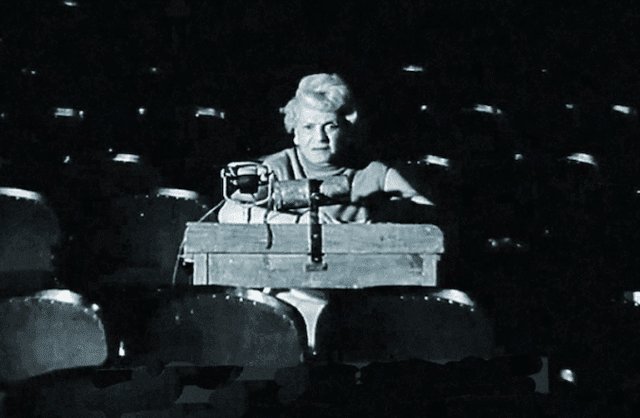
At Krakow Film Fest Docs to Go, actor/director/producer Dawid Szurmiej presented his project telling the story of the eponymous Polish luminary, the only actress from behind the Iron Curtain to be nominated for an Academy Award, but who was forced into exile at the height of her career as anti-semitic riots swept across Eastern Europe in 1968
There is a very strong personal undertow to the project, he revealed. “Both my parents are actors. They worked at the Yiddish Theatre. By proxy, I was essentially raised there, but I wasn’t [initially] interested in Ida because she seemed like a relic of the past, a ghost. That was until I saw the head of a sculpture rolling on the floor as the theatre was moving its premises. And nobody knew who that was. I knew it was Ida Kaminska, and I thought, how could she become so forgotten? So I wanted to learn more about her – and I did.”
The story of Ida Kaminska is a tale of resistance, he reminded the professional audience at Krakow FF. “[It is] a fight to hold onto the past, a daring to dream of the future, and an unyielding will to forge those dreams into reality. It is the story of a woman who stood on the stage of history and refused to be silenced.”
The project is fully financed, courtesy of the Polish Film Institute, the Mazovia Warsaw Film Commission and Rolat Foundation. In Krakow, Szurmiej is looking to garner sales and distribution/broadcast interest, as well as archive partners. Delivery is expected Winter 2026.
Szurmiej divulged more information about Kaminsky’s life and subsequent legacy. She was the daughter of two stars of pre-war Yiddish theatre and “always was destined for greatness,” and the first woman theatre manager in all of Poland in the 1920s. What’s more, she ran one of the most “highly sought-after” artistic theatres in the country, not just in the Yiddish language, but across all of the Polish language.
“Ida took Yiddish theatre from the shtetls to the art houses of Warsaw. That was all until a corporal named Adolf Hitler came along and the Holocaust happened,” he stressed. “But Ida Kaminska was so much more than just an actress. She was the epitome of Yiddish culture. She thrived throughout the first 35, 40 years of the 20th century. She survived partitions, two World Wars, the Holocaust, and finally the events of March of 68, where the communist government blamed the Jews for student protests.”
“She was like Bertold Brecht’s ‘Mother Courage,’ or Arthur Miller’s ‘Billy Loman,’” he added. “ She pulled that bandwagon no matter what. Essentially, Ida Kaminska went from being the cornerstone of Yiddish culture before the war, to becoming the bridge of a lost culture of 300,000 Jews of Warsaw and the 3 million Jews of Poland. And she became the bridge to the remnants that we had after the war and what we have today.”
Fellow producers on the film are Katarzyna Kaczmarek and Milena Drinčić.