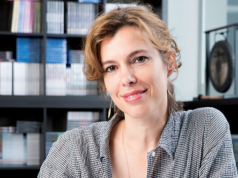
Cuban filmmaker David Bim was given the inaugural Marcel Łoziński Documentary Award on June 3 for his debut feature To the West, in Zapata. The film world-premiered at Vision du Réel in 2025, where it won both the Fipresci prize and the Special Jury award. Bim was handed the award in Krakow by director Paweł Łoziński, son of Marcel. The film is sold by Square Eyes.
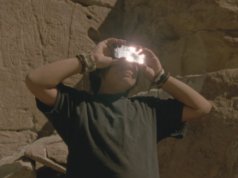
In To the West, in Zapata, shot in black and white, Landi and Mercedes live in Cuba’s Zapata swamp, a biosphere reserve. To feed their sick child, Landi must secretly hunt crocodiles, leaving his wife and son behind for days on end. Amid social unrest and a global pandemic, Bim follows this loving family as they go to extreme lengths to survive, in a constant cycle of reunion and separation.
The news of the Marcel Łoziński Award came somewhat as a surprise to Bim.
“I checked the email in the middle of the night. I had just woken up drenched in sweat because the power had gone out in the apartment where I’m staying at the Cuban Film School, and between the heat and the mosquitoes, there was no way to sleep,” he tells Business Doc Europe.
“I spent almost half an hour trying to open the email, but it wouldn’t load, the internet here is very slow. I thought it was an invitation to participate in the Krakow Film Festival, which already seemed like wonderful news to me. I’ve never been to Poland, and I’m a great admirer of Polish cinema, especially the New Wave of the 1960s: Polanski, Wajda, Kieslowski, Skolimowski…”
“When I finally managed to access the message, dawn was already breaking. That’s when I understood it wasn’t an invitation to the festival, but that the film had received the first Marcel Łoziński Award,” Bim continues. “Immediately, I thought of two of his films that I watched as a student: 89mm from Europe and Anything Can Happen. I remember them vividly because they possess an extraordinary power of persuasion. In both films, there is something I consider fundamental: sound and image do not overlap, but move along separate paths, like blood vessels whose unified experience gives rise to cinema of immense poetic and cinematic value… I feel deeply honoured to receive an award bearing the name of a giant of documentary cinema such as Marcel Łoziński.”
The film represented a full decade of Bim’s life, having met his characters when he was 23 and premiering the film in Nyon 10 years later at the age of 33. It was a process both singular and collaborative.
“I made it alone, alongside them,” Bim says. “Of course, without money and using second-hand equipment. We spent five years living together before filming, after which I shot around four hours of material over the course of a month and a half. Then I spent a full year recording all the sounds of the film in the way I felt they needed to be captured (for me, the colour of this film is its sound). Only then did I realize I had something that could be shared. That was when I looked for a producer, Lia [Rodriguez], to accompany me through the process of finishing the film and helping it find a life of its own.”
“I had never made a film before, and from that perspective, every obstacle imaginable existed,” he adds. “But there is something I consider fundamental for me, not only as a filmmaker but also as a person: that my life and my work remain coherent with one another. Perhaps having so many obstacles and moving more slowly, or having to become more essential because I was filming alone and under circumstances that were very damaging to my health, allowed me to understand my characters’ point of view in a very clear way. They have ultimately become my family.”
“I believe cinema today has value insofar as it allows us to gain truth and intimacy through the time of the people who inhabit it. Cinema is the art of time, of sharing time; only through that can movement emerge. Not only within the film itself, but also within the spectators, who are transformed as they watch it. So perhaps all of those limitations helped me give the film more time, and that very limitation ultimately became a great teacher for me.”
Bim finds the process of filmmaker self-aggrandisement to be distasteful, and he therefore (quite modestly) prefers not to define his own approach to the craft.
“I think filmmakers are sometimes overvalued and too concerned with their own image. I see my profession more like that of a poetry translator,” he says. “To translate poetry, you need to understand the culture of the original language, as well as the life, work, and point of view of the author. Once you acquire that understanding, you must do the same with the culture of the language you are translating into.”
“When a translation is truly good, people read the poetry and you remain to the side,” he underlines. “No one remembers the translator, because in the end, they are not what matters.”
Nor did Bim ever imagine making a film when he first encountered his subjects. That came later, after the five initial years he spent living alongside Mercedes, Deinis, and Landi.
“The decision to make the film emerged because, in 2021, many things happened in the country that deeply affected our own freedom,” Bim explains. “Those conditions still exist today, but at that moment they intensified to the point where the possibility of continuing to live together was no longer in my hands, nor in those of my characters.”
“Especially during those days, being an artist, and specifically a filmmaker, became a risk. Because I loved the time we shared, I began to feel a terrible nostalgia at the thought that those days might come to an end. I decided to make a film so that no one could take away our ability to return to those lives.”
The film is both small and vast, I suggest, and takes on the qualities of myth. It is a suggestion with which Bim agrees.
“I believe mythology comes from the need to tell, through simplicity, the complexity of the experience of living. That is why it has such persuasive power. By reducing the number of elements, we can achieve greater depth and also a more playful experience. And we remember much better what we love,” he responds.
“In the case of the film, during those years I was rereading a book that is fundamental to me: ‘The Myth of Sisyphus’ by Camus,” he adds. Many of my friends in the country were beginning to leave, as was my partner at the time, and the person without whom it would have been impossible to make this film. That creates a great deal of frustration and nostalgia. You turn on the television or the radio, and all the news speaks of a utopian world that does not exist in the world of facts.”
“For me, meeting Mercedes and Landi gave me something I needed as a human being: they gave me hope in what is real, in facts,” Bim continues. “Remaining united as a family meant living each day of their lives apart from one another, in a vast off-screen space, with all the pain that this entails. For me, that is true love: what you choose to renounce. I understood that they were not even doing it for themselves, but for little Deinis, someone they love more than their own lives, more vulnerable than they are and completely dependent on their actions.”
“From there, they carry that rock up the hill again and again, aware that it will fall once more and that all suffering will restart. But love gives hope: hope that tomorrow might be different, and that what you are not able to do for yourself, you manage to do for someone you love more than your own life. There is no stone large enough to destroy that love,” Bim concludes.