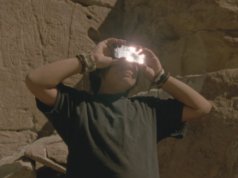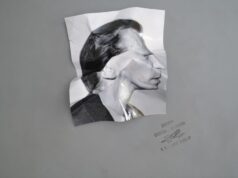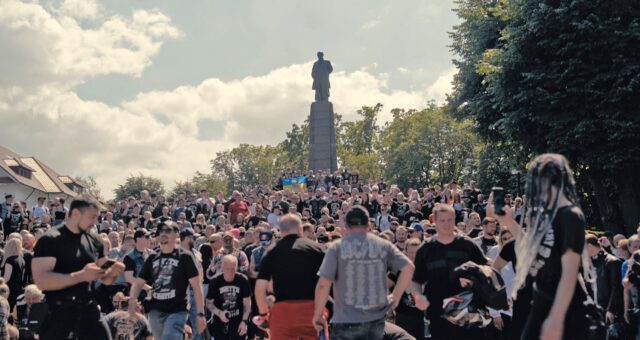
To prove or disprove his direct descent from Ukrainian national hero Taras Shevchenko (who was always assumed to have fathered no children), dentist Mykhailo agrees to a DNA test. The genetic material is provided by three descendants of Shevchenko’s siblings: Valentyna, an academic singer; Yevhen, a guitar maker from Poltava who became a soldier after the Russian invasion; and Artur, a civil servant, farmer, and performer on the Ukrainian queer scene.
As the DNA test approaches, Mykhailo faces either triumph or disappointment. But there is another matter to consider. A positive result would threaten the almost saint-like reputation of Shevchenko, the so-called Father of the Nation.
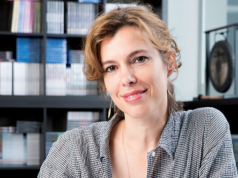
DNA of the Nation is produced by Ivanna Khitsinska of Babylon 13, the Ukrainian collective of independent filmmakers founded during the ‘Revolution of Dignity’ in 2013. “Today, international audiences often encounter Ukraine almost exclusively through news about war, destruction, and geopolitics,” Khitsinska told BDE ahead of Krakow Industry 2026. “DNA of the Nation offers a completely different way of seeing the country — through humour, intimacy, absurdity, and deeply human everyday situations.”
“The idea that an ordinary contemporary Ukrainian dentist could suddenly turn out to be his [Shevchenko’s] direct descendant feels simultaneously absurd, funny, emotional, and strangely believable. What begins almost like a joke gradually evolves into something much deeper,” she adds of the film which is in production, ahead of delivery early 2027.
“The film follows Mykhailo through family stories, everyday routines and situations where he tries to prove his theory. Some people support him sincerely, while others react with irony or disbelief. Yet beneath this almost detective-like journey lies a deeply human desire – to understand one’s roots and one’s place inside national history.”
Director Ivan Sautkin is a co‑founder of Babylon’13, as well as a member of the Ukrainian Guild of Directors. “He has a rare ability to discover cinematic drama inside real life without artificially constructing it. He is attentive to small details, emotional contradictions, and moments where reality suddenly becomes both funny and heart-breaking at the same time,” says Khitsinska.
“His directing style is observational, intimate, and emotionally precise. Rather than explaining reality through interviews or statements, he allows life itself to unfold naturally in front of the camera. This approach is especially important for DNA of the Nation, because the project constantly moves between absurd humour and profound existential questions about national identity.”
Khitsinska expands on the film’s wider prospects. “From a producer’s perspective, the project combines strong festival potential with broader audience accessibility. While clearly auteur-driven, the concept itself is immediately understandable and emotionally engaging all over the word. Themes of ‘hero to zero,’ identity, and national mythology resonate universally beyond Ukraine.”
“The self-ironical tone also allows the film to connect with audiences outside traditional arthouse circles,” she adds. “We believe this balance between artistic depth and emotional openness is one of the project’s strongest assets.”
“We make this film together with our trusted Lithuanian partners and friends from Zero Copy Reel and have strong belief that our film need to reach wide audience all over the world.”
The producer senses a shift in international interest on the part of investors, with a “growing curiosity toward stories that move beyond direct war reportage and reveal more layered, unexpected, and emotionally complex portraits of Ukrainian society. DNA of the Nation exists exactly in this space.” For Khitsinska, KFF is the perfect sounding board to test this theory.
“One of our key goals at KFF Industry is to connect with partners who understand that contemporary Ukrainian cinema should not be reduced only to trauma narratives,” she tells BDE. “We are looking for collaborators interested in projects that combine artistic ambition, emotional accessibility, irony, and strong local identity.”
“The visual style of the film can be described with the expression, ‘the funniest jokes are those told with a serious face,’” she adds. “Ivan demonstrates absurd things in an almost conservative style. Such a cinematic language gives great freedom not only for funny things, it also allows for unexpected turns between genres. From comic to tragedy.”
“And yes, there are elements of tragedy in the film because this is exactly how our Ukrainian present looks,” Khitsinska reminds us of the context in which she is producing this highly ambitious film.