

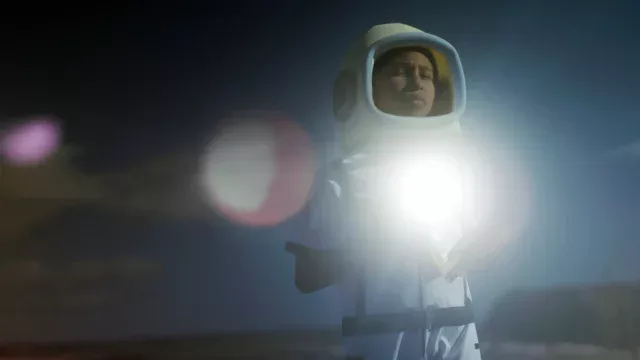
Eliza Capel’s The Fabulous Time Machine opens with a cross-examination of the Biblical creation myth. Before everything else, there was darkness, and then God started playing, we are told. Then out of the Dust he created Man, and from Man’s rib he created Woman.
All of which is a little confusing for the eleven young girls featured in the film. Why weren’t women also created out of Dust? And wouldn’t they be fundamentally different if they had been, they muse.
Thus commences a documentary investigation into the business of being a woman…and being a girl. In the film, our protagonists look to the past, and interview older women, sometimes their own mothers, and eliciting, at times, difficult responses. They then assess the present time, remarking how boys seem to be favoured while the girls are relied upon at home, for domestic duties. And they talk about religion in their lives. And about how older girls change when they get their periods – they’re not as much fun as they used to be, bemoan some of the younger ones.
Then the girls enter their nominal time machine to look into the future, and think about what they want to become, whether it be an actress, a teacher or even, in one case, a coroner.
The film is as charming as it is instructive, and what’s even more remarkable is that these kids come from what is reckoned to be the poorest town in Brazil, Guaribas, which has historically offered very little by way of prospects to its young. But such is director Capai’s confidence in her protagonists, who operate as de facto co-creators of her film, we could be watching any kids from any city in the world, and from any socio-economic background. “We were in this fluidity of creation,” she says.
In 2013, Capai made a short film about the Bolsa Familia income redistribution programme which was designed to elevate Brazil out of the UN Hunger Map. She was documenting, even then, women who had lived through “slavery, no food, no sandals, nothing,”
“I was capturing the beginning of a historic process,” she writes in her film notes about the fundamental changes she subsequently observed. “Eleven years later, I was back to hold an audiovisual workshop for girls. Together, we entered their homes, schools, and churches. The great challenge, both in filming and editing, was understanding how to transform the film into a big game. How to observe the process of leaving poverty, and questioning structural sexism from the girls’ perspective?”
“I think we are talking about them as this first generation that were born with the right to eat, the right to go to school. And [therefore] to have time to think about dreaming about solutions,” she adds to Business Doc Europe.
There are poignant moments in the film, such as when teenage Manu is told by her mum how, if she’d had the chance, she would have done things differently, and that may even mean not having had children. In a subsequent role-play, Manu morphs seamlessly into the role of depressed mother.
Later, Sofia is upset as she discusses the inevitably of death with her own mother. “So she [Sofia] went out and she started to act as a zombie,” says Capai. “She was trying to understand how to deal with the fact that she can die. But in her place, she could also come back to life again as a zombie. And that, for me, was really interesting, because it kind of reveals what we do when we are learning things.”
The kids are eager church attendees and retain strong religious belief. While director Capai remains highly critical of the Evangelical movement within Brazil (as detailed in fellow Brazilian Petra Costa’s BAFTA-nominated Apocalypse in the Tropics) she sees positive signs of its influence within the town.
“I like that we are able to understand the good impact in their [the girls’] lives, like when we see how the father of Sofia stopped drinking because of the Evangelical church,” says Capai. “We can feel how it really changed the dynamic of the families…I think faith is very important and each person has to decide what to do.”
She offers a rejoinder, however. “But it’s a problem, when the only option that you have is the church. You don’t have an option of dance or theatre or sports or music.”
That said, the girls themselves are well aware of the propaganda they are being fed. At one point in the film, Lorenna dutifully repeats that God is her only friend, before remembering that she has all her other friends as well. “I think they are all the time negotiating with the information that they receive, and trying to understand how to deal with that,” says Capai.
Bolsa Familia’s redistribution of finances, designed to elevate folk out of poverty and to offer a clearer future for Brazilian kids, is something that Capai welcomes. But she has her own fears for its future.
“I have this feeling that the film is both very optimistic and very sad at the same time. For me, it was this confirmation that it’s possible to change, but at the same time it’s a lot of work. Bolsa Familia is something that the extreme right in Brazil are all the time trying to say is creating lazy people… even though it’s really small money, we are talking about less than $200 per month per family.”
“But it’s small money that is changing life in the structure of the family, and in the structure of society. I think that’s really powerful.”
Which is why the film is ripe for impact treatment. “I think a lot of kids [in the audiences] will be represented by those kids, and will feel powerful to think about their dreams and about their creativity, about what they want to make in life and what they want to change.”





