On the eve of its demolition, six former inmates return to London’s Holloway Prison which stood for some 150 years in the middle of the city. When it closed in 2016 it was the largest women’s prison in Europe. For the six women the return is part-catharsis and part self-examination as they once again serve time (albeit voluntarily this time) for several days in the building that shaped much their lives.
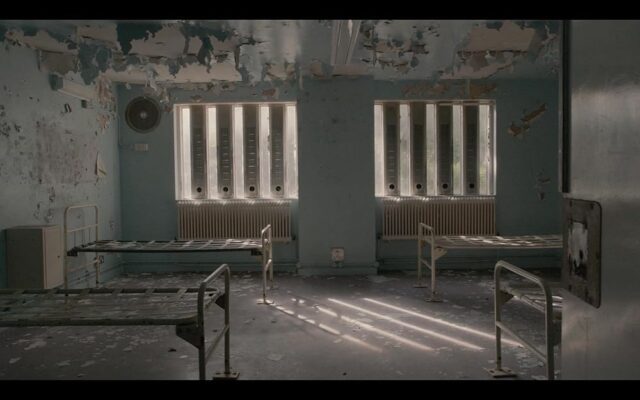
Sophie Compton and Daisy-May Hudson’s film Holloway could very easily have dwelt on the dark history of the prison – it was used to hold Suffragettes, Irish Republicans and fascists, while five executions also took place there, including Ruth Ellis in 1955, the last woman to be executed in the UK – but instead the now ramshackle and partly overgrown space enables the six women engage in a series of therapy sessions and slowly open up about their lives, their time in the prison and their personal journeys.
The film gives each woman a platform to reclaim their stories, and highlights the power of sharing and co-support as a form of healing. The six are shown re-visiting cells and communal areas inside Holloway as they reminisce about their time there, but for the majority of the film they are joined by facilitator Lorraine Maher and therapist Maria Takaendisa and asked to sit in a circle and – quite simply – talk.
Initially the women – Tamar, Gerrah, Aliyah, Mandy, Sarah and Brenda aka Lady Unchained – tentatively enter into the spirit of the venture as they are asked to dwell on the emotions generated at Holloway, but before long things change direction as several admit to being uncomfortable with the process as well as trying to understand the different personalities within the group.
Footage of them arriving back at Holloway is extremely powerful, with several sighing and taking deep breaths as they head back behind the forbidding walls. Some try and hold back emotions while others display a sense of bravado. One says: ”I did not expect this – this is crazy,” admittin that it is not easy to walk through the gates, whether open or closed. As they explore the empty cells and corridors where they once lived, memories naturally resurface.
It is to the filmmakers’ credit, however, that they can gently pivot, and are very sensitive to the women’s need to talk within a truly safe environment, and while it is all shot over the period of a week there is a real sense that the six do manage to find ease with each other and reflect their very different personalities, backgrounds, hopes and dreams.
The idea is that therapy exercises will help the women process what has happened to them and their lives, but dealing with trauma is clearly a complex and highly individual procedure, and while there are efforts by the facilitator to help them to get to know those in the room, the women come to appreciate they have to discover their own process, with each offering different perspectives and ways of dealing with what happened to them.
Some have an odd sense of nostalgia for Holloway, based on how they chose to deal with their different situations. For some a “it was a holiday camp” or a “walk in the park” while for others it was “self-destruction.”
While some make vague reference to why they were initially sent to Holloway, the film is actually more interested in discussing their whole life storyiesand how, in different ways, they are all victims of generational cycles of neglect, abuse and violence. Sometimes the women need to leave the room and the circle in order to deal with matters in their own ways, but at the end there is a very real sense of them having undertaken a therapeutic journey, with an acknowledgement that they are more powerful when they find their own voices.
Engagingly, as they walk out of the prison for a final time they all find it funny that they are reverting to their old habit of walking in single file, just as they did when prisoners, and are quick to laugh out loud and bounce out of formation, all aware that they have full agency over their movements now. As one says in voiceover: “It is healing to see Holloway prison falling apart,” as verdant nature takes over the crumbling building prior to its final demolition.
UK, 2024, 85mins
Dirs: Sophie Compton, Daisy-May Hudson
Production: Power Play, Beehive Films, Murmuration Production
Scr: Sophie Compton, Stella Heath Keir, Daisy-May Hudson
Producers: Alice Hughes, Polly Creed, Sophie Compton, Tarquin Ramsay
Cinematography: Sarah Cunningham
Editor: Stella Heath Keir
Music: Adam Janota Bzowski
With: Tamar Mujanay, Gerrah Selby, Aliyah Ali, Mandy Ogunmokun, Sarah Cassidy, Brenda aka Lady Unchained, Maria Takaendisa, Lorraine Maher