

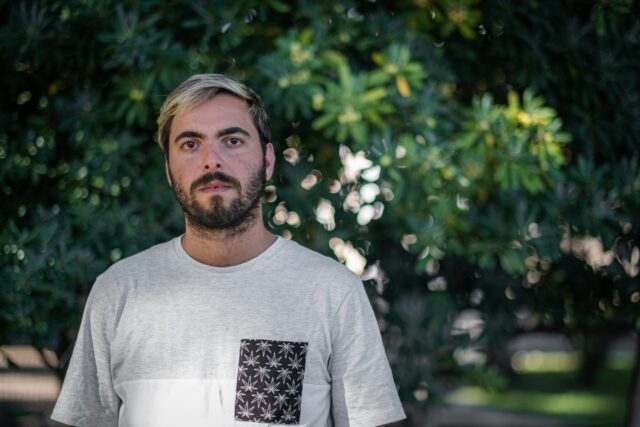
Doclisboa’s Miguel Ribeiro
Doclisboa may be enjoying its 20th edition but its establishing principles remain intact despite two years of disruption caused by Covid. In fact, the lifting of restrictions on movement and social engagement is proving somewhat of a catalyst, with higher numbers than ever expected during this year’s celebration of all things doc.
“The festival has always been a place of bringing together people from very diverse backgrounds, and that has definitely become more clear after Covid to see everyone getting together again,” says festival director Miguel Ribeiro. “[Doclisboa] is a place of encounters and connections through cinema, with film at its center.”
The festival opens October 6 with the Portuguese premiere of North Terminal by acclaimed Argentinian filmmaker Lucrecia Martel, who returns to documentary with a short film made during the pandemic, where she follows the singer Julieta Laso in her various encounters with an extraordinary group of Argentine artists in the Salta region. The opening session will include a musical show, starring Portuguese composer and singer Lula Pena, who will present a sound experience at Cinema São Jorge, in Lisbon.
Doclisboa will close October 15 with Love-Lights by Acácio de Almeida and Marie Carré, described as “a declaration of love to photography and cinema.”
The 2022 programme comprises some 281 films, of which 47 are world and 28 are international premieres. The International Competition “travels through 13 different territories. It brings 12 perspectives on the world and on cinema, with a formal and aesthetic diversity that questions the world in its different facets,” writes the festival.
The Portuguese dimension is particularly dynamic, with 40 new docs, 12 of which will feature in the National Competition and 8 of which are world premieres, comprising “proposals that challenge our constructions on reality, between spaces, times, memories, and affections.”
“We have a Portuguese Competition that we are proud of, if we want talk about risk and using cinema freely,” says Ribeiro. The dozen films “engage with the very political and the very intimate,” he says, and cites how, “Portuguese cinema challenges itself in investigations on space, time, family, memory and love.” The films in the National Competition range in duration from 15 minutes to just shy of two hours.
In The Island, after 500 years of African presence in Portugal, Black people take refuge in the utopian creation of the titular island, “a place situated in the space between fiction and reality, where you can rewrite stories and think about futures through the characters and their paths.” João Rosas’ Death of a City portrays the passing of a “certain Lisbon” in the face of creeping gentrification within the centre of Lisbon as an old printing workshop is demolished to make way for luxury apartments. This is a theme also touched upon in the intimate and very personal Rosa’s House by Rosa Coutinho Cabral in which the filmmaker films her last moments before being evicted from the house she has lived in for many years. “The camera serves as a guide in this grieving process, building an archive of the house, the neighborhood, the people who lived there or those who visit.”
Outside of the National Competition, Ribeiro stresses how the Portuguese films “really show the vitality and diversity of ways of making cinema in Portugal right now.” He cites Margot by Catarina Alves Costa, about German director and anthropologist Margot Dias (1908-2001), stressing the notions of “film as memory and film as document,” as the director returns to the Makonde people of Mozambique to show them the footage that Dias, whom she greatly admired, had shot decades before.
Ribeiro further highlights Diogo Varela Silva’s João Ayres – An Independent Painter. “There are so many layers of reality and ways of addressing history, memory and community. So we have Margot on one hand, but then we have [Silva’s] portrait of a painter who is not in our collective history as he should be…There’s this diversity in Portuguese cinema that we are very happy to [programme].”
Despite the wide spectrum of platforms and range of technical gadgetry available to highly gifted and contemporary filmmakers, whether international or local, Ribeiro questions the notion that docmaking is at a zenith of sophistication or creativity right now. He points to the Doclisboa retrospective highlighting the 1960s works of Brazilian Carlos Reichenbach, an avant-garde author who explored several genres, including melodrama, porn and experimental, as he sought to address and critique the Brazilian military dictatorship of the time, together with fellow collaborators within the São Paulo-based Cinema of Invention collective.
“His films were very daring in many ways in the way that he can [use] fiction modes to address his world and the constraints of a military leadership in Brazil. And it was really through cinema that he was discussing and imagining other worlds. So in that sense, I have a hard time saying that anything is the ‘most something ever’ now, but I do see filmmakers continuously finding forms of freedom and owning their own ways of building cinema. So for us it’s ever inspiring and we are happy that every year we keep on seeing the thriving of filmmakers to strike from that perspective.”
As earlier reported, dance, music and literature remain the “beating heart” of Doclisboa’s film offer. Alexandre O. Philippe puts together the relationship between the cinematographic work of David Lynch built on the universe of The Wizard of Oz in Lynch/Oz. In Godard Cinema by Cyril Leuthy, audiences rediscover the master of the Nouvelle Vague and the constant renewal of his art. French filmmaker and actor Mathieu Amalric will be in Lisbon to present his trilogy about jazz musician (and close friend) John Zorn.
In anticipation of the Cinekomix!!! series, directed by Edgar Pêra – which explores the relationship between cinema and comics – the festival presents three episodes about three internationally renowned authors – Neil Gaiman, José Carlos Fernandes and Tommi Musturi.
The festival’s From The Earth to the Moon strand once again presents “a set of attentive and critical perspectives on the world through the lens of history and contemporaneity.” In solidarity with the Ukrainian resistance to the Russian invasion, Doclisboa presents the restored copy of Olexander Dovzhenko’s Earth.
Ukrainian director Sergei Loznitsa, returns with the portrait of former Lithuanian president Vytautas Landsbergis, in Mr Landsbergis. Alon Schwarz travels through the memories and wounds of the lost Palestinian village of Tantura. The conspiracy theory about the death of John F. Kennedy becomes more and more real with new evidence presented by Oliver Stone in JFK Revisited: Through the Looking Glass. Frederick Wiseman delves into the intimacy of Lev and Sofia Tolstoy’s troubled relationship in Un Couple, and Sébastien Lifshitz pays a moving tribute to the queer community that found refuge in Casa Susanna in the 1960s.
In ‘Artistic Differences: Colectivo Cine Mujer’ – presented in partnership with UnionDocs and Artistic Differences – Doclisboa screens 4 restorations of short films by this Mexican collective from the 70s and 80s, a pioneer in the articulation of an openly feminist cinema.
The New Visions section once again “expands the boundaries of cinema, with a programme that takes risks on new cinematographic languages, questioning different times and territories,” the festival notes. Éric Baudelaire and Ana Carolina are the invited directors of this edition.
Želimir Žilnik’s cinema, the subject of a retrospective in 2017, returns to the festival with the screening of 4 short films that were considered lost. Laurent Achard films Patricia Mazuy in the making of her film Before Saturn Bowling, and Peter von Bagh reveals the fascinating cinema of Finnish Mikko Niskanen, whose Eight Deadly Shots can finally be seen, thanks to von Bagh and Martin Scorsese’s recovery and restoration efforts.
In the thematic programmes, audiences can also find the most recent films by João Pedro Rodrigues and João Rui Guerra da Mata (Where Is This Street? or With No Before Nor After); by James Benning (The United States of America); by Ruth Beckermann (Mutzenbacher); Mike Hoolboom (Waves); and by Elisabeth Perceval and Nicolas Klotz (Song of the Buried City), among others.
From October 11 to 16 October, Nebulae – Doclisboa’s networking space – hosts new meetings for industry professionals. In partnership with the Calouste Gulbenkian Foundation, the festival will present the first edition of ‘Jumpgate – Inspiring European Producers,’ comprising (what will become) an annual summit aimed at European producers from different areas and different levels of experience in the field of non-fiction film production. Nebulae also welcomes France as its Guest Country in 2022, as well as a new edition of Arché. It will also focus on ‘The Colonial Question Retrospective’ and will debate on ‘Women in Cinema, Women at Work.’ Industry professionals can also meet to discuss methods and tools for creating audiences in ‘State of the Art.’





