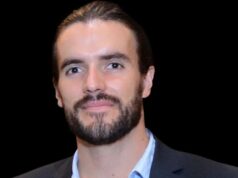
Doclisboa co-director Miguel Ribeiro talks to Business Doc Europe about the creative reappraisal of the festival structure in 2020/21.
“We’re very happy with this model for this year, but we are very conscious that it works well only with the times and restrictions we are living in. It’s not a model that we’d want to keep forever,” says Doclisboa co-director Miguel Ribeiro on the festival’s decision to amend the structure of the event in the light of pandemic.
Instead of the standard 11 days in October, into which are normally squeezed 300 screenings, a series of talks, seminars, masterclasses and a full professional programme, the event will be, for one year only, a more relaxed affair, and divided into six segments, or ‘moments’ as the festival likes to phrase it, spaced out over the coming five months.
“It allows us to have continuous debates and dialogues with the audience and with the films,” he adds of the extra time that will be available for richer engagement with the programme. “What we are suggesting is something also very soothing, which is the idea that everyone can follow the programme in its entirety and have a common debate about what we are all watching… This was the model we felt we wanted to engage with.”
Professional and public audiences will all have a clear idea of festival content after the press announcement on October 12, but core to Doclisboa’s first offering in October is a focus on Georgia, which features newly restored copies of films by auteurs such as Mikhail Kalatozov and Sergei Paradjanov, among others, as well as contemporary filmmakers including Otar Iosseliani and Lana Gogoberidze.
Georgia is also the guest country of Nebulae, Doclisboa’s industry program, with a series of activities that will highlight contemporary Georgian cinema.
Another key element in late October is an industrial strength focus on work and labour, presented in the ‘Body of Work’ programme that arises from a partnership between Doclisboa and the European Agency for Safety and Health at Work (EU-OSHA). The event will aim to offer a platform for dialogue, through cinema, on human rights and social issues related to contemporary working conditions and practices.
The programme also promises to build bridges between remarkable moments in the past, and ideas that reveal our present. In an era in which labour issues are at the centre of public debate, forcing a re-evaluation of logics and structural models, this programme will stimulate discussion on issues that affect everyone, the festival stresses.
“We are very engaged with matters that have to do with labour and work. We acknowledge that filmmakers have been for a long time highly engaged with social inequalities that come from a very powerful structure which is a capital structure,” says Ribeiro. “We don’t want to be pedagogical to our spectators, but what we want is to bring views and discourses that can promote a debate and a true dialogue.”
“I wouldn’t put it in terms of left wing,” he adds, reacting to my suggestion. “Rather in terms of we are a film festival that is very aware of the context in which we operate, both locally and internationally. From what we see and what concerns us, we are very interested in debating everything and opening up a discussion into a deep reflection on matters can have consequences.”
The Doclisboa professional programme Nebulae will be presented online in October 2020. Launched last year, the programme is a networking space where related industry activities are carried out with a focus on the development, creation, production and dissemination of independent cinema.
As many professional events discovered in 2020, the forced move to online has allowed organisers to cast a wider net in terms of projects and participants whose previous attendance was impossible due to costs. “It’s a great opportunity to engage with even more people throughout the territories…Right now we have the possibility to engage really interesting people who are doing amazing work in quite far away [places]. Hopefully it makes for a much more interesting network of dialogues and connections.”
“Of course, every time we go to a festival, physical or not, we are always looking to see how people do it, and we get inspired. This year has been a very particular year in how everyone was re-imagining their own places. One thing that was very clear is that we didn’t want to replicate what we had been [previously] doing. We wanted to adapt the goals of Nebulae into what is [this year] a digital platform,” concludes Ribeiro.