When contemplating the film to follow 2016 Berlinale Golden Bear winner Fire At Sea, it seemed essential to Gianfranco Rosi that he should immerse himself within the borderlands between Syria, Iraq, Kurdistan and Lebanon, “this land of crisis, of war, of violence, of disaster.”
In Lampedusa he had been frustrated by his inability to engage with the migrants he met there – “I just met these faces and nobody stayed more than two/three days, so it was impossible to engage a kind of relationship” – and was therefore determined to invest time within another constituency of protagonist, those who remained behind to fight, to work or to grieve. Or to suffer.
Rosi had sensed a lessening of the war’s impact and a contraction of ISIS reach. “There was a moment of change and I wanted to witness that,” he says. “I wanted the film to start when the headlines stopped, when the reportage stopped. I wanted to give the tales of the film to the people that I was meeting/encountering by chance.”
“This border became the margin of my story, became the layers, the stratification through the memory of the characters in trying to give a sense of what is happening there,” Rosi further emphasises.
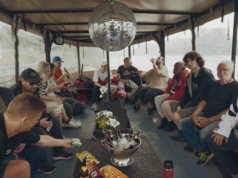
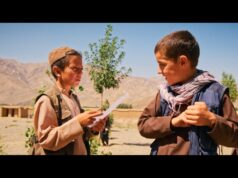
Those tales, memories or ‘encounters,’ as Rosi prefers, are numerous and diverse, ranging from a mother lamenting her dead son in the cell where he was tortured, to a young lad eking out a living at $5 a day to support, one assumes, his large family compressed into two small rooms. A troop of female soldiers relax in their dorm after manoeuvres while in a prison compound prisoners decked out in orange suits walk and talk before filing back inside, heads bowed, each man holding the shoulder of the man in front. Meanwhile a fisherman fishes at night beneath a dramatic red sky illuminated by the flames from the nearby oil refineries. And then there are the traumatised Yazidi children who bear the most desperate verbal testimony to ISIS atrocities they witnessed at first hand, and which they re-create in crayoned drawings that fill a mosaic of horror on the classroom wall. Later in the film, a woman is returned her phone after three years, only to hear the litany of historical and increasingly terrified voice messages left by her daughter held in captivity by ISIS over this period.
Only rarely are we offered respite from the suffering as we join a happy couple at a rooftop bar at night. “Is there anything as beautiful as rain?” she asks him. In another encounter a man is helped into his robes by his wife. He sings sweetly to her before he leaves to continue his serenade along the empty night-time streets.
“My big investment in this film was time, time also to create a relationship of trust with the people I met,” comments Rosi. “These were people I had never met before and suddenly they were opening their life to me, they were opening their home, they were opening their intimacy, and my duty as a documentarist was to use the language, the formality and the rigorousness of cinema with the awareness of the weight of reality in front of me.”
It is a film therefore whose aesthetics and whole raison d’etre are underpinned by the discipline of waiting, and Rosi’s accompanying well of patience. “When I put my eyes in front of the viewfinder, then suddenly I discover a world and then it starts an interaction. And I put a frame, and within this frame things have to happen… I am aware that by doing this I lose 99.99% of things, but when I capture something it is extremely strong and it becomes the moment, it becomes the synthesis.”
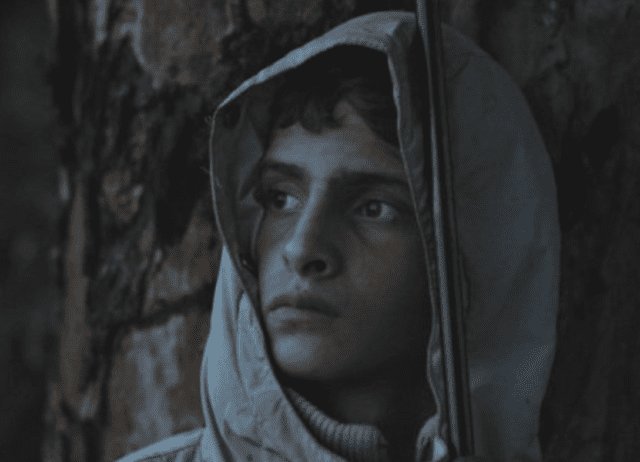
“I never interviewed people. I didn’t want to ask questions, but I think at the end if you are patient to go through this journey that happened to me in these three years, I think there is a lot of answer in that,” Rosi adds. “Maybe by the silence, maybe by the moment of suspension, maybe by lack of words. It’s not by chance that I ended the film with the close-up of Ali [the boy searching for work]. I think in [his] face you have this extremely strong sense of this suspended future.
“And we are experiencing this a bit in the West, in this privileged society. For the first time we are experiencing this lack of certainty in the tomorrow.”
Rosi then explains, lyrically and maybe metaphorically, the significance of the film’s title. “When I started the film I wanted to be protected by the night. At night a stick can be a snake, a snake can be a stick, so you have this element where you can watch and not watch things,” he comments.
“I’m also photophobic, I don’t like too much light. I started the film literally at night, and then slowly slowly I went to the morning, down into the sunrise, and then slowly slowly I discovered the outside. But I always wanted to be protected from the light,” he concludes.
Production: (Documentary – Italy-France-Germany) A 21uno Film, Stemal Entertainment, Rai Cinema production in co-production with Les Films D’ici, Arte France Cinéma, No Nation Films, Mizzi Stock Entertainment. (Int’l sales: The Match Factory, Cologne.) Producers: Donatella Palermo, Gianfranco Rosi, Serge Lalou, Camille Laemlè, Orwa Nyrabia, Eva-Maria Weerts.
Crew: Director, writer: Gianfranco Rosi. Camera: Gianfranco Rosi. Editor: Jacopo Quadri.