

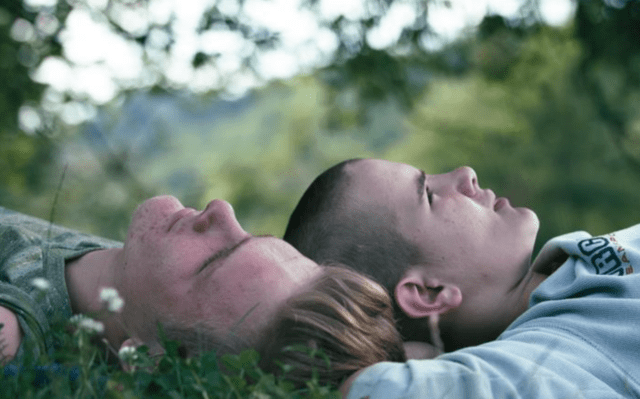
Before he begins a 23-month prison sentence, a Muslim veteran of the war in the Balkans sets a series of tasks for his three sons, each of whom goes through a significant personal evolution over the subsequent two year period.
Francesco Montagner’s fascinating and at times beautiful study of masculinity and identity involves Jabir, Usama and Useir, three brothers living with their father on a sheep farm in Bosnia. The boys’ ages are unspecified, but when shooting of the film began in 2015, the eldest sibling Jabir, a boy with a serious countenance as well as a shock of ginger hair, seems to be in his late teens while the youngest Useir, giggly and playful, looks to be of single digit age. Usama, the middle boy, is in his early teens.
But all three live in the long shadow of their patriarchal and seemingly overbearing father Ibrahim, described in the film as a “mujahidin” who fought against the Serbs back in the Bosnian War of the 1990s and who now must go to jail for uploading allegedly Islamist terrorist posts.
Before Ibrahim leaves for prison, he addresses his sons, telling each what is expected of him. Jabir must work and provide for the family. The middle boy Usama must protect the herd, while Useir must embrace education.
Of course, when the father returns, there is a reckoning. Have the boys measured up to expectations or requirements? But throughout the course of the film we have observed what Ibrahim hasn’t, how the process of growing towards adulthood has wrought profound existential change in each lad, which may well determine the degree to which patriarchal influence will shape their future lives.
Director Montagner, from northern Italy, came across the story of Ibrahim and the boys when he saw a news report about radicalisation in Bosnia. “I was just curious, I just couldn’t understand how in Bosnia there are some radical families, some radical enclaves, which I knew nothing about,” says the director, who grew up as a boy seeing continual television reports of the Balkan conflict enfolding nearby. “For me, culturally, they [Bosnians] were very similar to us as Mediterranean people.
“And especially these boys were strikingly interesting because they were so different. Even from the little reportage I saw they appeared to be so sincere, so honest, without any filters. I just went there because I wanted to meet them.”
“It became four long years of shooting,” Montagner continues. “And four years of becoming men with them and seeing what are the challenges that these boys face in such an environment, which includes many different things from finding your own identity (that we all have in that very delicate period of time when we are teenagers), to something even more complex, as in reflecting on what is the legacy that your father has left you.”
The structure of the story, in which specific patriarchal demands are made of the three boys, lends itself to universal, at times, mythological interpretation, Montagner argues, and becomes a tale that could have been told “100, 200, even 300 years ago.”
What’s more, the presence of women in the documentary is very limited. “There was a mother, there is a mother, but for many different reasons, also connected to health issues, which were diverging from the story of the film, she wasn’t present in those years in their lives, so they were left exactly on their own,” says the director. “Furthermore, the mother was detached, let’s say, from the family. So I preferred to concentrate entirely on their [the boys’] pure evolution, their pure feeling of growing up, which happened without a female presence.”
Montagner describes working with father Ibrahim as “really, really hard because he wanted to have a strong degree of control over the shooting, and so it became like a little bit, in a certain way, a power struggle.” Nevertheless, the director concedes that the father was relieved not to be the centre of attention, as he had been in previous local and inflammatory news coverage. “Also the father thanked us for respecting them [the boys],” Montagner adds. “For not, let’s say, abusing the lack of a patriarchal figure to manipulate the boys.”
There is an acute sense of honesty and transparency within the boys’ performance which could only have resulted out of mutual trust between all concerned during the production. How was the director able to engender such levels of trust?
“I always treated the boys as peers,” explains Montagner. “My crew was composed of men in their thirties. So they always looked at us as kind of like elder brothers. So especially with them being shepherds, sharing with them many hours of a day during which you’re only looking at the herd, our presence was important because we could hang out together and we could spend time together.”
“And I think also because of the way they were being brought up as sort of forced labour, from the perspective of the father, they ended with a therapeutic feeling of ‘someone is looking at me, someone is taking care of me and someone cares sincerely for my feelings.’”
World sales for Brotherhood are handled by Deckert Distribution.





