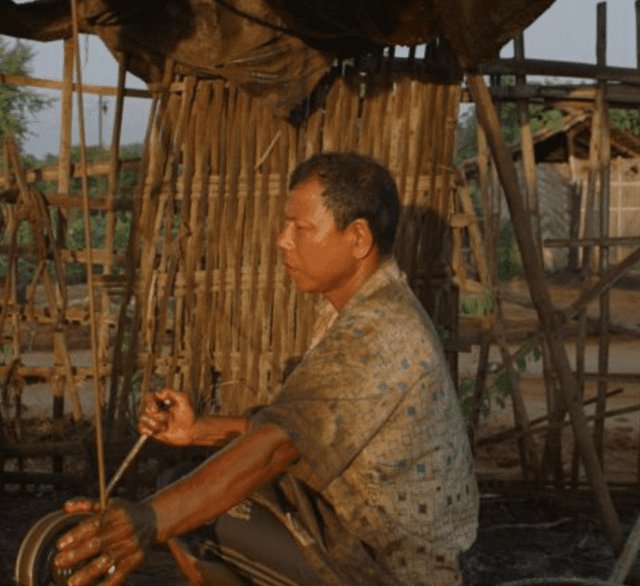
Husband and wife Thein Shwe and Htwe Tin eke out an existence extracting oil by hand from an unregulated oil field in Myanmar’s Magway region. Meanwhile their son Zin Ko Aung eyes up a future playing football in the big city, with no interest whatsoever in following in his mother and father’s footsteps.
For the parents, the oil work is laborious and filthy, and everything is black. Bodies are blackened, as is the scorched earth which must be systematically cooled beneath the handmade oil derricks. Even a pale puppy cannot avoid paddling through the tarry substance.
Nevertheless Thein Shwe and Htwe Tin are proud homebuilders who maintain a spotless, albeit modest, domicile that contains a Buddhist shrine to which they make daily offerings. Both are diligent, loving and patient, and seem to understand the needs, psyche and emotional make-up of a son whose gaze is focused on sporting success far away.
What’s more, they believe in superstition and folklore, and visit fortune tellers for advice and guidance. They were wise to call their boy Zin Ko Aung (Tuesday-born) as it confers luck, they are told, although a change of name may deliver greater success. Nevertheless, their good karma will continue to protect them, we further hear.
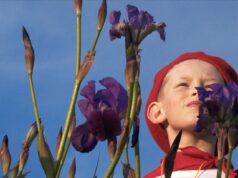
Their son meanwhile is like a lot of teenagers; shy, a little feckless and desperate to distance himself from the world of his parents. He dyes his hair red and razors it into keen shape. And he wants fame as a footballer. He shows a lot of promise at the beautiful game and his sister tells him to follow his dreams, as then he will be able to support them all.
“What is apparent, I think to viewers, is the love of family, the closeness of the family and the fears of a parent, which is something that almost everyone can relate to,” says director Farouky of his film, selected for Locarno Critics Week. A major reason for this, he explains, is the influence of women in the production, notably French producer Estelle Robin You of French Les films du Balibari and editor Catherine Rascon during post-production. “I really have to credit them for emphasizing that [the family emphasis], because it’s not necessarily something I saw until going through the footage with Estelle and Catherine who really pushed me to look at this emotional family core of the film.”
But if the emotional heartbeat of the film is found within a family in flux, the divisive and at times corrupt economics of oil provides the documentary’s editorial propulsion. It is a subject that has fascinated director Farouky for decades.
“It is [my] interest in how oil drives conflict, how capitalism drives conflict, and how oil is in some ways the biggest challenge facing mankind right now. It’s a political issue. It’s an issue of climate. It’s an issue of capitalism and exploitation,” he underlines. “But even if I say that I’m completely against the oil industry in every way, there’s no way I can avoid it being entwined in my life, in everything I do, whether you’re talking about transportation or plastic or products made from petroleum or products made by transporting petroleum.”
For a number of reasons Farouky didn’t want to focus on the “well-established” oil industries. Firstly he wasn’t entirely sure he would be granted free access by multinational companies to shoot the kind of film he wanted to make. Secondly, and not surprisingly, he didn’t want to go to oil-fields within countries such as Iraq to tell his story. “I didn’t want it to be an active war zone because I had just made this film in Afghanistan [Tell Spring Not to Come This Year, 2015] and was a bit tired of being shot at,” he says.
He eventually found his subject after being shown a news clipping about the unregulated oil fields of Myanmar, worked by individuals who would sell their oil locally. “For weeks [we] travelled around the country looking at some of the oil fields, following rumours [about] where there were new oil fields, and filming immediately, as I always do, as part of my research. Then by chance, we met this guy [Thein Shwe] and I just felt this incredible connection to him immediately, a very instinctive connection. There was no idea of a story. There was no idea of structure, but that’s how I like to work. And over the years, the story emerged, but it was really just this kind of very slow, quiet observation with him and the family over several years.”
Farouky is eyeing up future feature projects on the subject of oil, one of which may be about giant oil tankers which are now run so efficiently that quite often a mere handful of crew is necessary, making the vessels resemble “floating ghost towns.”
He explains further his fascination for the commodity. “I think that as the climate crisis becomes much more profound and much more apocalyptic and immediate, there’s something there that I’m really drawn to in terms of understanding our obsession with this industry, the comfort that it has brought us, and the incredible advancement that it’s given us – but at such a great expense,” he stresses. “How much are we willing to sacrifice for our own survival when our only scale of advancement and success…is this capitalistic obsession with development and growth, and it’s all based on this [oil] industry.”
“From a journalistic perspective there are some really interesting aspects to the oil industry [such as] war and invasion. It can make countries incredibly wealthy, but it can also totally destroy them,” Farouky concludes.