

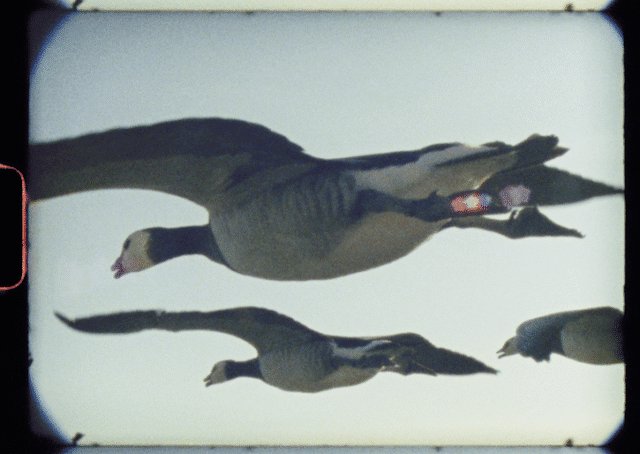
In his paean to the wonders of nature, feature debutant Ed Sayers turns to old tech, in the form of Super 8, to offer us a new way of seeing. For Super Nature, sold by Autlook and which world premieres October 12 at BFI London FF, forty collaborators from around the world filmed their natural habitat using this wonderful format, replete with its scratches, graininess and oversaturation, and submitted their efforts to Sayers.
“It is an incredibly emotive format – I can’t overstate that,” the director agrees, contrasting the near-impressionistic feel of Super 8 with the pristine (some may argue soulless) 8k digital clarity we are used to seeing on our wide-screen televisions. “Our eyes, it’s not all about the sharpness. The things that we remember more emotionally, and in our hearts, come from something different than very clinical vision.”
“It’s not that I’m anti-digital, but I think that our memories aren’t like that,” he adds of the format and its impact on the senses. The film is light years from the super-slick, hi-res BBC Wildlife or National Geographic output we have become used to, but its effect is just as mesmeric, if not more so. Precious nature is displayed in its myriad manifestations, and Super 8, with all of its imperfections, captures it in a way that is elegiac and timeless, and at times heart-stoppingly beautiful.
The whole idea for the feature documentary began in 2019. Or maybe it was 20 years prior to that, back in 1999, when Sayers launched his Straight 8 international filmmaking competition, targeted at devotees of the home movie format. A regular entrant over these two decades was Roger Batteault from Beaune, France, but it was his 2019 entry ‘Nature Hunter,’ shot on a single roll of Super 8, which had a profound effect on Sayers. In his film. we see a flock of flamingos flying in unison, but it is the final image, that of a single bird disappearing into the clouds, that touched Sayers’ soul. Quite simply, he didn’t want to see the flamingo vanish, with all of the ecological connotations that that implies.
Sayers was consequently inspired to make an entire feature about our relationship with nature, all to be shot on Super 8. So, mere days before lockdown in early 2020, he took his camera to the Norfolk coast to film seals. At the same time, he invited two friends from the Straight 8 project to join him remotely in this quest: Dice Rose from California, and Karan Talwar from Mumbai. Together, the three of them endeavoured to capture the magic of nature near their respective homes, despite none of them having had any prior experience in wildlife filmmaking.
Sayers created a teaser, which worked as proof of concept in piquing the interest of heavy hitters such as Oscar winner Asif Kapadia, who came on board as an executive producer, and BFI Doc Society. The call for content was sent out to more and more filmmakers from the Straight 8 community, and beyond, who further dedicated themselves to the task of shooting the glorious nature observable within their immediate vicinity, and providing moving, pithy commentary on accompanying audio. All of the visuals (from 26 countries in total) were shot on cameras that were more than 40 years old.
In the film, we see footage of the fast and elusive desert quail in Joshua Tree, US; whales off the coast of Patagonia; orphaned geese in France who grant mother-status to the filmmaker recording their movements; leaping salmon on the Isle of Lewis, Scotland; elaborate and delicate weedy sea-dragons in Tasmania, and two of the world’s last remaining white rhinos, in Kenya.
As UK-based Adrian Cousins films a fly suspended in a very particular light, it becomes an “abstract angelic figure.” Australian Ollie Birt has known kangaroos his whole life, but when he looks through the lens he sees the animal in an altogether new vein – as a deer crossed with a rabbit, wearing a bum-bag. In Brazil, cinematographer Rodolpho De Barros engages with the Enawene Nawe indigenous community to teach them how to film on Super 8, who then shot for over a week to bring their story and struggle to life.
And there is so much more, even Sayers himself shooting a common garden snail in extreme close-up in the middle of a downpour. It was only when the Super 8 film was developed that he could confirm that the two black dots on the snail’s antennae/tentacles were indeed tiny eyes looking straight back at the camera.
“Equally, I knew Carlotta [Beck Peccoz], but I didn’t know about her grandfather helping to reintroduce the ibex to the Italian mountains until I happened to mention I was making this film,” Sayers explains to BDE of the Alpine goats’ inclusion within the film.
On the face of it, Super 8 seems wholly unsuited to filming wildlife, with each film cartridge lasting only two and a half minutes and the need for infinite patience being a core criterion. “[But] this film is about doing things differently,” the director writes in his film notes. “Due to the limited film reel, the filmmakers had to be more intentional about their shots. People relished the opportunity to use a Super 8 camera, often for the first time, to attempt to capture some of the world around them through such a uniquely emotive and tactile format. Putting time to this project revealed their sense of curiosity, faith in the unknown, and relish of the unpredictable – qualities that come through vividly in the footage.”
Another particular feature of Super 8 is the sense of delayed gratification it confers. You have to wait for the film to be developed before you can see the results, unlike digital where you can assess immediately (and potentially discard just as easily) what you have just shot. “I think most of the people found the shoot far more enjoyable because they weren’t constantly reviewing to see if they ‘got the shot’…It was like, ‘I’m actually more focused on the animal or the landscape now, the light…I’m not staring at a digital screen and immediately checking.’ It’s like actually being in the moment,” Sayers tells BDE.
“And as you’ll have noticed at the top and bottom, you’re constantly seeing the frame before and the frame after, which is rather like a projection,” he adds. “And to me that speaks of time and the future and the past. Time is another theme within the film.”
The director was always a big fan of Koyaanisqatsi, the classic, wordless montage on humankind’s relationship with nature, directed by Godfrey Reggio and shot by Ron Fricke. While Super Nature similarly directs our sensibilities towards deep emotional and psychological responses, it doesn’t eschew narration. Words are used in Sayers’ film, but sparingly. “The way we wanted to approach the film was to let the words breathe, not have too many words, not be too information laden,” he tells BDE. “You’re not going to learn a lot about any of these species. But you’re going to learn how the person that’s showing them to us is made to feel, or what it makes them think about.”
We see fellow filmmaker Pinny Grylls (Grand Theft Hamlet), who has impaired hearing, as she films frogs in her garden pond. “I love the fact that Super 8 is silent,” she says in the film. “It’s very much like my experience when I don’t have my hearing aids. I was completely devastated when I lost my hearing, but when I got used to working around it I thought, it’s actually a relief. I can just immerse myself into the world, like when I was a child.”
Sayers further concedes that the process of making Super Nature was “almost spiritual,” although he is at pains to avoid sounding trite in saying this. “It was more this connection that I’d built up with the natural world through these people, and through my own shoots – even shooting a snail in my garden in macro,” he says.
He is keen to point out, however, that Super 8 is merely the means to an end. What is of paramount importance is the core message of the film – to observe and embrace nature, and that it’s never too late to “repair” the damage we have done to it as a species. With this film he wants to “oxygenate” the wider conversation, he says.
“We want to hit wider audiences because we feel people want a new conversation around nature, and what we were really at pains to do was to try and make a film that’s about the problems we’ve got, but [at the same time] put a fair share of joy into it,” he says. “If anyone who sees this film has any change in their attitude towards the natural world that we live in, and that we are a part of, then great.”
The director signs off by quoting South African Zandi Ndhlovu, whom we see in the film and who founded the Black Mermaid Foundation, a pioneering non-profit dedicated to transforming ocean conservation by promoting diversity, access, and education. “We need to remember how to be good stewards,” he underlines.





