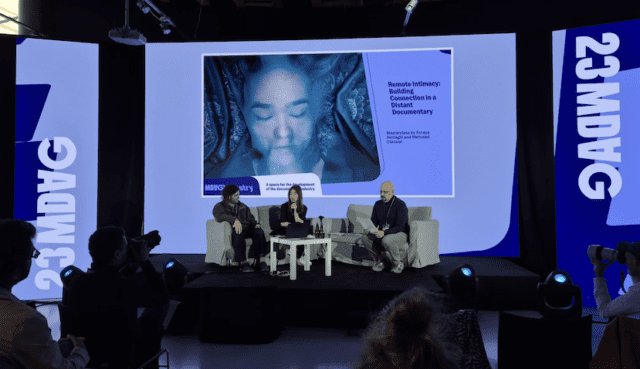
“This movie, for me, is not just a project. It has been part of my life,” said Soraya Akhalaghi at the beginning of a masterclass held at Millennium Docs Against Gravity in Warsaw, where she appeared alongside Iranian filmmaker Mehrdad Oskouei to discuss the making of A Fox Under a Pink Moon.
The session, held on May 9 and titled “Remote Intimacy: Building Connection in a Distant Documentary,” focused on a seven-year creative process shaped by “distance, trust, danger and improvisation.”
Akhalaghi, who began filming her own life as a teenager, described the production as a formative experience: “During making this movie, I learned a lot, and I learned how to produce.”
Oskouei began by placing the film within the broader evolution of his own practice. Having made several films in Iran about girls and boys under eighteen in correctional and rehabilitation centres, he said the restrictions under which he worked had altered his cinematic language. “Difficult conditions have silenced me, but shaped my language,” he told the audience. “I learned to say more by saying less.”
A central question for him, he explained, became how to reduce the filmmaker’s authority over vulnerable subjects. “I asked myself: how can I reduce the director’s power, their dictatorship, their hegemony a bit? How can I give at least some of that power to the characters and create a kind of collaboration in directing?”
In earlier films, including Starless Dreams and Sunless Shadows, Oskouei had encouraged his protagonists to take the microphone, hold the camera, interview one another or even film themselves. In Sunless Shadows, he placed a camera in a room and invited girls whose mothers were awaiting execution to speak directly to them. “I gave the power to them,” he said. “They recorded everything and they participated in the filmmaking. For me, it was amazing. The new form was suggested to me by my characters.”
That experience paved the way for his collaboration with Akhalaghi. Oskouei initially intended to make a film about an Afghan sculptor, but after meeting Soraya, then a gifted young artist, he changed direction. “I said to myself, wow, I have met a little genius,” he recalled. “And I said, Soraya, if you want, together we can make a film about your life, about your art, about everything you want.”
The turning point came in 2019, while Oskouei was in Japan. Akhalaghi contacted him to say that her husband was forcing her to leave for Turkey. Oskouei’s response was immediate: “Please record everything around you.” From that moment, the film became a remote collaboration conducted through phones, messages and nightly conversations.
Akhalaghi, speaking through a translator, said she knew nothing about filmmaking when the process began. Oskouei guided her shot by shot, asking her to record close-ups, long shots, objects, windows, shoes, curtains and the details of daily life. “Every time I was shooting some shots, I was sending them to him and he was teaching me how to do better,” she said. “Little by little, I realised that I really liked making videos.”
The conditions were far from simple. At one point, she was living in a dormitory with around 30 people, where many did not want to be filmed. Privacy was scarce, space was limited and the camera itself could put her at risk. “It was difficult filming myself,” Akhalaghi admitted. “I used to film myself and look at it, and then delete it again.”
Over time, however, the phone became a confidant. “This camera started to be my friend,” she said. “In Persian, there is a saying: to talk about the pain of my heart to a friend. I was talking about the pain of my heart to my camera.”
She also had to develop practical survival tactics. Because she filmed with the back camera of her phone, she often could not see where she was sitting in the frame. She would place a flip-flop where she intended to sit, frame the shot around it, then remove it and record herself. When travelling, she sometimes tied her phone to a tree with a headscarf or tape. Her ex-husband, she said, would inspect her videos and delete material he disliked, including shots where he objected to her words or appearance. “But I was lucky, because my ex-husband did not know that [I] could restore the videos from the recycle bin,” she said. She began deleting files herself, then recovering them later.
For Oskouei, these imperfect, improvised images often contained the strongest cinema. He remembered receiving footage of Afghan refugees on a bus in Turkey. “I said to myself, wow, I couldn’t make this scene like this,” he said. “She was 16 years old at that time, and very shy, in the corner of the bus. She recorded wonderfully. At that time I was crying, because it was cinema.”
The production eventually involved more than 430 remote sessions over five years of shooting, within a seven-year filmmaking process. Oskouei said they spoke almost every night, often for two or three hours, once Akhalaghi’s ex-husband had gone to sleep. They discussed the following day’s plan, possible scenes, her surroundings, her relationships and her inner life. “I shared my ideas about the possible storyline,” he said, “but I always listened to her and let her guide me in her life.”
The workflow also required editing during the shoot rather than after it. With thousands of single shots arriving by Telegram, Oskouei and his team had to structure the material while continuing to request new images, reflections and sounds. “You cannot just have all the material and then start to edit,” he said. “It doesn’t work in this style.”
Post-production became a major creative challenge. Mobile-phone sound often had to be rebuilt, while colour grading, sound design and animation were used to create what Oskouei called “a very poetic film.” Akhalaghi recorded additional voice material in a small Tehran studio, where she was asked to close her eyes and speak from the heart about her paintings and sculptures.
Those recordings led Oskouei towards animation. He did not want simply to place voiceover over images of her artwork, but to find a way into what he described as her “inner world.” He saw her creatures — moons, devils, foxes, clowns and other figures — as inhabitants of an imaginative universe that could deepen the film’s emotional reality.
For Akhalaghi, the process meant more than learning how to shoot. It meant confronting fear, claiming authorship and turning art into a means of survival. For Oskouei, it confirmed a method based on surrendering control. “Always you have to wait for something special,” he said. “Something that shocks you, that sparks you.”