Everybody has heard of the Arctic explorers Robert Peary and Roald Amundsen. Some will have heard of the British Sir John Franklin (UK), who led an expedition in the 19th Century to find the Northwest Passage, during which his entire crew perished. But who were the intrepid female pioneers, breaking new ground, making new and crucial geographical and scientific discoveries?
If history is to be believed, there simply weren’t any. Obviously, the processes of discovery and exploration were exclusively within the masculine domain. Yes? Well, no.
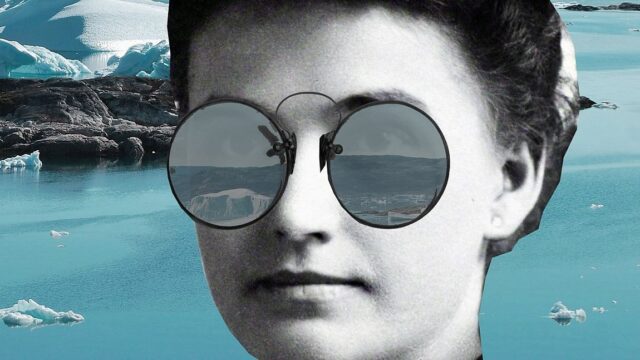
In their feature documentary Ice Women, selected for DOK.fest Munich German Comp, Jens Becker and Dorothea Braun set out to challenge the male-dominated story of Arctic exploration by shining the spotlight squarely on the courage, resilience, and scientific contributions of women in the North. In the process they show how these great women of the past are inspiring new generations of explorers and leaders.
At the heart of the film are three extraordinary women.
Josephine Peary (1863-1955), the wife of the renowned, but ethically suspect, explorer Robert Peary, was much of the time left at home as her husband sought fame and renown, but it was her earned income that paid for his exploits and got him back home to safety, time and again. After one expedition that she was allowed to attend she wrote a memoir which piqued the interest of the US public, and saw enormous sales. Further publishing ventures and lecture tours continued to finance her husband’s expeditions. On a later trip, however, she discovered that her husband had fathered two children with an Inuit teenager. Later, Josephine became a noted speaker and was awarded the National Geographic Medal for her Arctic accomplishments.
Ada Blackjack (1898-1983), an Iñupiat woman from Alaska, endured nearly two years alone on Wrangel Island with four explorers, all the time sustained by faith, devotion to her son, and the strength of her ancestors. She agreed to the doomed expedition out of financial necessity, but just as she was set to embark she discovered that she would be the only female. Before the trip, a shaman warned of “death and destruction,” which turned out be true. Three of the men died in the snow while in search of food. Resourceful and clever, Ada cared for and protected the last, Lorne Knight, who was suffering from scurvy, until he too died, but she was able to survive alone in the Arctic for months until help eventually arrived. She did it all to pay for her son’s TB treatment.
Louise Arner Boyd (1887-1972), a self-taught American scientist and photographer, funded her own journeys to the Arctic, producing meticulous research and imagery that fused art and science, in the process upending the expectations of her time. Boyd inherited her father’s company, but sold it fully to indulge her greater love for nature. That said, she retained a strong sense of business acumen, as she financed expeditions and research in Norway and Greenland, where a large area is still called Louise Boyd Land. In 1960 Boyd became the first woman to be elected to the board of the American Geographical Society.
The stories of these women continue to resonate in today’s Arctic via women who continue to research, document, work in and protect the region. Maddy Kiminaq Alvanna-Stimpfle is an Inupiat linguist from Nome, who preserves her language as a form of “cultural survival.” Professor Angelika Humbert, a German glaciologist and avowed fan of Louise Boyd, studies the melting of Greenland’s ice sheets as a measure of planetary change. Meanwhile, Kaalannguaq Eipe Uvdloriaq, a mother and social worker in Qaanaaq, “embodies everyday resilience in a community still marked by colonial displacement.”
For co-director Dorothea Braun, also an ethnologist, the film began with a photograph of a woman in Arctic clothing, a rifle on her back. This was Josephine Peary.
“I remember thinking: Why don’t I know her? Why have I never heard about women like her? The more I searched, the more I realized that the absence was not accidental. Women were present in the Arctic — travelling, researching, documenting, surviving — but they rarely became part of the dominant narrative. The ‘Golden Age’ of exploration was told as a male story,” she writes in her film notes.
“For me, the process became less about ‘correcting’ history and more about taking responsibility for how history is handled today. Ice Women is an attempt to hold the archive carefully — to acknowledge the colonial gaze embedded in it, and to open space for narratives that have long existed, but were rarely centred.”
There was a strict division of labour on the film between Braun and co-director Jens Becker. Back in 2020, when they began working on it, Braun was pregnant, soon to be a single mum. So she concentrated on research and writing, while Becker went to Greenland and Alaska to shoot, especially after funding began to come in. It was an arrangement that worked well, but the irony was not lost on the filmmakers.
“It is a little bit like a mirror to our subject, that it was not so possible for Dorothea to make the travels, so we often spoke that our personal situation is a little bit like in our film,” says Becker. “Some [situations] are today really better than 100 years before for women, but not all – really not all.”
In making a film that addresses so carefully the contemporary concerns of the Indigenous people of the Arctic region, the filmmakers took great pains to film in an ethically appropriate manner. “Especially in Northern Greenland, we had the chance to work together with Mikisoq H. Lynge, a Greenlandic filmmaker,” Braun tells BE. “We decided that he is the best person to go there and try to tell stories from one of the northernmost points in Greenland or generally in the world. Society in [places like] Qaanaaq is so isolated and, like you have seen the film, they really don’t want to talk about it. And we didn’t want to force anything.”
“So, we just told them that we are working on this film about Josephine Peary, and whatever they want to share with us, we would be glad to share this as their view on history,” Braun adds. “And this is what our protagonist Kaalannguaq [did].She really was so proud about her achievements in her own family, [how] she overcame violence and alcoholism in her own family. This is a big topic in Greenland, suicide among young people, and alcoholism.”
“And this was brought through colonialization, and [she is] showing within this story that she’s just there, and that this is her life, her land, and this is her view on it, without reflecting that much on Peary and his story. We hope that we made this bridge to this part, and this perspective on the story. This was one of our biggest learnings.”
As we see in Ice Women, many of the men who dominate the history of the Arctic region were driven by desire for fame and glory, [in the case of Peary, also driven by lust]. They were also men who much of the time placed their crew in enormous danger.
When it comes to the female explorers of that period, however, Braun has an altogether different take. “They were driven by love. Love for science, love for exploration and bringing something new to life, something the world really needs to know, like Louise Anna Boyd did. She was contributing so much to science, to the scientific knowledge of the fjords of Greenland, that I can really see a deep love and compassion for her work,” she says. “While Ada Blackjack, of course, was trying to survive and secure the life of her son,” she adds.
Even Josephine Peary was, in her own way, acting out of love for her husband and his work, even after she discovered the family that he was harbouring elsewhere.
The film will be released theatrically in Germany by W-film in late 2026, and a 3 x 52-minute series will be broadcast on NDR in 2027. In Munich the filmmakers are looking to drum up interest from international festivals and distributors. Sales are handled by First Hand Films.
For co-director Becker, the experience on the film was eye-opening. “It was a wonderful experience to work nearly only with women. I think Mikisoq H. Lynge, our Greenlandic co-producer, the composer Hannes Gil, and me were the only male persons in that production,” he says, furthering underlining how the personnel ratio he was hitherto used to was generally stacked three to one in favour of men.
“It has a completely different touch if you have only women in the film,” Becker ends.