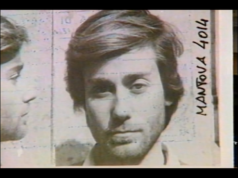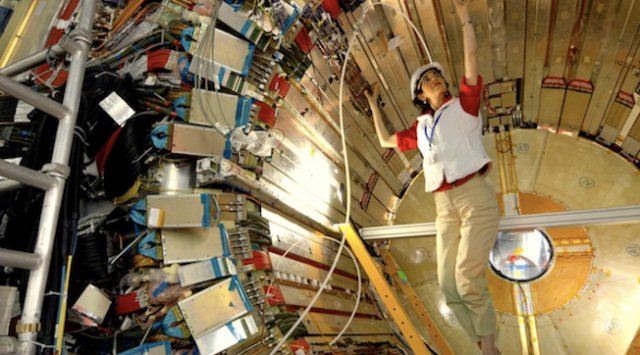
Iconic Italian physicist Fabiola Gianotti is a woman on a mission. Having completed her historic tenure as Director-General of CERN, during which time The Higgs Boson particle was discovered, she is now facing her most complex battle yet in advocating for the Future Circular Collider (FCC), the multi-billion-dollar successor to the Large Hadron Collider, and which represents “humanity’s next attempt to answer some of the universe’s greatest remaining mysteries.”
“This would be vastly bigger and more powerful than any particle accelerator ever built and would allow scientists to investigate questions that remain unanswered about our universe,” director Alex Kiel confirms to BDE. “But whether it will ever be built is far from certain. Fabiola now has to build international support for the project – working with scientists, governments, institutions and potential funders.”
“Our film (produced by Elin Rhys of Welsh production outfit Telesgop) follows this story as it unfolds – witnessing the diplomacy, persuasion, collaboration and uncertainty behind a project of extraordinary scale,” he adds.
Gianotti is the perfect subject for intensive study. Before committing to physics, she trained as a concert pianist at the Milan Conservatoire, studied classical literature and dreamed of being a ballerina. For her, music and physics are two expressions of the same human instinct: a search for underlying structures, harmony, and hidden order beneath the chaotic surface of reality, the film notes underline.
“Music and physics are incredibly similar,” Gianotti herself has commented. “It’s complexity built upon simplicity. The rich symphonies by Beethoven and Mahler are built on 7 notes. Similarly, our world and our nature are made up of only three particles.”
As the first female Director-General of CERN, Fabiola helped lead one of the defining scientific breakthroughs of the 21st century: the discovery of the Higgs boson in 2012, in the process overseeing the world’s largest scientific laboratory with a staff of 15,000 and an annual budget of $1.4 billion.
Inspired by Marie Curie as a teenager, she entered a field where women rarely occupied positions of power. Her rise to lead the world’s largest scientific laboratory required overcoming not only challenges of physics, but the barriers faced by women in science.
Director Alex Kiel’s work has been nominated for BAFTAs, Griersons, RTS and Emmy awards within a 20-year career making high-end documentaries for Netflix, BBC, Disney, Discovery and ARTE. “I have developed and scripted original ideas, with a proven track record of taking them from initial idea through to final delivery,” he underlines his credentials.
“My films, like the hits Mark Cavendish Never Enough and Bad Sport, are well-crafted, with emotional power that attracts huge global audiences and receive critical acclaim. I work across Sport, Feature Docs and Specialist Factual genres combining cinematic scale with intimacy, leading multi-camera shoots and managing high-profile talent.”
“I love telling incredible human stories with emotion, scale, humour and intimacy,” Kiel adds. “Recently I’ve followed the first woman from Latin America to search for Cleopatra’s tomb [Cleopatra’s Final Secret, National Geographic]; explored the largest machine humans have ever built at CERN [The Peace Particle, broadcast by Arte and BBC, selected for CPH:DOX]; and created a beautiful (multi award-winning) portrait of a jazz-dancing Olympic coach who believes wrestling and kindness will save the world [Grappling Grace].”
Kiel further describes the visual look of the film. “What begins as an intimate portrait becomes a visceral and emotional journey into the invisible world of physics, music and moments of chance that shape our understanding of the universe,” he says. “The film will combine intimate observation with animation, video art and music to translate things that normally exist beyond human perception – particles, forces, vibrations and probability into music, movement and light.”
The project promises to be just as adventurous within the realm of the sonic. “Pieces by Bach, Mozart and Brahms sit alongside an experimental soundscape built from CERN – its machinery, vibrations, cryogenic systems and the rhythms of particle collisions,” the project notes reveal. “Throughout the film, these sounds begin to bleed into one another. The pulse of a particle beam becomes rhythm; vibration becomes melody; the hum of the machine becomes music. The soundscape allows us to move beyond explaining the science and towards experiencing it.”
As a young girl, Gianotti was inspired by Marie Curie, which is reflected in the Impact campaign that will be devised for the project. “We are currently seeking financing to film with Fabiola over the coming months,” says Kiel. “We are also looking to develop international co-production opportunities, strengthen our finance plan and build an impact strategy that can connect the film with a new generation – particularly young women considering their own futures in science.”
“Alongside the film, we intend to develop a digital-first impact campaign to transform key moments into short-form content for YouTube, TikTok and Instagram, reaching younger audiences where they already consume media,” he adds in his film notes. “Classroom-ready educational modules and partnerships with CERN, schools and STEM organisations will extend the project’s reach, encouraging young people – particularly girls and young women to see science as a creative and meaningful career.”