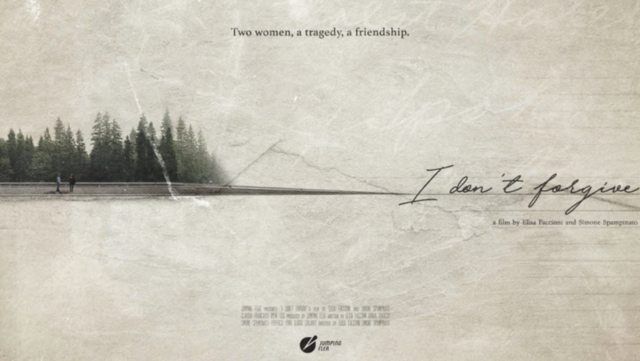
In Simone Spampinato and Elisa Faccioni’s rhetorically titled documentary I Don’t Forgive, pitched this week at MIA, Claudia and Irene are bound together by a tragic event. Irene’s son killed Claudia’s husband at a police checkpoint.
After months of loneliness and grief, they decided to meet each other and, against all odds, embarked on a journey of reconciliation. Their bond soon became a profound friendship.
“We already made three feature documentaries with a similar thematic to the documentary that we want to do now,” explains Faccioni. “Because we’re fascinated by stories of people who even in the most tragic situations are able to find beauty in life.”
She gives the example of their 2018 doc Koi, about people in Japan who are trying to keep alive the memory those who died in the tsunami. “We followed the story of a man who dived into the water every day to search for his wife. And even though he knows he won’t ever find her he says that this is the one thing that gives him hope.”
A third component in I Don’t Forgive is son Matteo who is serving time for the murder, and who is undergoing rehabilitation within an association (Amicainoabele) founded by the women primarily to support the families of victims and offenders. They launched the initiative to transform the pain they were experiencing into something positive.
In the film, as the two women embark on a journey to see Matteo in jail, past and present intertwine to create a dynamic narration made of flashbacks, archive footage, interviews, present time footage, and animated sequences to delve deep into the characters emotional journey.
“We want to investigate Matteo to get his persective,” adds Faccioni. “We didn’t want to tell the story only from the women’s point of view, because we think that giving him a voice is equally important. We never take sides.”
The budget is small (€85,000) but costs are kept in check as everything will be done in-house, say the filmmakers. “We have our own equipment and our own film crew and post-production [facilities],” says co-director Spampinato, adding that the pair are looking for partners especially for the ‘distribution phase.’ He adds, however, that they would be interested in partnering with co-producers from France or the UK.
The directors further explain the significance of the title. “Reconciliation – which is very different from forgiveness – is at the heart of the documentary,” they say. “It’s not a unilateral act, but a journey to undertake together, a path in which we learn to empathize with others, regardless of the severity of their actions.”