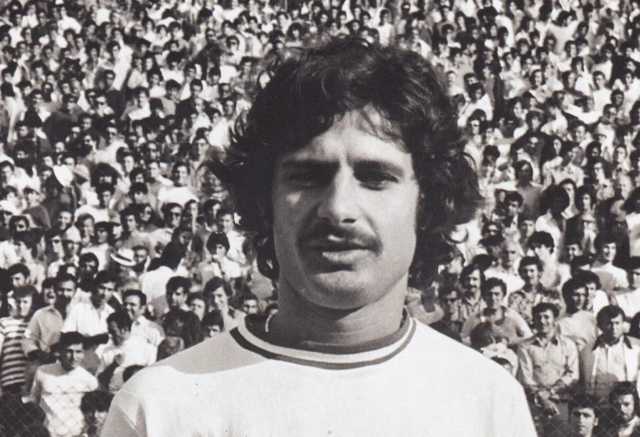
As one of the golden footballers of his generation Roni Kalderon had the world at his feet, playing for the mighty Ajax and impressing for the Israeli national team. But then he turned to the dark side, morphing into an international drug lord. He served time, and then he disappeared. Erez Laufer and Hilla Medalia tell BDE more about Kalderon’s life of two halves, and how they will document it.
It’s not every 17-year old who gets to share a football pitch with the likes of Johan Cruyff before eyeing up a future in the mould of Pablo Escobar. But that’s what Israeli footballer Roni Kalderon did.
Co-director Laufer says that Kalderon could manipulate a football like no other and defenders came to expect the unexpected. “It seems to be that the way he moved the ball, that’s the way he moved his life,” he says.
Kalderon ended up in Brazil where he was imprisoned for 32 years before planning and executing a successful escape plan. Since then, nobody has seen or heard a thing from him. There are rumours that he was assassinated by rival drug dealers in Brazil and that he lives the life of an Orthodox Jew in New York. He might well be dead, or he may still be alive…
As the directors note, Roni Kalderon’s story “has all the elements a scriptwriter could want: football, love, passion, and crime. Roni is the type of living legend that, even after his disappearance, myths continue to live on long about afterwards.”
“Like every good story it is all about strong characters,” says Laufer. “When you follow his character from childhood, with the background that he came from in this poor neighbourhood of Tel Aviv, where his parents deserted him when he was 12 years old and moved to America…that probably influenced a lot of his choices along the line, such as his relationships with women. He had a wife and two daughters that he deserted, and then he had another woman in America. And then we, of course, we have the Brazilian wife that you can see in [the project].”
“The film also asks this big universal question,” adds co-director Hilla Medalia. “Are choices that we make in life really our own, and if everything is already (pre)decided, if you believe in that from the get-go, can we create another destiny for ourselves? So there are all kinds of bigger universal questions, but I think that the heart of the film is the story itself. It is just such a great story.”
Medalia (who reveals that she too has sporting antecedents, as a competitive triple jumper) adds that the project is also highly entertaining. “It’s fun. It’s what people want, especially now… I feel that sometimes within the doc community, we forget that those films are super important and they’re also important to break outside of the traditional documentary audience. So we are hoping that we’re able to reach a wider audience with this film, and have fun.”
“I think we both have a lot of experience that we can make a film that can be very popular for a wide audience, but still be a festival film,” adds Laufer of the €489,133 budgeted film, of which just over half is secured (including €150,000 from Israeli broadcaster yesDocu).
The pair refuse to be drawn on Kalderon’s current status (ie whether he is alive or dead) or his whereabouts, if indeed they know any of these details. But they do concede that the third act of the film will constitute a search for their elusive subject. Most of the film is in the can, they say, with a final New York trip planned (Covid permitting).
Their plans for MIA go beyond the Kalderon project. “Every market is an opportunity to meet new people, new friends, new connections and new partnerships that lead to something bigger, both for this film and for other films and other projects that we do,” says Medalia. “With respect to this film we are looking for partners, we’re looking for distribution. We want partners in more countries to be able to make the film that we want to make, but also to be able to deliver the film to the audience.”