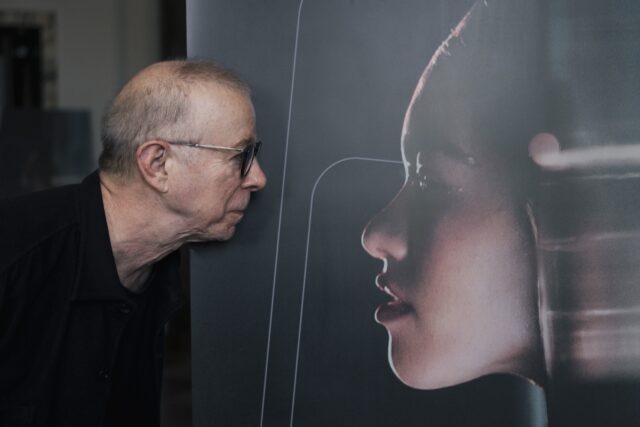
At MDAG 2026, US filmmaker Alan Berliner delivered a generous masterclass titled Think Like a Filmmaker, guiding the audience through more than four decades of work built around memory, family, identity, insomnia, archive and the “fragility of the human condition.”
Opening the session, Berliner gently questioned the very idea of a masterclass. “I have a little trouble with this word ‘master,’” he said. “I’ve been making films for more than 40 years and really what that means is that I’ve made more mistakes than you.” If there was one thing he felt entitled to say, he added, it was that he was still learning how to make films: “No film is born perfect.”
The New York-based director of Benita, Letter to the Editor, Wide Awake, Nobody’s Business and Intimate Stranger framed filmmaking as a process of persistence, passion, patience, accident and luck. He recalled entering college at 16 and discovering an avant-garde experimental film programme almost by chance. Within a month, he said, he knew he wanted to be a filmmaker for life.
Much of the session revolved around Berliner’s studio and archive. Showing a clip from Wide Awake, his 2006 film about insomnia, he described the colour-coded boxes that contain old newsreels, sound effects, anonymous home movies, family footage, photographs and decades of images cut from newspapers. “When you surround yourself with so much stuff, you have to be extremely organised,” he said in the clip. “The whole point [is] to be able to act at the speed of thought.”
Asked about his collecting, Berliner called himself “a natural collagist.” His archives, he explained, are not static storage systems but living structures that inspire his films and constantly shift as his understanding of the world changes. Categories in his newspaper archive, for example, evolved from “men with guns” to “women with guns” and then “children with guns”. This, he said, was not just organisation, but a way of learning “how to be an informed citizen of the world.”
That archival patience also shaped Benita, his latest film, centred on a former mentee and friend who died by suicide during the pandemic. Berliner said her family eventually gave him her notebooks, papers and 40 hard drives. “A hard drive is a map of the brain,” he observed, describing the painstaking process of opening folders containing thousands of apparently anonymous images. One folder might reveal nothing; another might hide thousands of files in “a sequence of eight photographs that are magical”.
Sound was another key strand. Berliner recalled an early job as a sound-effects librarian at ABC Sports, where he spent days listening to rivers, winds, footsteps or elephants and cataloguing them by hand. The job sensitised him to sound, he revealed, and left him with a vast private library. In his films, sound often becomes metaphor: the typewriter in Intimate Stranger gives rhythm and structure to his grandfather’s unfinished autobiography, while boxing footage in Nobody’s Business mirrors the “verbal sparring” between Berliner and his father.
For Berliner, portraits are never simply about their subjects. “It’s never really just about that person. It’s about your relationship with that person,” he said. In Nobody’s Business, his father appears not as an abstract figure, but as a man speaking to his son. That relationship, Berliner argued, is where the storytelling energy lies.
Responding to a question about the ethics of revisiting his parents’ divorce on screen, Berliner was frank. “I’m still processing my parents’ divorce,” he said, describing the film as part of that process. He said he was “profoundly shaped by the drama and trauma” of his childhood, but insisted that the personal risks are tied to a larger artistic purpose: “I’m here to make films that make us understand the human condition.”
This led to one of the session’s central ideas: the screen as both window and mirror. Cinema allows viewers to look into someone else’s life, country, family or experience, he said, but his aim is also to create recognition. “I want the screen to also turn into a mirror,” he explained. “I want to zap you with a warm shock of recognition.”
Berliner repeatedly stressed that he does not write treatments and does not begin with a fixed destination. He described Benita as beginning with a hunch, which became “a vague idea,” then “a sustaining intuition.” The danger of over-planning, he suggested, is that a filmmaker may only arrive where they already expected to go. His preferred approach is slower and more exploratory: “I don’t make films in which I have a frame and the picture is predetermined… I like to think I make films in which the pieces determine what the puzzle is going to be.”
Editing, for Berliner, is inseparable from that process. “People call it editing, but I call it noticing,” he said. “I call it discovering.” He described intuition as a muscle and urged filmmakers to personalise their systems, labels and working methods rather than letting anonymous digital tools shape their thinking.
In the final section, Berliner read from his own advice to filmmakers. “Follow your fascination,” he said. “Enter your subject with an open spirit… Allow yourself to get lost along the way.” He urged filmmakers not to fear bad ideas, since “every good idea is the great grandchild of bad ones,” and to accept that they will “never stop learning how to make films.”
He closed by stressing love as the central force behind his practice. Filmmaking, he said, is the most difficult thing he knows how to do, and that difficulty is precisely why it matters. “If you can figure out in your life to love the most difficult thing that you could possibly do, that’s healthy. That’s how you grow,” he concluded.